St. Declan of Ardmore
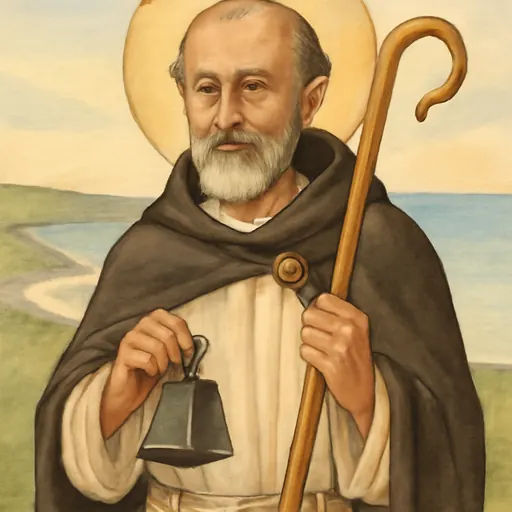
St. Declan of Ardmore was one of the first bishops in Ireland, the apostle of the Déise people of County Waterford, who founded a monastery at Ardmore on the south coast. His Life places him even before St. Patrick, though his dates are disputed. We keep his feast on July 24, when pilgrims still visit his oratory, well and stone at Ardmore.
Who was St. Declan of Ardmore?
St. Declan of Ardmore was one of the first Christian bishops in Ireland, the apostle of the Déise, the people who gave their name to the Decies of County Waterford. He founded a monastery on a headland at Ardmore, on the south coast, which his editor P. Power called "St. Declan's holy city of Ardmore." We keep his feast on July 24, the day his Life gives for his death, and the people of Waterford have kept it for centuries with a pilgrimage, the Ardmore pattern.
Few Irish saints have so strong a hold on their own place. When Power edited Declan's Life in 1914, he noted that hundreds of Waterford men still bore the name Declan, and that one recent pattern day had drawn as many as fourteen thousand pilgrims from Waterford, Cork and Tipperary.

What his Life tells us
Our main source is the Irish Life of St. Declan. The Irish copy Power translated was made by Michael O'Clery in 1629 from an older book, and Power believed the Irish Lives were written down before the Latin ones of the twelfth and thirteenth centuries, from local tradition and older records. It is a work of devotion, full of wonders, and it contradicts itself on dates. Read it the way its author meant it, as the memory of a people about their father in the faith.
Birth and boyhood
The Life says Declan was born among the Déise, son of Erc and Deithin, and that a fiery light was seen over the house where the baby lay. A Christian priest named Colman came, preached to the parents, and baptized the child. At seven Declan was sent to study under a holy man named Dioma, with another boy, Cairbre, who also became a bishop.
Rome, the bell and the bishop's city
As a young man he went to Rome with his disciples. There, says the Life, St. Ailbe welcomed him, and the Pope ordained him bishop and sent him home with books and rules. On the road through Italy he met St. Patrick, who was on his way to Rome; the two bishops embraced and made a bond of friendship.
Then came the gift remembered best. While Declan was beginning Mass in a church on his road, a little black bell came in through the window and rested on the altar. The Irish called it the Duibhín Déagláin, "Declan's little black one," and the Life says it was kept in his church and worked many miracles.
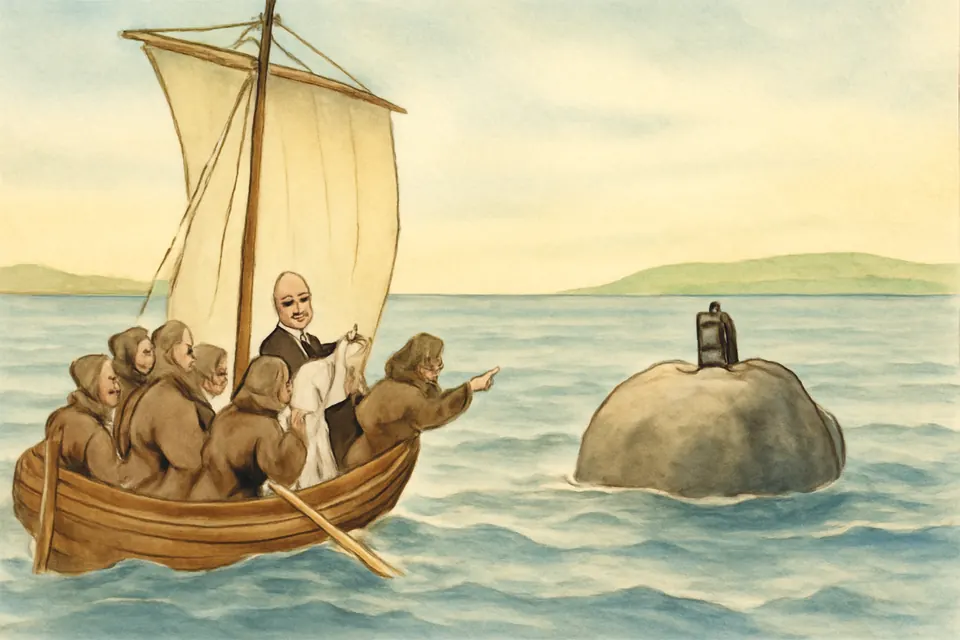
On a later journey, after forty days with St. David at Menevia, the bell was left behind on a rock by the shore. Halfway across the sea Declan prayed, and the rock itself floated after the ship with the bell on top. "Permit the bell to precede you," he told his monks, "and whatsoever haven it will enter into it is there my city and my bishopric will be." It led them to a sheep island on the coast of the Decies. When a disciple called the hill there a little height, Declan answered, "Do not call it little hill, beloved son, but 'great height' [ard mor]," and the place has been Ardmore ever since.
Miracles and legends of St. Declan
Everything in the Life belongs to the category this site calls traditional: long-held tradition and legend, written down centuries after his death. That includes the fire over his birthplace, the bell from heaven, the floating rock, the empty ship that carried him across the sea to Britain when he had no fare, and the springs that burst out at his prayer. No miracle of his has been formally investigated, and there was no process of canonization in his era; his cult is ancient and local.
Healings at Ardmore are reported to this day by pilgrims at the well and the stone, but none has been examined by the Church.
His death and grave
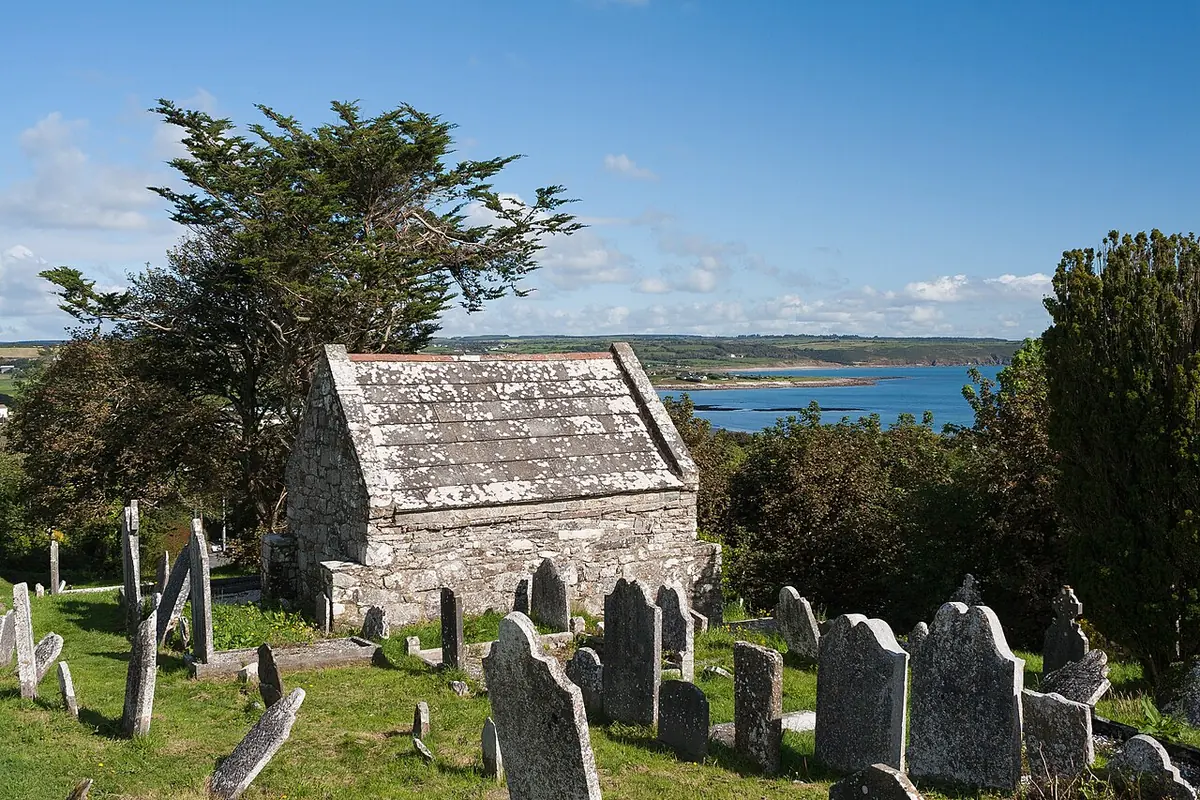
When he felt death near, Declan was living in a little cell he loved, Disert Declain, between the hill and the sea, where he went to read and pray away from the crowds of pilgrims and beggars who followed him. He sent for his spiritual son MacLiag, returned to his city, urged his monks to live holily, received the Body and Blood of Christ from MacLiag's hand, kissed his people, and died. He was buried at Ardmore "in the tomb which by direction of an angel he had himself indicated."
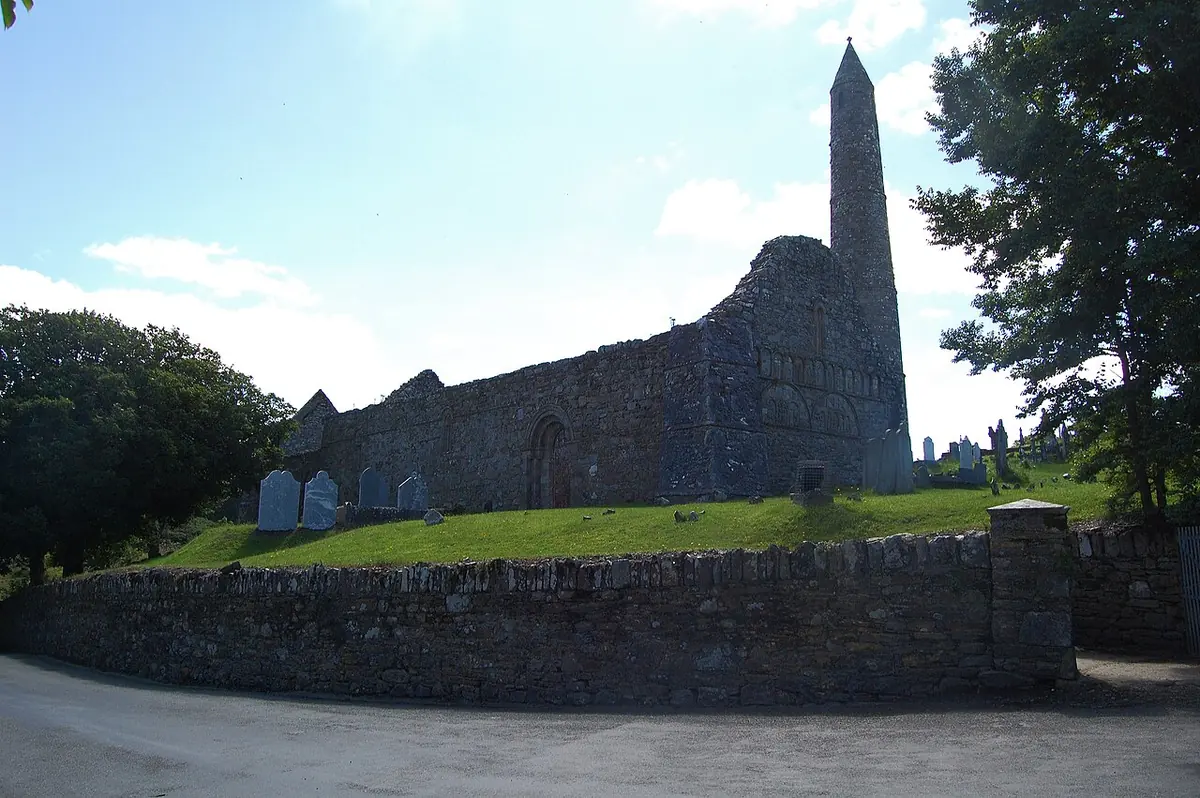
That grave is traditionally the small stone oratory beside the round tower. Power thought the tradition "highly probable," and judged the little church to have been built over the grave in the century after Declan's death. Bishop Mills gave it a slate roof in 1716.
The pattern of Ardmore
On and around July 24 pilgrims make the rounds of the places tied to Declan:
- The oratory in the graveyard, his traditional grave.
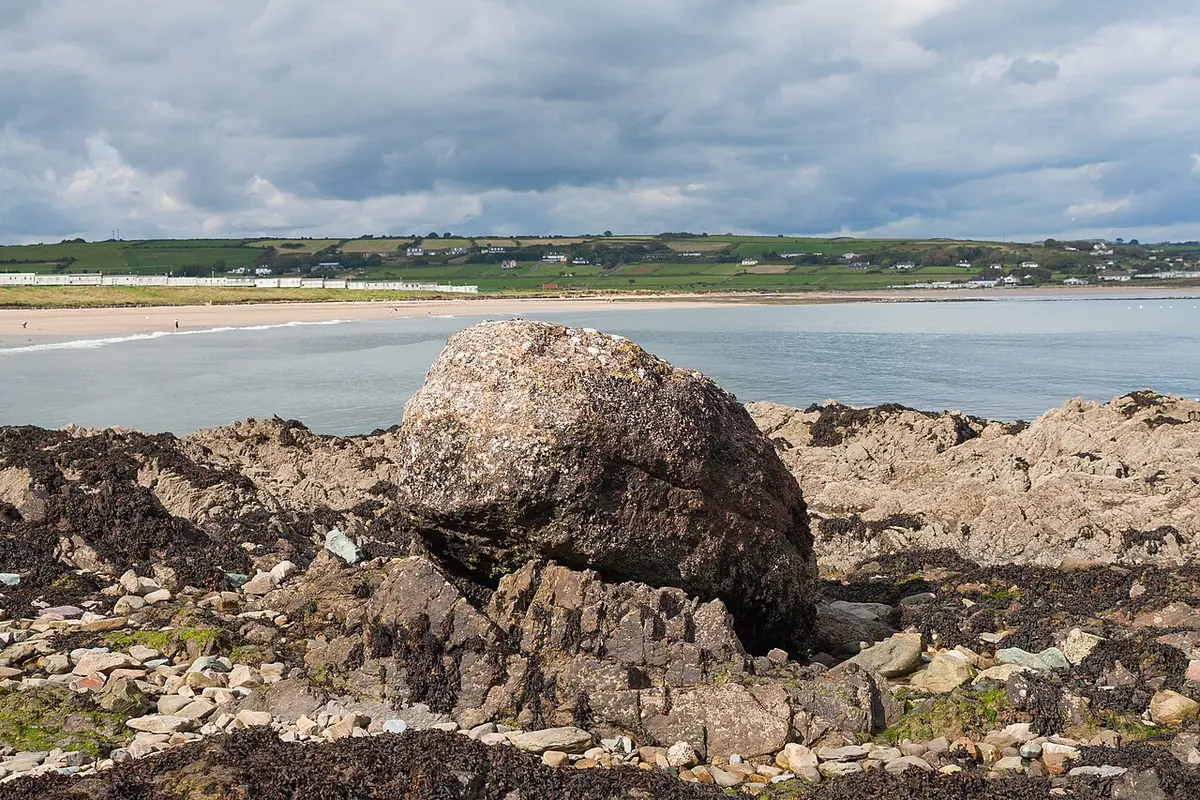
- St. Declan's Stone, a glacial boulder on the beach. Local tradition takes it for the rock that carried his bell. Power described devotees crawling on hands and knees through the narrow gap beneath it.
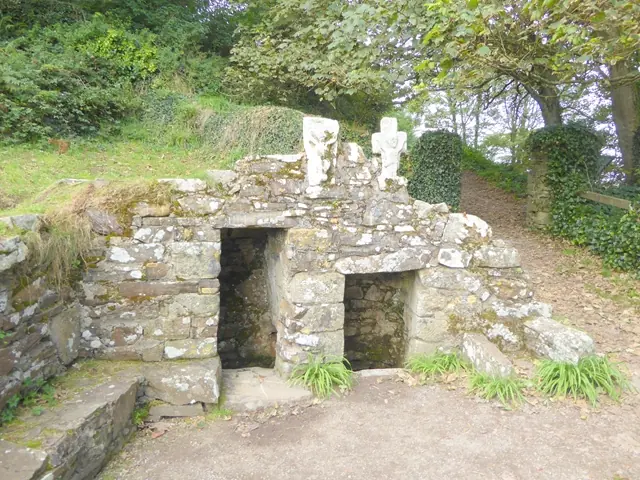
- St. Declan's Well at Dysert on the cliff, beside a ruined church, where pilgrims bathe their hands and feet. Carved figures of the Crucifixion are set in the masonry above it.
Power also recorded a small, cross-inscribed black stone said to have been found in his tomb and once lent out to cure cattle; it disappeared in the nineteenth century.
Symbols of St. Declan in art
Images of Declan are mostly modern and local, and they draw on his Life:
- A crozier: he was a bishop, and his Life mentions his pastoral staff, lost long ago.
- A small black bell: the Duibhín Déagláin, sent from heaven.
- A boulder by the sea: the floating rock and St. Declan's Stone.
- The round tower of Ardmore, which stands beside his oratory, though it was built centuries after him.
Prayer to St. Declan
No traditional prayer of St. Declan's own has come down to us. At the pattern, pilgrims pray at the oratory, the well and the stone. Let us ask St. Declan, father in the faith of the Déise, to pray for the people of Waterford and for every Irish family far from home, and let us thank God for the patient preachers who first brought Christ to Ireland. See the feast day calendar and the patron saints index.
Frequently asked questions
Who was St. Declan of Ardmore?
An early Irish bishop of the Déise (the people of what is now County Waterford) who founded the monastery at Ardmore. His Life says he was baptized as a baby by a priest named Colman, studied in Rome, was made a bishop by the Pope and preached to his own people before St. Patrick arrived. Historians agree he was a very early missionary but debate his exact dates.
When is St. Declan's feast day?
July 24. His Life says he died "on the ninth day of the Kalends of August," that is, July 24. The Ardmore pattern is held around that day.
What is St. Declan's Stone?
A large glacial boulder on the beach at Ardmore. Tradition links it with the rock that, according to his Life, floated across the sea carrying his bell. On the patron day pilgrims used to crawl through the narrow gap beneath it for healing.
Was St. Declan in Ireland before St. Patrick?
His Life says so, and the Lives of Sts. Ailbe and Ciaran agree, but the Life also contradicts itself, making him a friend of St. David a century later. P. Power, who edited the Life in 1914, concluded that Declan was certainly an early teacher of the Déise, either before Patrick or in his time.
Keep exploring
Sources
- Life of St. Declan of Ardmore, edited and translated by P. Power (Irish Texts Society, 1914; Project Gutenberg). The Irish Life (copied by Michael O'Clery in 1629), its miracles and death date, and Power's introduction on the disputed dates, the pattern, the oratory, stone and well
- Catholic Encyclopedia (1913): Diocese of Waterford and Lismore (Wikisource). Declan's preaching in the Decies, the confused chronology, and Ardmore as an early episcopal church