Our Lady of Akita

Our Lady of Akita is the title under which the Church in Japan honors the Virgin Mary for the events at a small convent in Akita, where Sr. Agnes Sasagawa received three messages in 1973 and a wooden statue of Mary wept 101 times between 1975 and 1981. In 1984 Bishop John Shojiro Ito of Niigata recognized their supernatural character and allowed the veneration of the Holy Mother of Akita. The Holy See has not issued a formal judgment.
Who is Our Lady of Akita?
Our Lady of Akita is the title under which we honor the Blessed Virgin Mary for what happened between 1973 and 1981 in a small convent on the hill of Yuzawadai, outside the city of Akita in northern Japan. There a religious sister, Agnes Katsuko Sasagawa, heard three messages from a wooden statue of Mary, and the same statue later wept on 101 occasions, before hundreds of witnesses, Christians and non-Christians alike.
In 1984 the bishop of the diocese, John Shojiro Ito of Niigata, recognized the supernatural character of these events and authorized the veneration of "the Holy Mother of Akita." Akita has a quiet place among the Marian apparitions. It happened in a country where Catholics are a small minority, to a convert, in a community that was only a few years old. Its message is about the Rosary, reparation and prayer for priests.
Sister Agnes Sasagawa
Katsuko Sasagawa was born in 1930 and raised in a Buddhist family. At nineteen, after a botched appendectomy, she was paralyzed and spent some sixteen years in and out of hospitals. A Catholic nurse at a clinic in Myoko befriended her, and through her Katsuko came to the faith. Father Teiji Yasuda, her chaplain and the historian of Akita, records that once, when she lay in a coma for ten days, she was given Lourdes water to drink and woke.
She tried religious life with the Sisters of Junshin in Nagasaki, but her health failed again. Later she joined the Handmaids of the Eucharist (Seitai Hoshikai), a small institute founded by Bishop Ito, and kept a parish church in Myoko, where she taught catechism. On March 16, 1973, she suddenly went completely deaf. That May, aged forty-two, she came to the institute's motherhouse at Yuzawadai.
She died on August 15, 2024, the feast of the Assumption, at ninety-three. At her request her body was given to a medical school.
The events of 1973
Light, a wound and a voice
On June 12, 1973, Sr. Agnes saw brilliant rays come from the tabernacle in the convent chapel; it happened again on the two days after. On June 28 a cross-shaped wound opened on the palm of her left hand. It bled and gave her much pain.
On July 6, while she prayed before the statue of Mary, she heard a voice come from it. According to the account published by EWTN, the voice began: "My daughter, my novice, you have obeyed me well in abandoning all to follow me. Is the infirmity of your ears painful? Your deafness will be healed, be sure." It asked her to pray in reparation for the sins of men, prayed with her the prayer of the Handmaids of the Eucharist, and told her: "Pray very much for the Pope, Bishops, and Priests."
That same day the sisters saw blood flowing from a cross-shaped wound in the statue's right hand. It bled again several times. On September 29 the wound in the statue's hand disappeared, and the statue began to give off a kind of sweat, especially on the forehead and neck.

The second and third messages
On August 3 the voice spoke of the many who "afflict the Lord" and asked for souls who would console him and make reparation "by their suffering and their poverty for the sinners and ingrates." It said that "Prayer, penance and courageous sacrifices can soften the Father's anger."
The third and last message came on October 13, 1973, the anniversary of the miracle of the sun at Fatima. It is the best-known and the most severe. It warns that if people do not repent, "Fire will fall from the sky and will wipe out a great part of humanity." It speaks of trials within the Church, "cardinals opposing cardinals, bishops against bishops." And it gives the remedy: "The only arms which will remain for you will be the Rosary and the Sign left by My Son. Each day recite the prayers of the Rosary. With the Rosary, pray for the Pope, the bishops and priests." It ends: "Pray very much the prayers of the Rosary. I alone am able still to save you from the calamities which approach. Those who place their confidence in me will be saved."
As with all private revelation, the Church reads such warnings as a call to conversion, not as a timetable.
The statue that wept
The statue stands about three feet tall. Father Yasuda writes that it was carved about ten years earlier by Saburo Wakasa, a sculptor well known in the area, from a single block of wood. It follows the image of Our Lady of All Nations: Mary standing on a globe before a cross, her arms lowered and her hands open.
On January 4, 1975, the statue began to weep. Over the next six years and eight months it shed tears 101 times. Witnesses included the sisters, priests, parishioners, visitors and, Father Yasuda notes, the mayor of Akita. A university analysis, the bishop wrote, found the liquid to be human tears. On December 8, 1979, a camera left in the chapel recorded a weeping, and the film was shown on television across Japan.
The last weeping came on September 15, 1981, the feast of Our Lady of Sorrows, at about two in the afternoon, with sixty-five people present. "It was the one hundred and first time that She wept," Father Yasuda wrote.

Healings
These are reported healings, cited by the bishop in his letter but never put through a formal canonical process.
Bishop Ito wrote of Teresa Chun Sun Ho, a Korean woman left in a vegetative state by a brain tumor, who recovered in 1981 after the Virgin of Akita, she said, told her to get up. He also cited the cure of Sr. Agnes herself. Her hearing had come back for a time in 1974 and then failed again. On May 30, 1982, Pentecost Sunday, during Benediction of the Blessed Sacrament, it returned completely and at once, as the first message had promised. A medical certificate from the same year attests the cure.
The Church's judgment
Bishop Ito, who had founded the Handmaids and directed the community, did not rush. By his own account in the 1984 letter, a first commission, set up in 1976 at his request by the Archbishop of Tokyo, said it could not prove the events supernatural, and a 1979 letter from the Congregation for the Doctrine of the Faith was unfavorable. He believed that letter rested on misunderstandings, re-examined everything when the weepings ended, and sent a fuller dossier to Rome through the nuncio in 1982. He had seen the statue weep four times and tasted the tears himself. In his pastoral letter of April 22, 1984, Easter Sunday, he wrote:
I recognize the supernatural character of a series of mysterious events concerning the statue of the Holy Mother Mary
He added that the messages contained nothing contrary to Catholic faith and morals, and he authorized "throughout the entire diocese, the veneration of the Holy Mother of Akita, while awaiting that the Holy See publishes definitive judgment on this matter." He asked that it be remembered that even a favorable judgment from Rome would concern "only a private Divine revelation."
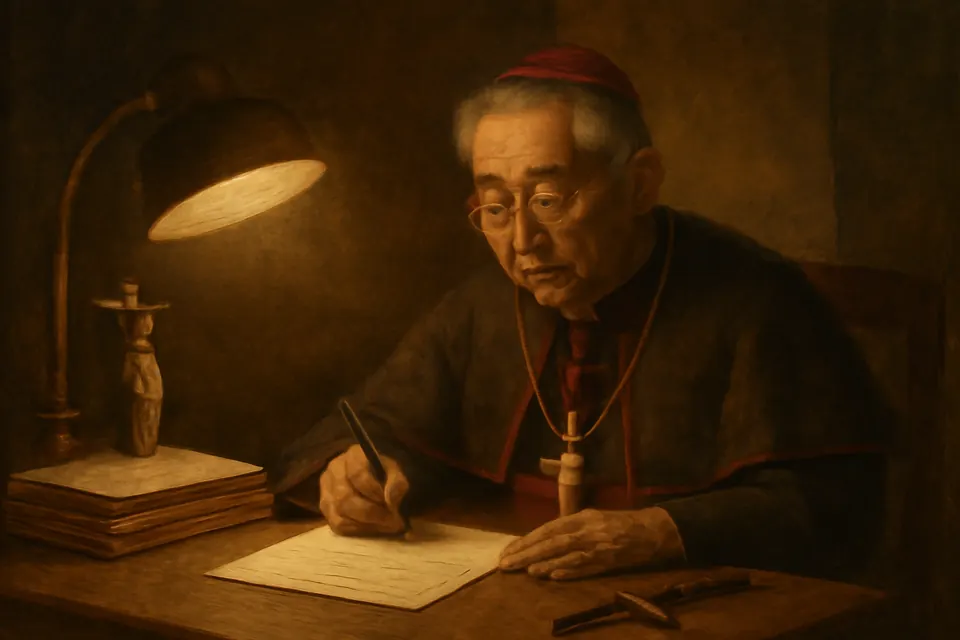
In June 1988, after meeting Cardinal Joseph Ratzinger, then prefect of the Congregation for the Doctrine of the Faith, Bishop Ito told an audience in the United States, "I was very pleased with the Cardinal's response." Catholic News Agency reports that Ratzinger let the bishop's judgment stand. A widely copied claim says that in 1988 the cardinal gave a "definitive judgment" that the events were "reliable and worthy of belief," but no such document from the Congregation has ever been published. What can be said plainly is that Akita rests on the approval of the diocesan bishop, and that the Holy See has never issued a formal judgment, for or against.
Symbols of Our Lady of Akita in art
Images of Our Lady of Akita copy the convent statue:
- Mary before the cross: she stands in front of a tall cross, its arms rising behind her shoulders, a reminder of her place beside her Son on Calvary.
- Lowered, open arms: her hands hang open at her sides, palms forward, as if pouring out grace.
- The globe: she stands on the world, the sign of her care for all nations. Both the cross and the globe come from the image of Our Lady of All Nations on which the statue was modeled.
- Wood: most copies keep the plain, warm color of the carved katsura or other wood, without paint.
- Tears: devotional pictures often add tears, or blood in the right palm, recalling 1973 and 1975 to 1981.
The shrine today
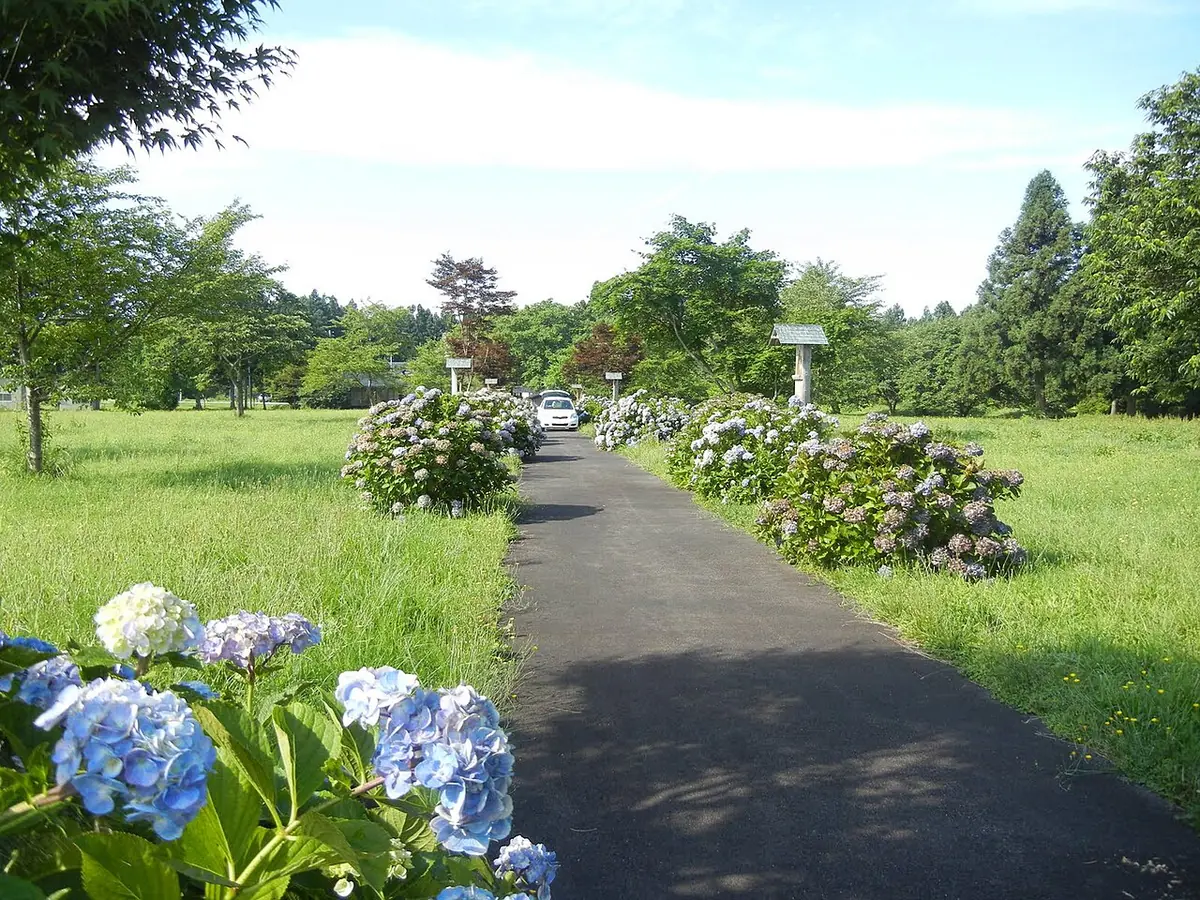
The statue remains in the chapel of the Handmaids of the Eucharist at Yuzawadai, and pilgrims come from across Japan and abroad. Devotion to Our Lady of Akita has spread across Asia; at PIK2, near Jakarta in Indonesia, a prayer garden named for her has a chapel built in the style of the Akita convent.

The events at Akita took place in a land with a long history of faith under trial: St. Paul Miki and his companions were crucified at Nagasaki in 1597, and hidden Christians kept the faith in secret for more than two centuries. Father Yasuda noticed that Sr. Agnes lost her hearing on March 16, 1973, the eve of the day the Church in Japan remembers the discovery of those hidden Christians at Oura in 1865.
Feast and anniversaries
Our Lady of Akita has no liturgical feast. Devotees often keep July 6, the date of the first message, and many remember September 15, the feast of Our Lady of Sorrows, when the statue wept for the last time. See the feast day calendar.
Prayer of Akita
The prayer most closely tied to Akita is the prayer of the Handmaids of the Eucharist, which, by the July 6, 1973, account, Our Lady prayed together with Sr. Agnes. Bishop Ito had written it for the institute. Sr. Agnes said that when she reached the words "present in the Eucharist," the voice added "truly," and the word has been part of the prayer since. As EWTN printed it:
Most Sacred Heart of Jesus, truly present in Holy Eucharist, I consecrate my body and soul to be entirely one with Your Heart, being sacrificed at every instant on all the altars of the world and giving praise to the Father pleading for the coming of His Kingdom.
Please receive this humble offering of myself. Use me as You will for the glory of the Father and the salvation of souls.
Most holy Mother of God, never let me be separated from Your Divine Son. Please defend and protect me as Your Special Child. Amen.
Above all, Akita asks us to pray the Rosary each day, for the pope, the bishops and priests. Holy Mother of Akita, pray for us.
Frequently asked questions
Is Our Lady of Akita approved by the Church?
Yes, by the local bishop. On April 22, 1984, after eight years of inquiry, Bishop John Shojiro Ito of Niigata recognized "the supernatural character of a series of mysterious events concerning the statue of the Holy Mother Mary" and authorized her veneration in his diocese. He wrote that he did so while awaiting a definitive judgment from the Holy See, which has never been published. Like every private revelation, it is not an article of faith.
What did Cardinal Ratzinger say about Akita?
Bishop Ito discussed his pastoral letter with Cardinal Joseph Ratzinger, then prefect of the Congregation for the Doctrine of the Faith, in Rome in 1988 and said afterward that he was "very pleased" with the cardinal's response. Catholic News Agency reports that Ratzinger let the bishop's judgment stand. No document from the Congregation on Akita has ever been published, so claims of a formal Vatican "definitive judgment" go beyond the record.
How many times did the Akita statue weep?
101 times. The statue first wept on January 4, 1975, and the last weeping came on September 15, 1981, the feast of Our Lady of Sorrows. Bishop Ito saw it weep four times himself, and a weeping in December 1979 was filmed and broadcast on Japanese television.
What is the message of Our Lady of Akita?
The three messages of 1973 ask for prayer and reparation for sin, prayer for the pope, bishops and priests, and the daily Rosary. The last, on October 13, 1973, warns of a terrible punishment if people do not repent and says, "Each day recite the prayers of the Rosary."
When is the feast of Our Lady of Akita?
There is no liturgical feast. Devotees often mark July 6, the date of the first message in 1973, and remember September 15, the day of the statue's last weeping.
Sources
- Bishop John Shojiro Ito, Pastoral letter on the events of Akita, April 22, 1984 (The Miracle Hunter)
- Apparitions of the Blessed Virgin Mary to Sr. Agnes Sasagawa of Akita, Japan (EWTN library, archived)
- Teiji Yasuda, O.S.V., Akita: The Tears and Message of Mary, trans. John M. Haffert (101 Foundation, archived PDF)
- Catholic News Agency: Sister Agnes Sasagawa, Our Lady of Akita visionary, dies at 93 (August 2024)
- Our Sunday Visitor: Marian visionary dies at 93 on feast of Assumption (August 19, 2024)