St. Cornelius the Centurion
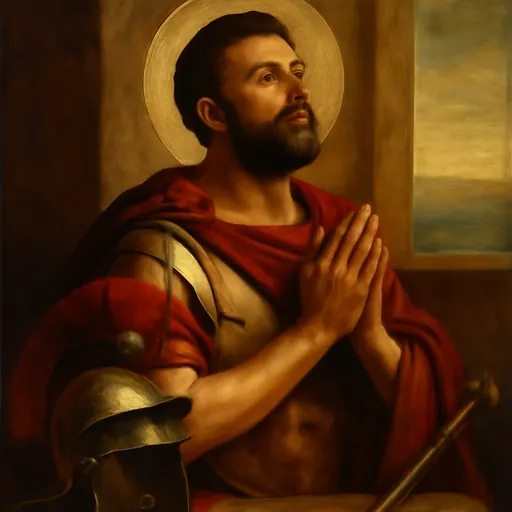
St. Cornelius the Centurion was the Roman army officer at Caesarea whose story fills Acts 10. An angel told him to send for St. Peter; Peter came, preached Christ, saw the Holy Spirit fall on Cornelius's household, and ordered them baptized. He is honored as the first Gentile received into the Church. The 1916 Roman Martyrology keeps him on February 2; the East keeps him on September 13.
Who was St. Cornelius the Centurion?
St. Cornelius the Centurion was a Roman army officer at Caesarea, on the coast of the Holy Land, and the first Gentile whom the apostles received into the Church. His story is told at length in the tenth chapter of the Acts of the Apostles, and St. Luke tells it twice more, because so much turned on it. Through this one household, God showed the Church that the Gospel was meant for every nation.
He should not be confused with Pope St. Cornelius, the third-century bishop of Rome whose feast is September 16.
The story of Cornelius in Acts
A devout soldier
Luke introduces him as "a centurion of that which is called the Italian band," a commander of about a hundred men in a cohort raised in Italy. He was not Jewish, but he had come to worship the God of Israel:
A religious man, and fearing God with all his house, giving much alms to the people, and always praying to God.
Even the messengers he later sent described him as "a just man, and one that feareth God, and having good testimony from all the nation of the Jews."
The angel at the ninth hour
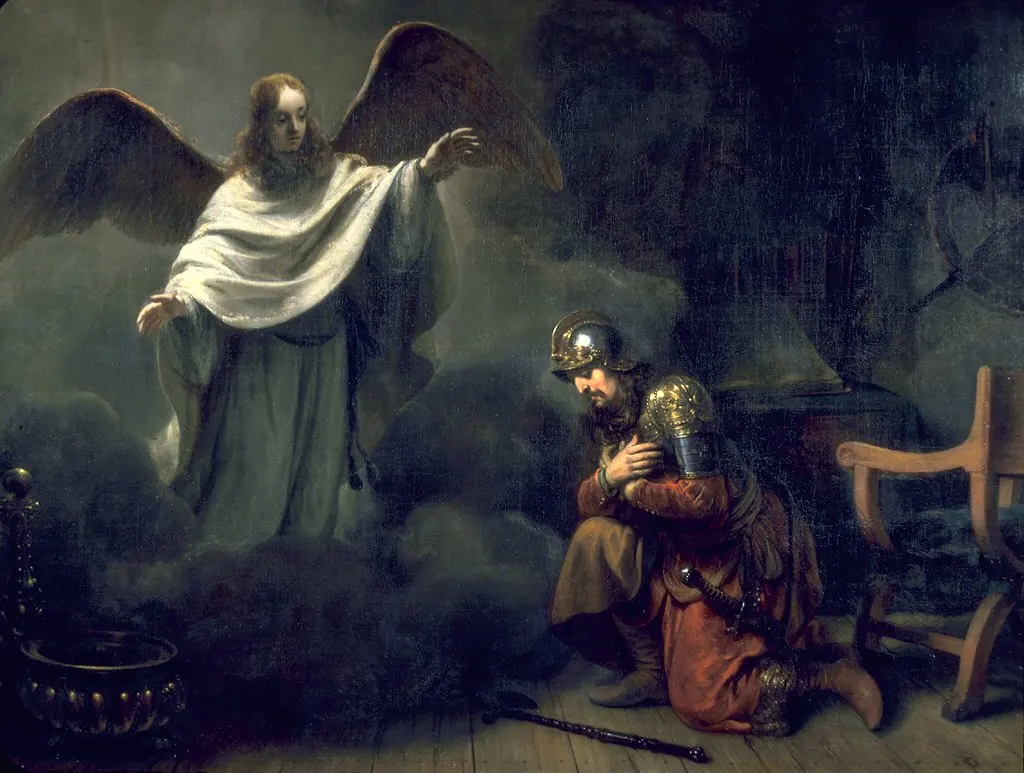
One afternoon, at the ninth hour, the hour of prayer, Cornelius saw an angel come into his house and call him by name. Frightened, he answered, "What is it, Lord?" The angel told him, "Thy prayers and thy alms are ascended for a memorial in the sight of God," and ordered him to send to Joppa for "one Simon, who is surnamed Peter." Cornelius sent two servants and a devout soldier at once.
Peter's vision on the rooftop
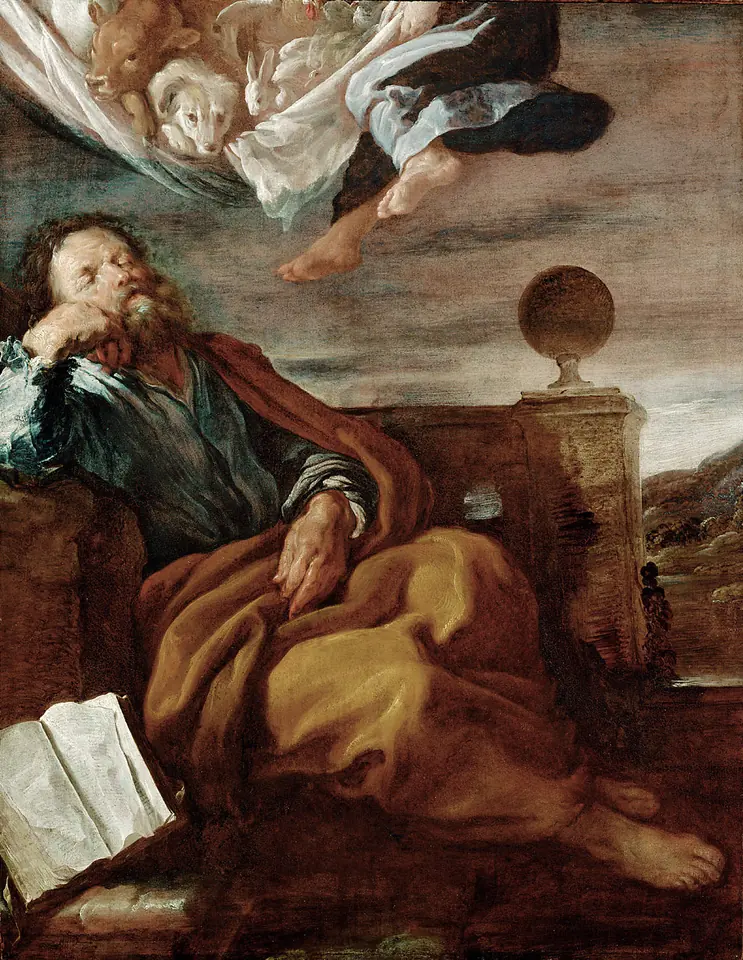
The next day, as the messengers came near Joppa, St. Peter went up on the roof to pray. In a trance he saw a great vessel like a sheet let down from heaven, full of animals that the Law of Moses called unclean, and heard a voice say, "Arise, Peter; kill and eat." Peter refused. The voice answered, "That which God hath cleansed, do not thou call common." This happened three times. While Peter was still puzzling over it, the men from Cornelius stood at the gate.
In the house at Caesarea
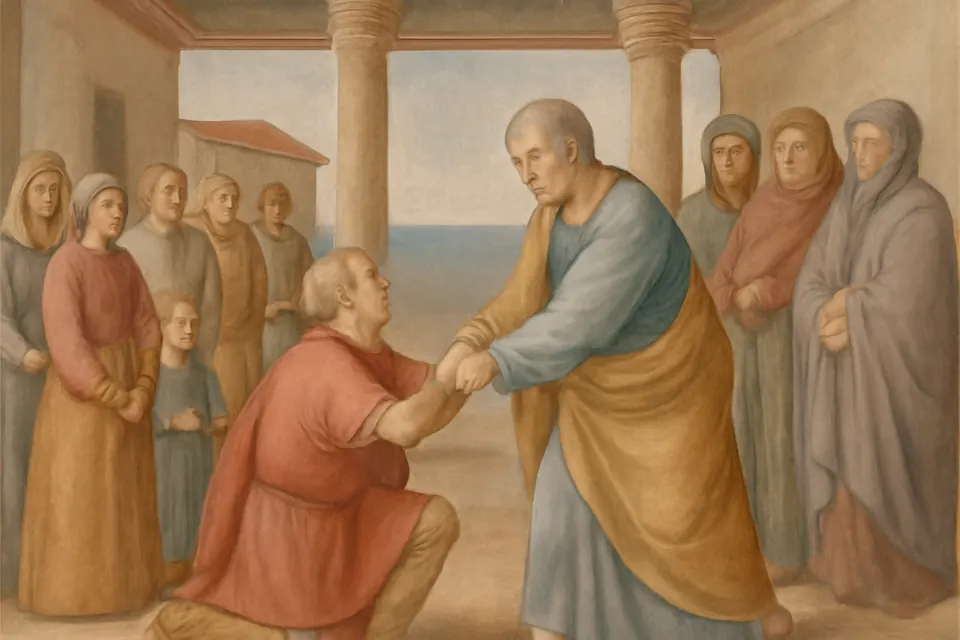
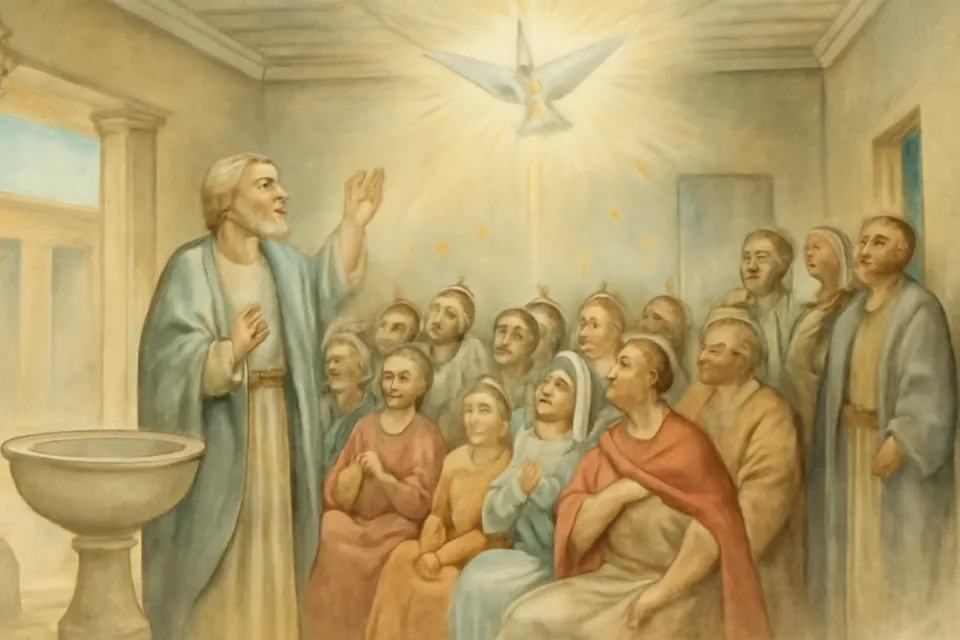
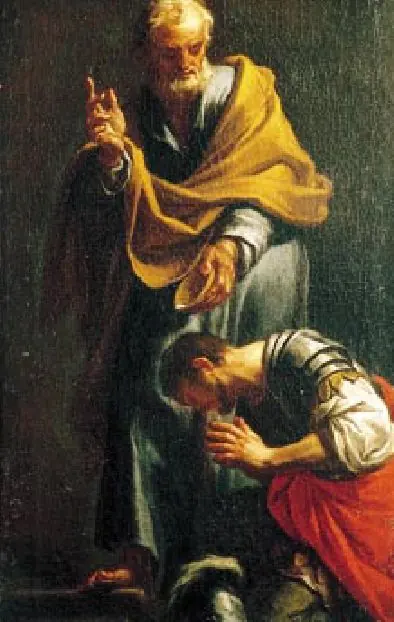
Peter went with them. Cornelius had gathered his relatives and close friends, and when Peter came in he fell at his feet. Peter lifted him up: "Arise, I myself also am a man." Cornelius told him of the angel and said, "Now therefore all we are present in thy sight, to hear all things whatsoever are commanded thee by the Lord."
Peter began to preach, and his first words were the lesson of the rooftop: "In very deed I perceive, that God is not a respecter of persons. But in every nation, he that feareth him, and worketh justice, is acceptable to him." He told them of Jesus of Nazareth, anointed "with the Holy Ghost, and with power," who was crucified and rose again.
While Peter was still speaking, "the Holy Ghost fell on all them that heard the word." The Jewish believers who had come with him were astonished that the gift was poured out on Gentiles too. Peter asked who could refuse water to people who had received the Spirit just as they had, "and he commanded them to be baptized in the name of the Lord Jesus Christ."
When Peter returned to Jerusalem, some criticized him for eating with the uncircumcised. He told them the whole story, and they "held their peace, and glorified God." Peter recalled it again at the Council of Jerusalem (Acts 15).
After Acts: history and tradition
Scripture says nothing more about Cornelius. By the late fourth century his house at Caesarea was a place of pilgrimage: St. Jerome writes that his friend St. Paula, traveling through the Holy Land, "saw the house of Cornelius now turned into a Christian church."
Two later traditions make him a bishop. The Roman Martyrology says Peter raised him "to be Bishop in that city," Caesarea. The Eastern tradition, as the Orthodox Church in America tells it, says that he went with Peter on his journeys, and that when lots were drawn at Ephesus to send a preacher to the idol-worshiping city of Scepsis, the lot fell to Cornelius. There he converted the prince Demetrius and lived to old age.
Miracles and legends
The angel's visit, Peter's vision and the coming of the Holy Spirit on Cornelius's household are told in Scripture.
The Scepsis stories are traditional. When the prince ordered him to sacrifice, Cornelius prayed facing east in the temple of Zeus, and an earthquake threw down the temple and its idols. The prince's wife and son were caught in the ruins, and their voices were later heard praising the God of the Christians. Cornelius brought them out alive by his prayer, and the prince and his household were baptized. These accounts are much later than Acts.

Symbols of St. Cornelius in art
- Roman armor, helmet and red cloak: in Western painting he is nearly always the centurion of Acts 10, often kneeling.
- The angel: the most common scene is his vision at the ninth hour, as in Eeckhout's painting.
- Baptism by St. Peter: the second favorite subject, a sign of the Church opening to the Gentiles.
- Bishop's vestments: Eastern icons, like the Menologion miniature, show him as a hieromartyr, a bishop-saint, sometimes with the falling temple of Scepsis.
Feast day and how we honor him
The 1916 Roman Martyrology keeps his memory on February 2. The Orthodox and Byzantine Catholic churches keep it on September 13. Visit our feast days page for other saints of these days.
Prayer to St. Cornelius the Centurion
There is no traditional Western prayer to St. Cornelius. The Orthodox Church sings this troparion in his honor (Tone 4, as the Orthodox Church in America gives it):
O Blessed Cornelius, / you were distinguished in works of righteousness. / You received the enlightenment of godliness, / and were a fellow-laborer with the Apostles, / for you shared in their work, / preaching Christ's incarnation to all. / With them pray that all who honor your memory may be saved!
Let us ask St. Cornelius to pray for soldiers and their families, for those who seek God with an honest heart before they know his name, and for the Church's mission to every nation.
Frequently asked questions
Who was Cornelius the Centurion in the Bible?
A Roman centurion of the Italian cohort stationed at Caesarea, described in Acts 10:2 as 'a religious man, and fearing God with all his house, giving much alms to the people, and always praying to God.' After an angel's visit he sent for St. Peter, heard the Gospel and was baptized with his household.
Why is Cornelius important?
His baptism showed the apostles that the Gospel was for the Gentiles as well as the Jews. Peter said in his house, 'In very deed I perceive, that God is not a respecter of persons,' and later defended the baptism before the church in Jerusalem (Acts 11).
What happened to Cornelius after his baptism?
Scripture does not say. The Roman Martyrology says Peter made him bishop of Caesarea. The Eastern tradition says he became a bishop, preached at Scepsis in Asia Minor, converted its prince Demetrius, and died there in old age.
When is the feast of St. Cornelius the Centurion?
February 2 in the 1916 Roman Martyrology (October 20 in the revised Martyrology, as reported), and September 13 in the Orthodox and Byzantine Catholic churches. He is a different saint from Pope St. Cornelius, whose feast is September 16.
Keep exploring
Sources
- Acts of the Apostles, chapters 10 and 11 (Douay-Rheims), Bible Gateway. Scripture quoted on this page
- St. Jerome, Letter 108, to Eustochium, New Advent. Section 8: St. Paula sees 'the house of Cornelius now turned into a Christian church' at Caesarea
- Hieromartyr Cornelius the Centurion, Orthodox Church in America. The Eastern tradition of his preaching and death at Scepsis
- Hieromartyr Cornelius the Centurion: Troparion and Kontakion, Orthodox Church in America. Text of the troparion quoted on this page
- Roman Martyrology (1916 English translation), February 2, Divinum Officium project. His Martyrology entry and the tradition that Peter made him bishop of Caesarea