St. Hyginus, Pope

St. Hyginus was the ninth pope, a Greek who led the Church of Rome for about four years, around 138 to 142 AD, after St. Telesphorus. In his time the Gnostic teachers Valentinus and Cerdo came to Rome, and the Church there had to hold fast to the faith of the apostles. He was buried near St. Peter on the Vatican. His feast day is January 11.
Who was St. Hyginus?
St. Hyginus was the ninth pope, the bishop of Rome who succeeded St. Telesphorus around the year 138 and shepherded the Church in the city for about four years, until about 142. He was a Greek by birth. He led the Roman Christians at a time when new and attractive teachers were arriving in the capital with their own versions of the Gospel, and the Church had to hold to the faith handed down from St. Peter and St. Paul.
We know very little about him, and we should say so plainly. The Catholic Encyclopedia warns that "the chronology of these bishops of Rome cannot be determined with any degree of exactitude." What we have are a few lines in St. Irenaeus and Eusebius and a short entry in the old Roman Book of the Popes. Let us honor him for what those sources tell us and not ask them for more.

What the oldest sources say
St. Irenaeus, about the year 180
St. Irenaeus of Lyon listed the bishops of Rome to show that the apostles' teaching had passed faithfully from one bishop to the next: "then Hyginus; after him, Pius; then after him, Anicetus." He was writing only about forty years after Hyginus died, close enough that older Roman Christians would have remembered him.
Irenaeus also tells us what made those years hard. "Valentinus came to Rome in the time of Hyginus, flourished under Pius, and remained until Anicetus. Cerdon, too, Marcion's predecessor, himself arrived in the time of Hyginus, who was the ninth bishop."
Eusebius, about the year 325
The historian Eusebius dates his election to the first year of the emperor Antoninus Pius, when Telesphorus died, which points to 138 or 139. "But Hyginus having died at the close of the fourth year of his episcopate, Pius succeeded him in the government of the church of Rome."
The Liber Pontificalis, sixth century
The Book of the Popes, compiled centuries later, calls him "by nationality a Greek, previously a philosopher of Athens, whose ancestry I have not been able to ascertain." It says that "he set in order the clergy and distributed ranks," held three ordinations in December, and "was buried near the body of the blessed Peter in the Vatican, January 11."
Historians weigh these lines with care. The Catholic Encyclopedia thinks the "philosopher" detail "is probably founded on the similarity of his name with that of two Latin authors" named Hyginus. The note about ordering the clergy is a stock phrase that the same book repeats for Pope Hormisdas, and the Catholic Encyclopedia says plainly that "it has no historical value." The burial beside St. Peter is the most trustworthy line.
Hyginus and the Gnostic teachers
The Gnostics taught that the world was made by a lesser god, that salvation came through secret knowledge for a chosen few, and that the God of the Old Testament was not the Father of Jesus Christ. Valentinus stayed in Rome for many years and drew followers there. Cerdo, Eusebius says, "made confession, and continued in this way, now teaching in secret, now making confession again," until he was finally put out of the community.

How much of this took place while Hyginus was bishop, the Catholic Encyclopedia admits, "is not known." Still, these were the questions in front of him: how to receive a man who repents and then relapses, and how to keep a small persecuted Church faithful when brilliant men offer it a different gospel. The answer the Roman Church gave, under Hyginus and the popes after him, was the rule Irenaeus later wrote down: hold to what the apostles taught and their successors have kept.
Was St. Hyginus a martyr?
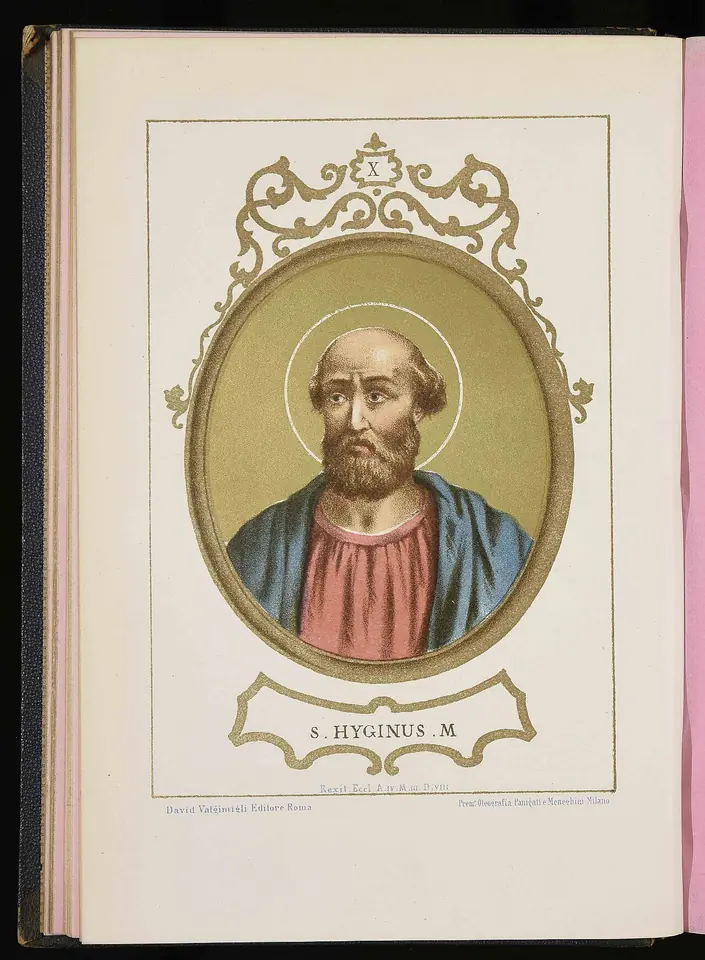
Some later calendars and prints call him a martyr; the 1879 lithograph on this page marks him "S. Hyginus M." The Catholic Encyclopedia is clear, though: "The ancient authorities contain no information as to his having died a martyr." So that title is at most traditional, and no miracles are recorded for him. We honor him as a faithful pope who kept the flock in a confusing time.
Symbols of St. Hyginus in art
No early portrait of Hyginus survives, so artists give him the signs of his office:
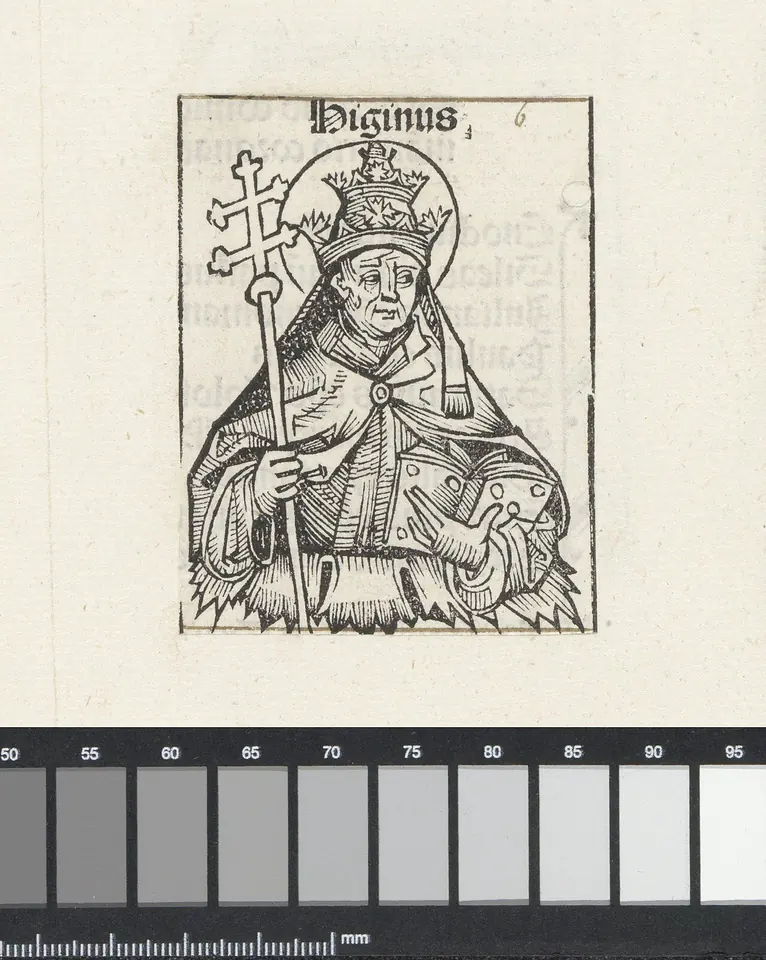
- Papal tiara or bishop's miter: later artists dressed the early popes in the regalia of their own day, as the Nuremberg Chronicle woodcut does.
- Pallium: the white wool band marked with crosses, worn over the shoulders as the sign of a bishop's authority.
- Book of the Gospels: the bishop as guardian of the apostles' teaching, which fits the Gnostic crisis of his day.
- Double-barred cross: a papal staff in some prints.
The surest way to know him is an inscription. Cavalieri labels him "Hyginius PP I Graecus," and his round portrait hangs among the popes in Rome's Basilica of St. Paul Outside the Walls.
St. Hyginus's feast day and tomb
We keep his memory on January 11, the burial date in the Book of the Popes and his day in the Roman Martyrology. He was removed from the General Roman Calendar in 1969, as were several early popes about whom little is known, but he remains in the Martyrology. See the saints around him on our feast days page.
He was buried on the Vatican hill near St. Peter, beside St. Evaristus and the other early bishops of Rome. His grave has never been identified.

Prayer to St. Hyginus
There is no traditional prayer written for St. Hyginus alone. In the older Roman Missal his feast used the common Mass for a pope. We can simply ask: St. Hyginus, pray for us. Let us ask him to pray for the pope and the bishops, for teachers of the faith, and for all who are drawn to clever doctrines that lead away from Christ.
Frequently asked questions
Who was St. Hyginus?
The bishop of Rome who succeeded St. Telesphorus around 138 and led the Church there for about four years, under the emperor Antoninus Pius. St. Irenaeus, writing about 180, names him as "the ninth bishop" of Rome counting from the apostles. He was a Greek by birth.
When is the feast of St. Hyginus?
January 11, the burial date given in the Liber Pontificalis and the day the Roman Martyrology lists him. He was removed from the General Roman Calendar in the 1969 reform, so his feast is no longer kept everywhere.
Was Pope Hyginus a martyr?
Some later calendars and prints call him a martyr, but the Catholic Encyclopedia notes that "the ancient authorities contain no information as to his having died a martyr." We honor him as a pope and confessor of the faith.
What happened in the Church during Hyginus's time?
Two Gnostic teachers arrived in Rome. Valentinus, says St. Irenaeus, "came to Rome in the time of Hyginus" and stayed for years, and Cerdo, the forerunner of Marcion, came in the same years, confessed his errors and fell back into them more than once. The Roman Church under Hyginus and his successors had to tell the apostles' teaching apart from these new systems.
Keep exploring
Sources
- Catholic Encyclopedia (1910): Pope St. Hyginus. Chronology uncertain, the philosopher claim probably from his name, no record of martyrdom, burial near St. Peter
- St. Irenaeus, Against Heresies, Book III, chapter 4. Valentinus and Cerdon came to Rome in the time of Hyginus, "the ninth bishop"
- Eusebius, Church History, Book IV, chapters 10–11. Succeeded Telesphorus in the first year of Antoninus Pius; died at the close of the fourth year of his episcopate
- Louise Ropes Loomis, The Book of the Popes (Liber Pontificalis), New York: Columbia University Press, 1916. A Greek, "previously a philosopher of Athens"; set the clergy in order; three December ordinations; burial January 11