St. Arsenius the Great, Desert Father and Lover of Silence
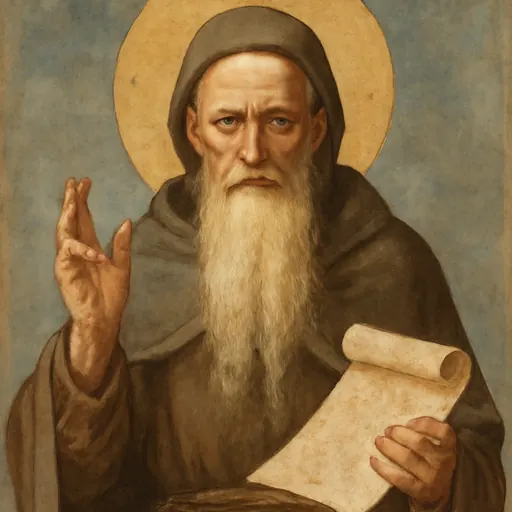
St. Arsenius the Great (about 354–450) was a Roman nobleman and deacon who tutored the sons of Emperor Theodosius, then fled to the Egyptian desert of Scetis and lived fifty-five years as a monk, remembered as the great lover of silence. The West keeps his feast on July 19; the Orthodox and Eastern Catholic churches keep May 8.
Who was St. Arsenius the Great?
St. Arsenius the Great was a Roman scholar who left the most splendid court of the empire for a cell in the Egyptian desert. Born in Rome about 354 to a noble family, learned in Greek and Latin, and said to have been a deacon of the Roman Church, he was sent to Constantinople to tutor the sons of the Emperor Theodosius. After eleven years he slipped away by ship, joined the monks of Scetis, and spent the next fifty-five years in prayer, silence and tears. The Desert Fathers who lived beside him called him "the Great." He died about 449 or 450, nearly a hundred years old.
His life comes down to us mostly through the Sayings of the Desert Fathers, the short stories and words of the early monks collected in the fifth century, and through later lives such as the one written by St. Theodore the Studite, who died in 826. The stories are old and vivid. Some details, like the exact dates, vary from one telling to another.

From the emperor's palace to the desert
Tutor of princes
When the Emperor Theodosius asked the West for a tutor for his son Arcadius, the Catholic Encyclopedia relates, Pope Damasus and the Emperor Gratian chose Arsenius. He reached Constantinople in 383 and taught in the imperial household for eleven years, in the last three also teaching the younger son, Honorius. One day Theodosius came in and found his sons sitting while their teacher stood. He would not have it, and made the boys stand and Arsenius sit.
The court gave him a splendid household, and he lived in style, but his heart was elsewhere. He prayed to know what to do, and the Catholic Encyclopedia records the answer he heard: "Arsenius, flee the company of men, and thou shalt be saved."
A beggar at Scetis
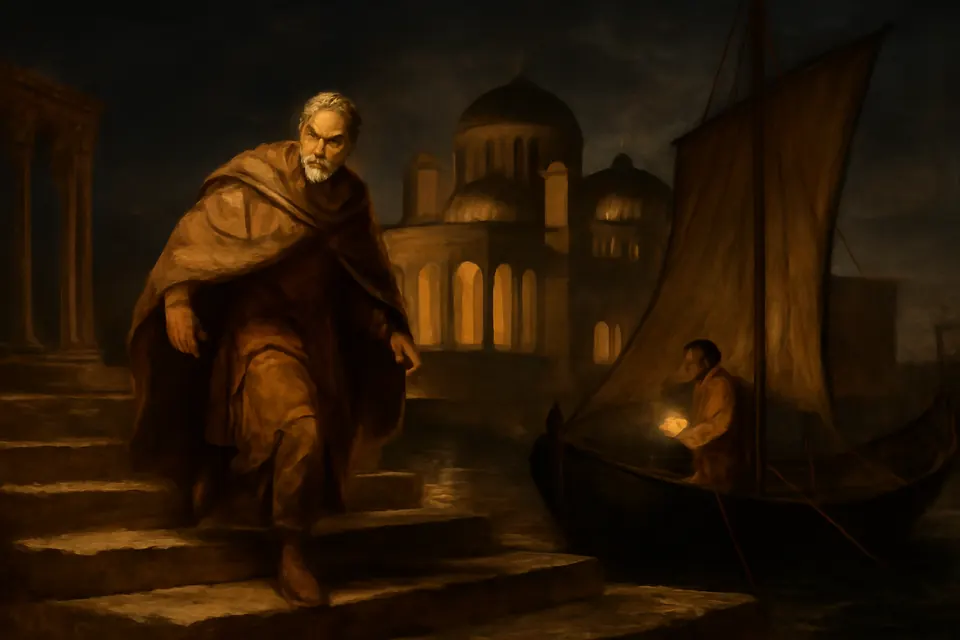
He sailed secretly to Alexandria and went out to the desert of Scetis, where the monks lived in scattered cells around a church. He was taken to Abba John the Dwarf. The old man had been warned who his visitor was. At the meal he let the others sit and left Arsenius standing; halfway through he tossed some bread on the ground and told him to eat if he wanted. Arsenius sat down on the ground and ate it. In the Orthodox telling he went down on his hands and knees to take it. John said he would make a great monk, and kept him.

Silence and tears
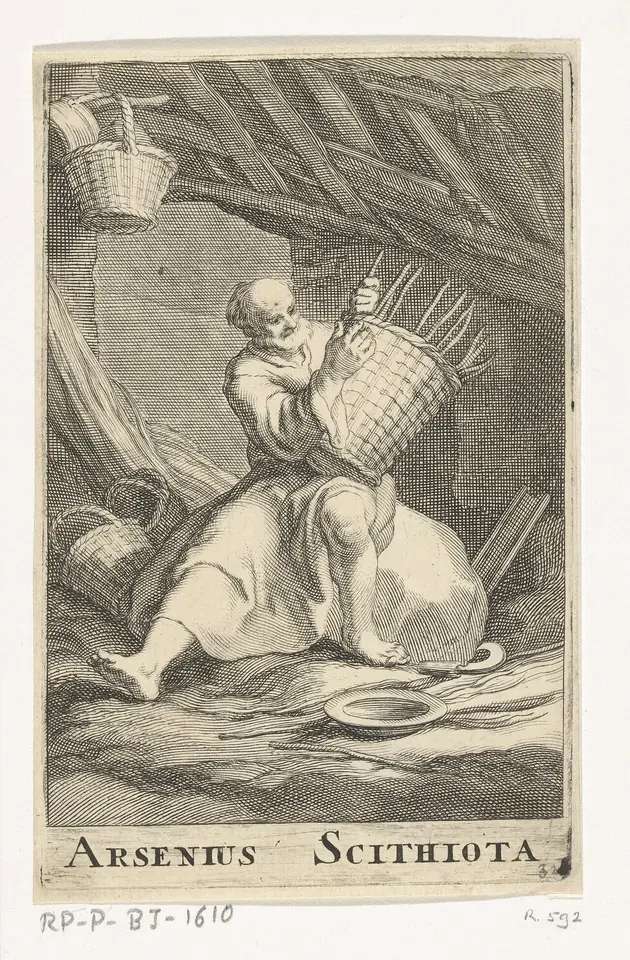
Arsenius worked at weaving palm leaves into mats and baskets, as the desert monks did. Because he had worn perfume at court, he never changed the water he soaked the leaves in, only topped it up, and let it stink. He wore the poorest clothes in the community. The Catholic Encyclopedia says that at all times copious tears of devotion fell from his eyes.
Above all he guarded his silence. When Abba Moses asked why he hid from the brothers, the OCA's life gives his answer: "God knows that I love you, but I cannot remain with God and with men at the same time." He refused to go back to court to advise the Emperor Arcadius, his former pupil, and would not even act as his almoner to the monasteries.
After forty years at Scetis, the OCA's life says, he spent ten years on the mountain of Troe near Memphis, three at Canopus near Alexandria, and two more at Troe, where he died.
Sayings and miracles
The sayings of Arsenius are among the best loved in the desert collections. The OCA's life gives these in English:
I have often regretted the words I have spoken, but I have never regretted my silence.
Rouse yourself, Arsenius, work! Do not remain idle! You have not come here to rest, but to labor.
One story says a monk looked through his window and saw him at prayer, wholly surrounded by flame. This is a traditional account from the desert sayings, handed down by the monks of Scetis. No formal miracle process exists for a saint of his age; his holiness was recognized by the Church from the beginning.
Symbols of St. Arsenius the Great in art
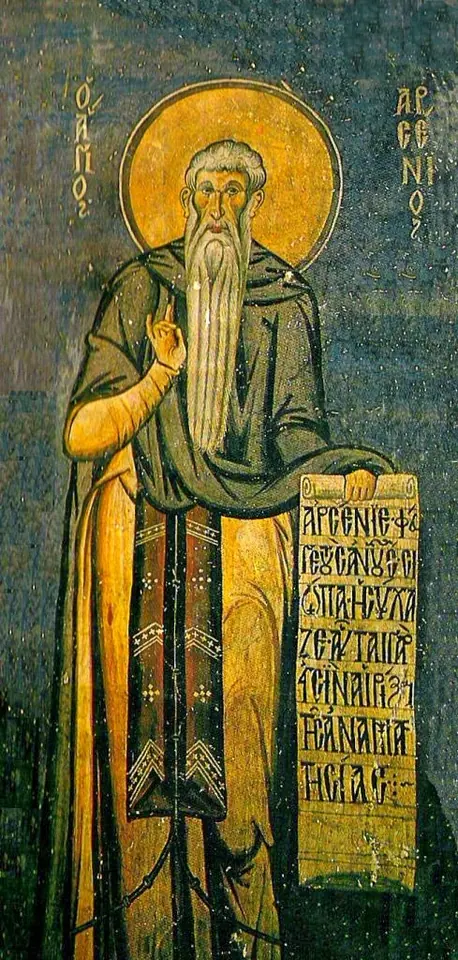
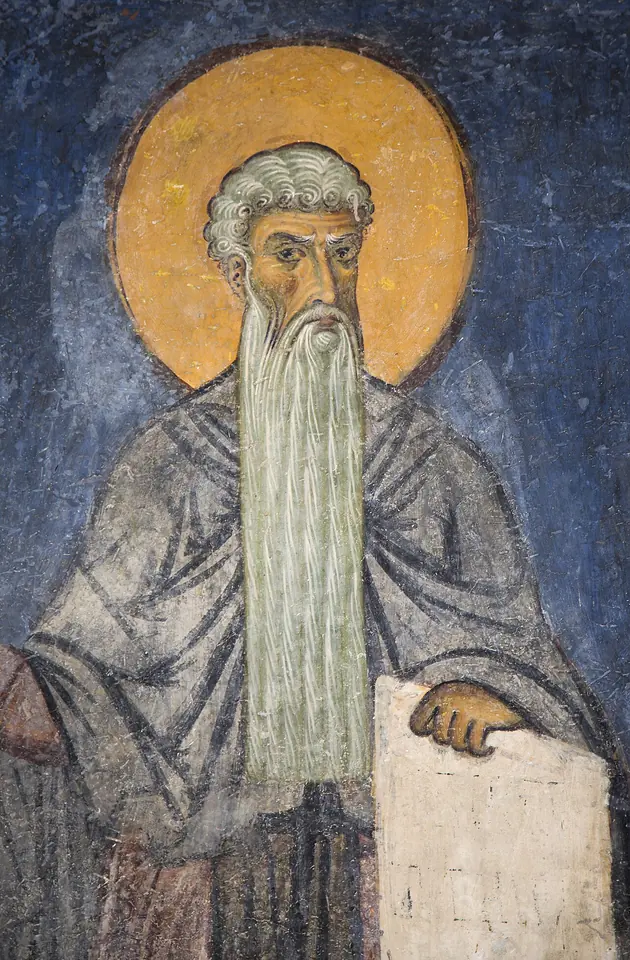
In Byzantine frescoes and icons, Arsenius is one of the most recognizable of the desert fathers:
- A very long white beard: often reaching to his knees, the sign of extreme old age and a life spent in the desert.
- The monk's habit: plain dark robes and a cloak.
- A scroll: opened to one of his sayings, as in the frescoes at Kastoria and Nerezi.
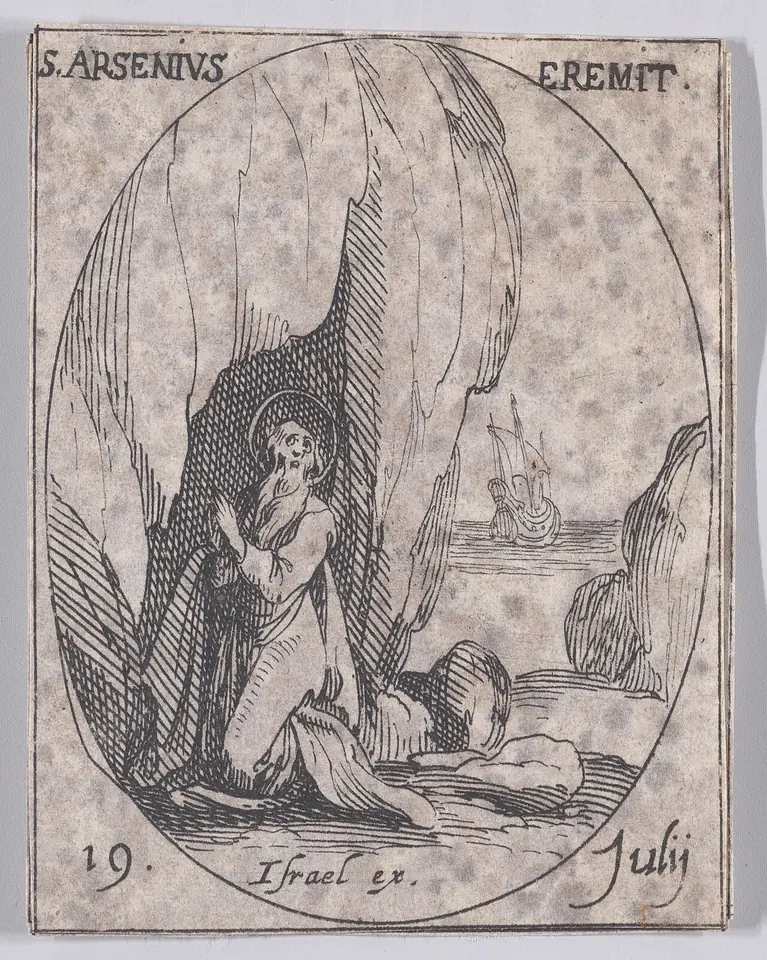
- Baskets and palm leaves: Western prints show him weaving, the work of his hands.
- Tears and a skull: Western painters like Philippe de Champaigne add a skull, the sign of a life spent preparing for death, and show his eyes wet with tears.
- Leaving the world: the scene of his flight from court, or a ship in the distance, recalls his voyage to Egypt.
Look for him among the rows of monastic saints on the lower walls of Byzantine churches: a grave face, a beard like a waterfall, and a scroll in hand.
Feast day and prayer
We keep the feast of St. Arsenius the Great on July 19 in the West. The Orthodox and Eastern Catholic churches honor him on May 8. See the feast day calendar for other desert saints.
The Byzantine Church sings this troparion in his honor, in the translation of the Orthodox Church in America:
By a flood of tears you made the desert fertile, / and your longing for God brought forth fruits in abundance. / By the radiance of miracles you illumined the whole universe! / O our holy father Arsenius, pray to Christ our God to save our souls!
Let us ask St. Arsenius to pray for us when our days are full of noise and words, that we may find a little of his silence and learn to weep for our sins and for the world.
Frequently asked questions
Who was St. Arsenius the Great?
A learned Roman of noble family, said to have been a deacon of the Roman Church, who was chosen about 383 to tutor the sons of Emperor Theodosius I, the future emperors Arcadius and Honorius. After eleven years at court he secretly sailed for Egypt and became a monk at Scetis under Abba John the Dwarf. He died about 449 or 450.
What did St. Arsenius say about silence?
Among his sayings is "I have often regretted the words I have spoken, but I have never regretted my silence," as the Orthodox Church in America's life of him translates it. He also heard a voice in prayer telling him to flee from men and keep silence.
When is the feast of St. Arsenius the Great?
July 19 in the Roman Martyrology and in the old Western calendars; May 8 in the Orthodox and Eastern Catholic churches.
Why is he called "the Great"?
His fellow monks so admired his humility, prayer and tears that they gave him the surname "the Great," as the Catholic Encyclopedia notes.
Keep exploring
Sources
- St. Arsenius, Catholic Encyclopedia (1907), New Advent. The imperial tutorship, the voice telling him to flee, the bread thrown by John the Dwarf, the stagnant water, and the oldest lives (Theodore the Studite, Metaphrastes)
- Venerable Arsenius the Great, Orthodox Church in America. His sayings, his answer to Abba Moses, the years at Scetis, Troe and Canopus, and his May 8 commemoration
- Venerable Arsenius the Great: Troparion and Kontakion, Orthodox Church in America. Text of the troparion