St. Frederick of Utrecht, Bishop and Martyr

St. Frederick of Utrecht was a Frisian bishop of Utrecht under Emperor Louis the Pious who sent missionaries to the last pagan corners of his diocese and fought hard against incestuous marriages. In 838 he was stabbed to death by two assassins in his own church after saying Mass. We keep his feast on July 18.
Who was St. Frederick of Utrecht?
St. Frederick of Utrecht was a bishop of the ninth century, born among the Frisians of the North Sea coast and raised in the church of Utrecht. He governed the diocese founded by St. Willibrord for about twenty years, sent preachers to the last pagan districts in the north, and was killed in his own church in 838. The Roman Martyrology names him on July 18: "At Utrecht, St. Frederick, bishop and martyr."
Most of what we know comes from a medieval life of the saint, summarized by Alban Butler with the notes of the Bollandist Cuper. Butler weighs it with care, and we will too.
The life of St. Frederick of Utrecht
A Frisian in the church of Utrecht
Butler writes that Frederick came "of a most illustrious family among the Frisons," and that his life made him a great-grandson of Radbod, the last pagan king of Frisia. Butler gives that royal descent only on the word of the life, and we cannot confirm it. He grew up among the clergy of Utrecht, gave himself to fasting and long night prayer, and after his ordination Bishop Ricfrid put him in charge of instructing the catechumens, those preparing for baptism.
A bishop against his will
When Ricfrid died, the clergy chose Frederick to succeed him. Butler says he declared his unworthiness "with many tears" before clergy and people and gave way only when the emperor Louis the Pious commanded it. He was consecrated at Aachen in the emperor's presence, and Louis urged him to root out what remained of idolatry in Frisia.
Back in Utrecht he set the diocese in order and sent missionaries north. One of them was the priest St. Odulph, whom Frederick persuaded to leave his parish in Brabant and help reform the Frisians.
Walcheren and the marriage laws
The hardest field was the island of Walcheren, in today's Zeeland, which Butler calls the most hostile of all to the Gospel. Frederick took it as his own charge. Marriages between close relatives were common there, and he worked to end them by preaching, tears, fasting and prayer. He called an assembly of the island's leading men, separated many such couples, and received back into the Church those who did penance.

A teacher of the Trinity
Butler records that Frederick wrote a prayer to the Blessed Trinity with an explanation of the mystery against heresy, used in the Low Countries "for many ages" with great devotion. The scholar-abbot Rabanus Maurus, his contemporary, wrote a poem in his praise.
Rebuking the empress
According to his life, Frederick also rebuked the empress Judith, second wife of Louis the Pious, for scandals at the court at Aachen, which lay close to his diocese. Butler compares him to "a second John the Baptist." He also notes that the life's charge that her marriage was itself unlawful was rejected by Mabillon as fabulous.
The martyrdom of St. Frederick
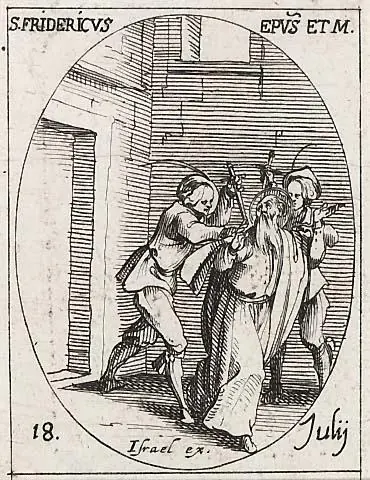
One day after Mass, as Frederick went to the chapel of St. John the Baptist to make his thanksgiving, two men stabbed him. He died within a few minutes, reciting the verse of Psalm 114 (116 in modern Bibles): "I will please the Lord in the land of the living." Butler, following Mabillon, dates his death to July 17, 838.
His medieval life, William of Malmesbury and later Dutch chroniclers say the killers were sent by the empress Judith. Baronius, Mabillon and others thought it more likely that they came from Walcheren, from the families whose marriages he had broken. Butler leans toward the empress; the question has never been settled. Either way, he died for defending the law of Christ.
Miracles
No particular miracles of St. Frederick are recorded in the sources we used. That he died praying, with a psalm on his lips, is the part of his story the tradition holds most dear, and it belongs to the traditional account of his life.
Symbols of St. Frederick of Utrecht in art
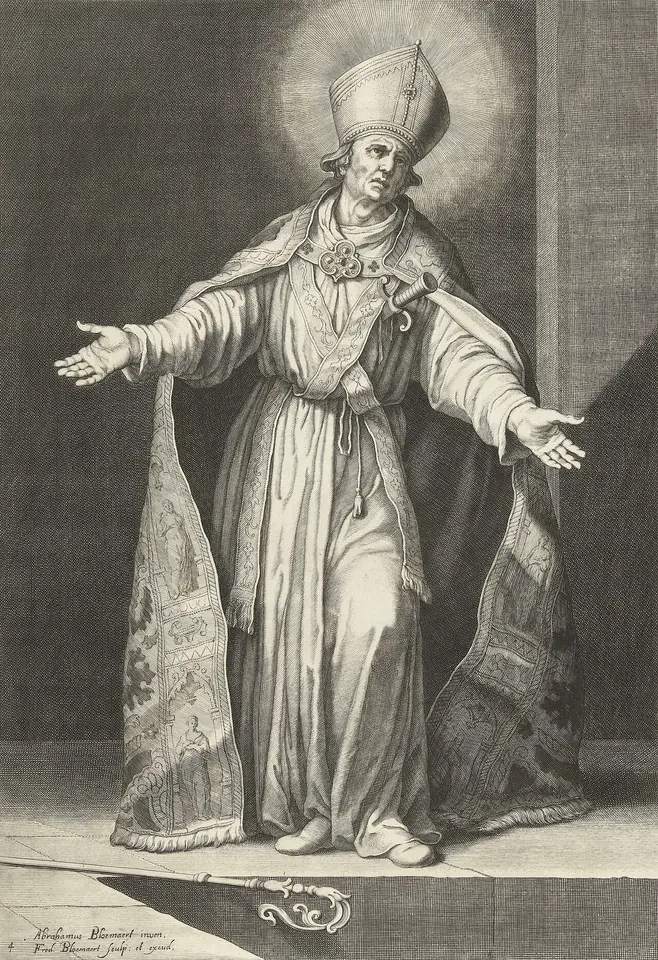
The Dutch engravers of the seventeenth century, who made whole series of the bishops and saints of the Netherlands, fixed his image:
- Miter, cope and crosier: his office as bishop of Utrecht.
- Two daggers or knives, sometimes shown in his breast: the two assassins.
- A palm: the martyr's victory.
Cornelis Visscher's engraving shows the knife handles at his breast as he raises his eyes to heaven. Callot instead shows the moment of the attack.

Feast day and grave
We keep his feast on July 18. He was buried in the church of St. Salvator, called Oudmunster, beside the cathedral of Utrecht. That church was pulled down in 1587, after the Reformation; its site lies under today's Domplein. See our feast days page for other saints of July.

Prayer to St. Frederick of Utrecht
His own prayer to the Trinity has not come down to us in a text we could verify. Let us take his last words as our prayer: "I will please the Lord in the land of the living." Let us ask St. Frederick to pray for bishops and priests who must speak hard truths, for married couples and families, and for the Church in the Netherlands. St. Frederick, pray for us.
Frequently asked questions
When is the feast day of St. Frederick of Utrecht?
July 18, the date in the Roman Martyrology.
How did St. Frederick of Utrecht die?
After saying Mass, as he went to pray in the chapel of St. John the Baptist, he was stabbed by two assassins and died within minutes, reciting "I will please the Lord in the land of the living," according to Butler's account.
Who had St. Frederick of Utrecht killed?
His medieval life and William of Malmesbury blame the empress Judith, whom he had rebuked. Baronius, Mabillon and others thought the killers came from Walcheren, where he had broken up incestuous marriages. The question has never been settled.
Why is St. Frederick of Utrecht shown with knives?
The two daggers or knives recall the two assassins who killed him.
Keep exploring
Sources
- Alban Butler, Lives of the Fathers, Martyrs and Other Principal Saints, vol. 7 (July), on archive.org. July 18: his Frisian family, Ricfrid, his reluctance and consecration at Aachen, the missions in the north, Walcheren, the prayer to the Trinity, Rabanus Maurus's poem, the murder in the chapel of St. John, the debate over who sent the killers, and the burial in St. Salvator's
- The Roman Martyrology (1916 English translation), on archive.org. July 18: "At Utrecht, St. Frederick, bishop and martyr"