St. Jadwiga of Poland, Queen
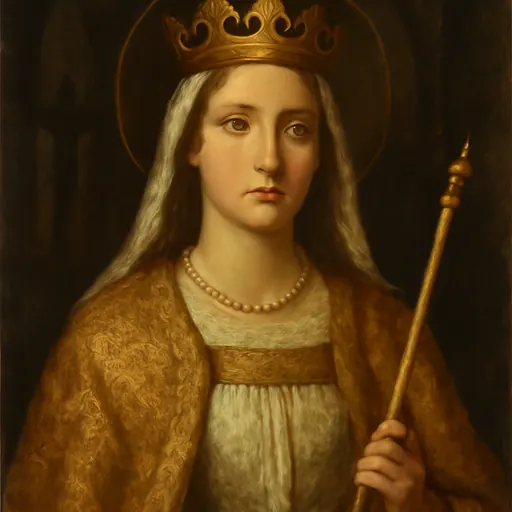
St. Jadwiga of Poland (Queen Hedwig of Anjou) was crowned ruler of Poland at about ten years old in 1384. By marrying the Lithuanian grand duke Jogaila, baptized as Władysław, she opened the way for the baptism of Lithuania, and she spent her short reign on the poor, on hospitals and on the University of Kraków. She died in 1399 and was canonized in 1997. Her day is July 17, and in Poland June 8.
Who was St. Jadwiga of Poland?
St. Jadwiga of Poland, known in English as Queen Hedwig, was a fourteenth-century queen who gave her whole short life to Christ, her people and the poor. Crowned at about ten years old, she married a pagan-born grand duke for the sake of the Gospel, saw Lithuania baptized, renewed the University of Kraków and founded hospitals. She died at about twenty-five. The people of Kraków called her a saint for six hundred years before Pope St. John Paul II canonized her in 1997.
She is not St. Hedwig of Silesia, the duchess and widow of the thirteenth century; Jadwiga is simply the Polish form of the same name.
The life of St. Jadwiga
A child crowned in Kraków
Jadwiga was born at Buda in 1373 or 1374, the youngest daughter of Louis of Anjou, king of Hungary and of Poland, and Elizabeth of Bosnia. She was raised among the Angevin court's learning and piety, and as a small child was betrothed to William of Habsburg.
When Louis died in 1382, the Polish lords chose Jadwiga to rule them. She came to Kraków and on October 16, 1384, was crowned in Wawel Cathedral. Poland's law had no place for a reigning queen, so she was crowned with the title of king.
The marriage that baptized a nation
The Polish council wanted her to marry Jogaila, the grand duke of Lithuania, still a pagan land, on condition that he and his people accept baptism. It meant giving up the betrothal of her childhood. Jadwiga consented. Jogaila was baptized in Kraków in February 1386 and took the name Władysław, and the two were married days later. The next year the king went home to Lithuania, and its people were baptized.
John Paul II said at her canonization: "Hedwig knew that her mission was to bring the Gospel to her Lithuanian brothers and sisters. She accomplished this with the help of her consort, King Wladyslaw Jagiello."

A queen who served
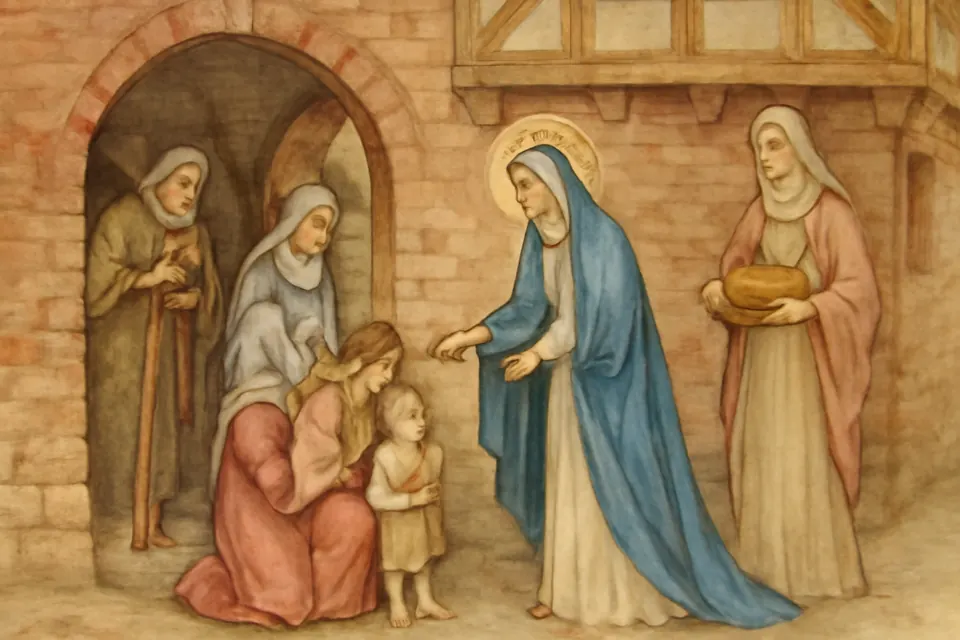
Jadwiga took an active part in governing, in diplomacy and in the recovery of lost lands, but her heart was with the poor. John Paul II named the hospitals she founded "in Biecz, Sandomierz, Sacz and Stradom." She cared especially for learning. At her and her husband's request, Pope Boniface IX founded a faculty of theology at Kraków by a bull of January 11, 1397, and she gave the university her own regalia. The canonization homily says: "She gave to the University even her golden sceptre, using instead one of gilded wood." After her death her jewels were left to renew the university, which bears the name of her dynasty today as the Jagiellonian University.
Death in 1399
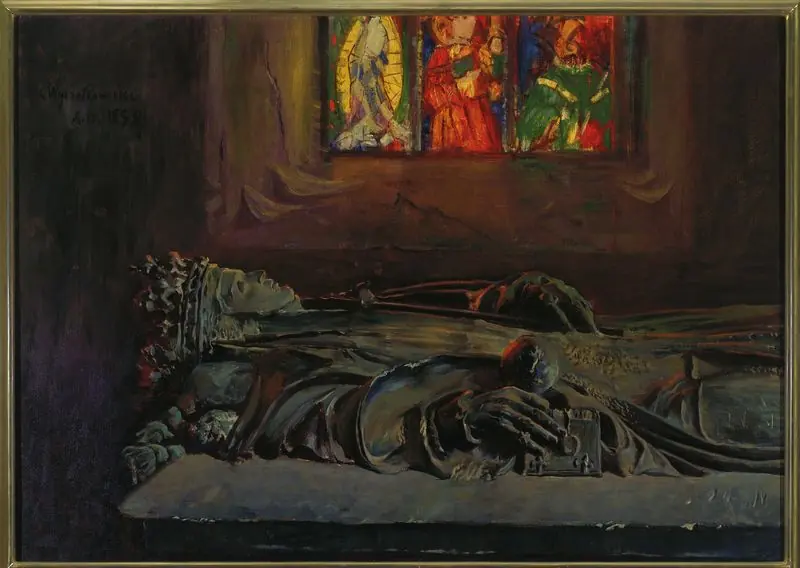
In June 1399 Jadwiga gave birth to a daughter, Elizabeth Bonifacia, who lived only a few weeks. The queen herself died on July 17, 1399, and was buried in Wawel Cathedral. All of Poland mourned her, and her tomb at once became a place of prayer.
Miracles and legends
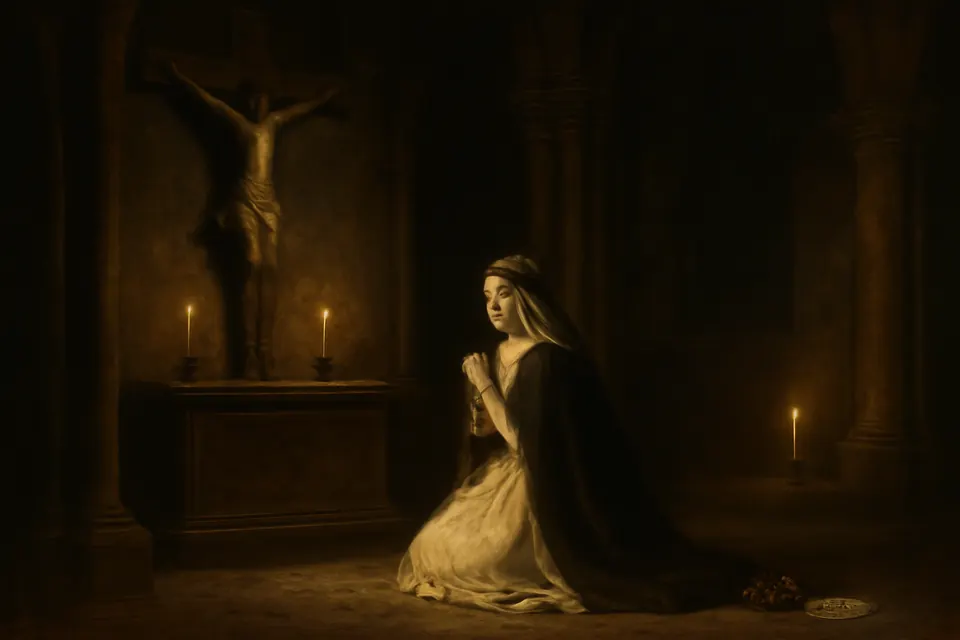
Kraków keeps several traditional stories of Jadwiga. Tradition holds that the large dark crucifix in Wawel Cathedral, before which she prayed for hours, spoke to her. Another legend says she once set her foot on a stone to give a poor stonemason a gold clasp from her shoe, leaving a footprint that is still pointed out at the Carmelite church "na Piasku" in Kraków. These are tender stories, kept by the city that loved her.
Her canonization in 1997 followed centuries of devotion. John Paul II told the people of Kraków that "you were not wrong in venerating Hedwig for centuries as a saint." The specific miracle approved for the canonization is not described in the homily, so we do not report it here.

Why St. Jadwiga is a patron of Poland and of queens
As a crowned ruler who governed for the good of her people, she is a patron of queens and rulers. As the queen who joined Poland and Lithuania and set her nation's university on its feet, she is one of the patrons of Poland. Find more patrons on our patron saints page.
Symbols of St. Jadwiga in art
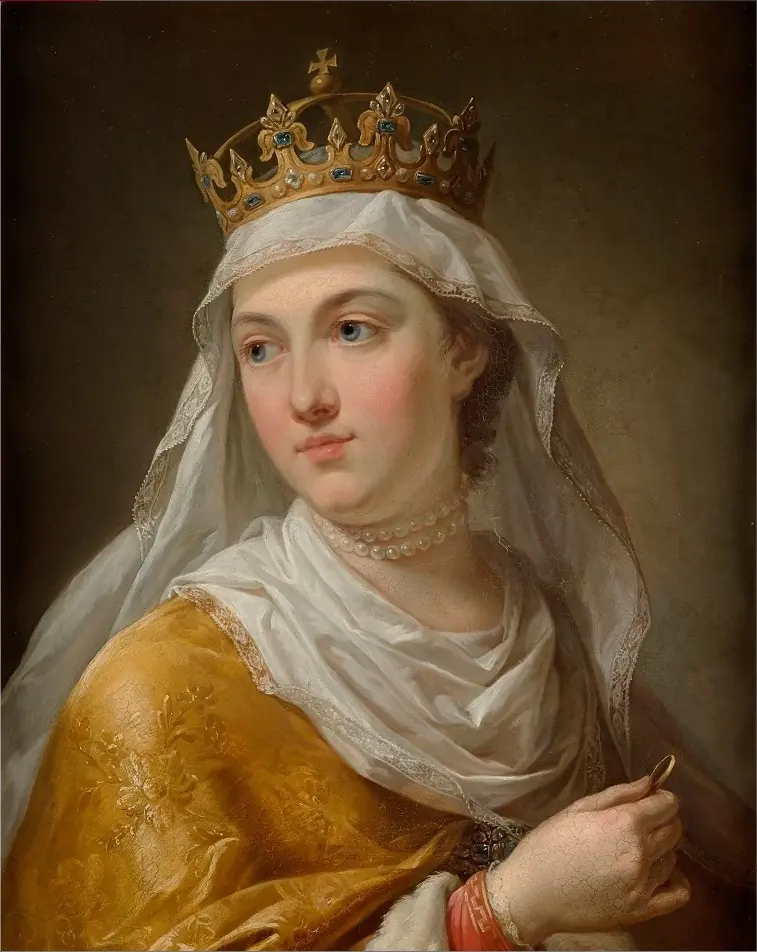
- Crown and royal mantle: she is always shown as a young queen, as in Bacciarelli's portrait.
- Wooden scepter: a sign of the gold scepter she gave to the university.
- Crucifix: the Wawel Crucifix, often painted behind her or with her kneeling before it.
- Bread or alms: her love for the poor and the hospitals she founded.
Painters, especially Jan Matejko, often show her in the great scenes of Polish and Lithuanian history.
Feast day and where she is honored
Her day is July 17, the day of her death. In Poland her memorial is June 8, the anniversary of her canonization at the Błonia meadows in Kraków in 1997. Her relics lie in Wawel Cathedral, under the altar of the Crucified Christ, where she so often prayed. Visit our feast days page for other saints of July.
Prayer to St. Jadwiga
John Paul II ended his canonization homily with this prayer to her:
Our Saint, Queen Hedwig, teach us today, on the threshold of the third millennium, that wisdom and love which you made your path to holiness. Lead all of us, Hedwig, to the Crucified One of Wawel, so that, like you, we may know what it means to love in deed and in truth, what it means to be truly free. Place under your protection your Nation and the Church which it serves, and intercede for us with God, that our joy may never end.
Let us ask St. Jadwiga to pray for Poland and Lithuania, for all who govern, and for students, teachers and the sick in our hospitals.
Frequently asked questions
Who was St. Jadwiga of Poland?
The daughter of King Louis of Hungary and Poland, crowned in Kraków in 1384 as Poland's ruler. She married Jogaila of Lithuania in 1386, which led to the baptism of the Lithuanian nation and founded the Jagiellonian dynasty. She died at about twenty-five, after the birth of her only child.
Is St. Jadwiga the same as St. Hedwig?
Jadwiga is the Polish form of Hedwig, and there are two saints of that name. St. Jadwiga the Queen (died 1399) is this saint. St. Hedwig of Silesia (died 1243), duchess and widow, is honored on October 16.
When is the feast of St. Jadwiga, Queen of Poland?
July 17, the day she died. In Poland her memorial is June 8, the anniversary of her canonization by Pope John Paul II in Kraków in 1997.
Where is St. Jadwiga buried?
In Wawel Cathedral in Kraków. Her remains were placed in a reliquary under the altar of the Crucified Christ, the Wawel Crucifix she prayed before, after her coffin was last opened in 1987.
Keep exploring
Sources
- John Paul II, Homily at the Canonization of Blessed Queen Hedwig, Kraków, June 8, 1997, Vatican. Canonization; her gold scepter given to the university; the hospitals she founded; the prayer quoted on this page
- Kraków: Relikwie św. Jadwigi pojadą na Litwę, dzieje.pl (Polish Press Agency). Her reliquary under the altar of the Crucified Christ in Wawel Cathedral, and the opening of her coffin in 1987 (in Polish)
- From the Faculty of Theology of the Kraków Academy to the John Paul II Pontifical University in Kraków 1397–2009, The Person and the Challenges. The bull of Boniface IX of January 11, 1397, founding the faculty of theology at the request of Jadwiga and Władysław