St. Markella of Chios: Virgin Martyr of Volissos

St. Markella of Chios is a Greek virgin martyr from Volissos on Chios. Tradition says her father was seized by an unnatural desire for her; she fled, and he killed her on the rocks by the sea rather than let her go. The Orthodox Church keeps her feast on July 22, and she is the beloved patron saint of Chios.
Who was St. Markella of Chios?
St. Markella of Chios is a virgin martyr of the Greek Orthodox Church, the patron saint of the island of Chios in the eastern Aegean. She was a young woman of Volissos, a village on the island's northwest coast, and she was killed by her own father on the rocks by the sea because she would not give in to him. The Orthodox Church keeps her feast on July 22, and on that day pilgrims crowd her shrine on the shore.
Her date is not certain. The Orthodox Church in America's life places her some time after the middle of the fourteenth century. Most Greek writers, following St. Nikephoros of Chios, who composed her liturgical service, place her martyrdom around 1500, noting that no shrine or record of her exists before then. Her story comes to us from the tradition of Chios and from the life read in church on her feast.
A daughter of Volissos
Markella was born into one of the wealthiest families of Volissos. Her parents were Christians, and her mother, who loved the Mother of God, taught her to pray, to fast, and to guard her purity. Her mother died while Markella was still young, and her father, the leading man of the village, took charge of her upbringing.
She grew into a young woman everyone in Volissos loved, generous to the poor and faithful at church. She kept her father's house and promised him she would care for him in his old age. In the life read on her feast, her father had little use for the Church and stopped going after his wife died.

Her flight and martyrdom
Then a darkness came over her father. The life describes how the devil, unable to lead Markella into sin, turned to her father and stirred in him an unnatural desire for his own daughter. He grew moody and harsh, forbade her to see the neighbors, and finally told her openly what he wanted. Horrified, Markella prayed before the icon of the Mother of God and avoided him as much as she could. The neighbors sensed that something was wrong and stopped speaking to him.
At last she fled into the hills, where, in the Greek life, a shepherdess friend hid her and shared her bread. Her father rode out after her with a bow and a knife. On a hot July morning she ran down toward the shore and hid in a thorn bush. A shepherd, frightened of the mayor, pointed out her hiding place. Her father set the bush on fire; Markella broke out the other side and ran over the rocks, wounded by his arrow, calling on the Mother of God.
When her strength gave out, she fell to her knees and prayed that the earth would open and take her. The rock split and received her body up to the waist. There her father caught up with her and killed her, striking off her head and throwing it into the sea. The calm sea rose in waves at his feet, and he fled. His end, the life says, is not recorded.
The miracles of St. Markella
Everything the Church remembers of Markella's death and after it is traditional, handed down on Chios and in her service:
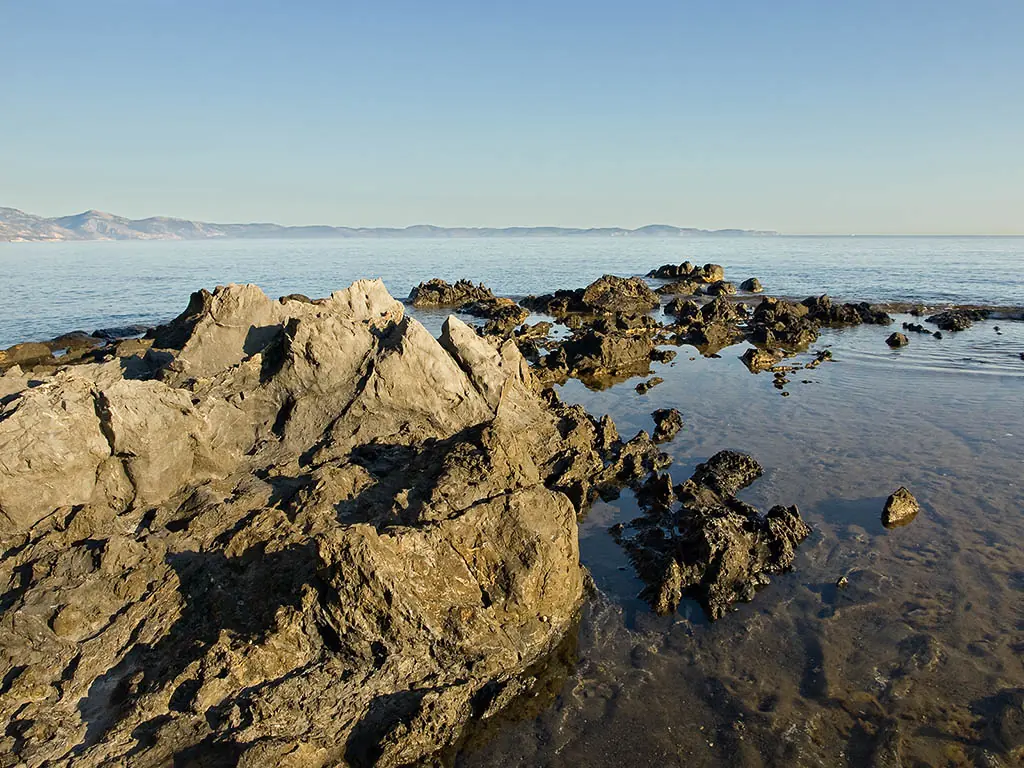
- The split rock: the stone on the shore that opened to shelter her is still shown to pilgrims. Tradition holds that the lower part of her body is enclosed in it.
- The healing spring: from a small opening on the seaward side of that rock, the OCA life says, flows a clear water that heals illness, and the rocks nearby are stained reddish-yellow.
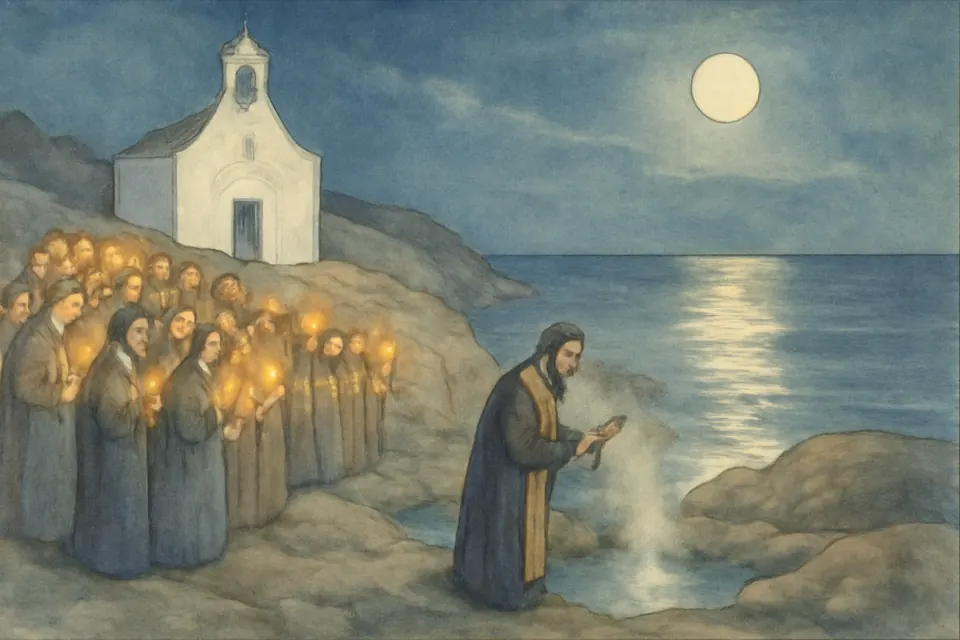
- The mist on her feast: when a priest performs the Blessing of Water at the spot, the life records, a kind of steam rises from the water by the rock and the whole area is covered in mist, and the sea returns to normal when the service ends.
- Her head: Greek tradition says her head floated on the waves shining with light, and a passing ship carried it to Rome.
Many healings are reported at the spring, and pilgrims come from all over Greece and the Greek diaspora.
Why St. Markella is the patron saint of Chios
Markella belongs to her island the way St. Spyridon belongs to Corfu. Chios honors her as its own daughter and patron. Her chapels now stand far beyond Chios, from Santorini to the Greek parish of St. Markella in Astoria, New York.
Her story has a tender meaning for people who have been hurt by someone in their own home. She did not seek death; she fled, and she prayed, and she kept her purity. Many who have suffered abuse find in her a friend who understands.
Symbols of St. Markella in art
Orthodox icons show St. Markella as a young virgin martyr:
- The red maphorion or veil: the color of martyrs' blood, over a dark green or brown robe.
- A small cross: held in her right hand, the sign of every martyr.
- A scroll: often with words from her hymns or her prayer.
- The split rock and the sea: in icons with scenes, the rock that opened for her and the shore of Volissos.
- Christ or angels above: bringing her the crown of martyrdom.
Some modern icons and murals show the martyrdom itself, her father with his sword and Markella kneeling in the rock. In older and simpler icons she stands alone, calm, with cross and scroll.

Feast day and pilgrimage
We keep St. Markella's feast on July 22. On the eve and the day itself, pilgrims fill the monastery on the shore below Volissos for the services, and the priests go down to the rock by the sea to bless the waters. At her chapels across the Greek islands the feast ends, as Greek village feasts do, with a meal, music and dancing. See our feast day calendar.
Prayer to St. Markella
The Orthodox Church sings her apolytikion, the hymn of her feast. It tells how she kept the Lord's teaching blamelessly, fled her father's violence to the mountains, and was struck down by him as a bride of Christ, and it gives glory to God who strengthened and crowned her and works healings through her. The OCA prints the full text on its website.
Let us ask St. Markella to pray for all who are not safe in their own homes, for the people of Chios, and for every young woman who must choose between fear and faithfulness.
Frequently asked questions
Who was St. Markella?
A young Christian woman of Volissos on Chios, the daughter of the village's wealthiest family. After her mother's death her father developed an unnatural desire for her. She fled into the hills, was hunted down by him, and was killed on the seashore near the village. Most Greek writers place her martyrdom about 1500.
When is the feast of St. Markella?
July 22. It is the great feast of Chios, celebrated with services at her monastery on the shore near Volissos and the blessing of the waters at the rock.
What is the miracle of St. Markella's spring?
Tradition says the rock where she fell opened and held her. A spring of water flows from a small opening in that rock, and pilgrims take it for healing. The Orthodox Church in America's life records that when a priest blesses the water at the spot, a kind of steam rises from the pool and mist covers the area until the service ends. These are traditional accounts.
Is St. Markella a Catholic saint?
She is a saint of the Orthodox Church, honored above all on Chios and among Greeks around the world. She is not on the Latin calendar, but Catholics may rightly honor a virgin martyr of the Christian East and ask her prayers.
Keep exploring
Sources
- Orthodox Church in America: Martyr Markella of Chios (July 22). Her life, the split rock, the healing water that flows from it, the tradition that part of her body is in the rock, and the mist at the blessing of the waters
- John Sanidopoulos, The Life and Martyrdom of Saint Markella of Chios (Orthodox Christianity Then and Now). An English life compiled from Greek sources (Metropolitan Dionysios and others); the dating debate, St. Nikephoros of Chios's service placing her about 1500, the tradition of her head carried to Rome, and her apolytikion