The Martyrs of Compiègne
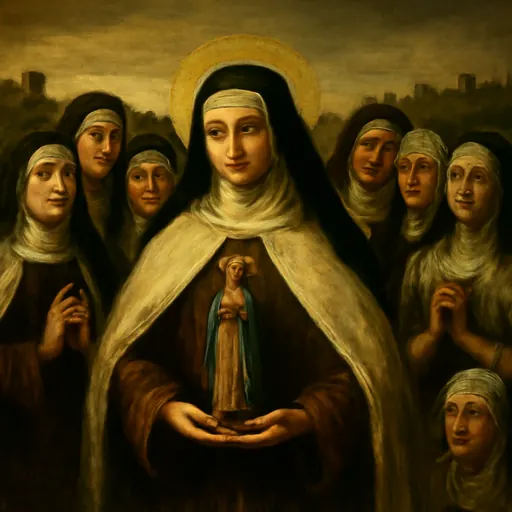
The Martyrs of Compiègne were sixteen Discalced Carmelites guillotined in Paris on July 17, 1794, during the Terror. They had offered their lives for peace in France and the Church, and went to the scaffold singing. Beatified in 1906, they were declared saints by Pope Francis on December 18, 2024. Their feast is July 17.
Who were the Martyrs of Compiègne?
The Martyrs of Compiègne were sixteen women of the Carmel of Compiègne, the Discalced Carmelite monastery of the royal town of Compiègne, north of Paris. Eleven were choir nuns, three were lay sisters, and two were sisters, Catherine and Thérèse Soiron, who were not Carmelites at all but had served the community as externs since 1772. On July 17, 1794, ten days before the fall of Robespierre ended the Reign of Terror, all sixteen were guillotined in Paris. They are honored as St. Teresa of St. Augustine and Companions.
They were the first victims of the French Revolution on whom the Holy See passed judgment, and their story is the true story behind Poulenc's opera Dialogues of the Carmelites.
The sixteen martyrs
The Catholic Encyclopedia gives their names, which we list here so that they are remembered:
- Mother Teresa of St. Augustine (Madeleine-Claudine Lidoine), prioress, born in Paris in 1752
- Mother St. Louis (Marie-Anne Brideau), subprioress
- Mother Henriette of Jesus (Marie-Françoise Gabrielle de Croissy), former prioress
- Sister Mary of Jesus Crucified (Marie-Anne Piedcourt), 78 years old
- Sister Charlotte of the Resurrection (Anne-Marie-Madeleine Thouret), sacristan, also 78
- Sister Euphrasia of the Immaculate Conception (Marie Claude Cyprienne Brard)
- Sister Teresa of the Holy Heart of Mary (Marie-Antoinette Hanisset)
- Sister Teresa of St. Ignatius (Marie-Gabrielle Trézel)
- Sister Julie Louise of Jesus (Rose Chrétien de la Neuville), a widow
- Sister Mary Henrietta of Providence (Anne Petras)
- Sister Constance of St. Denis (Marie-Geneviève Meunier), the novice, about 29
- Sister Mary of the Holy Spirit (Angélique Roussel), lay sister
- Sister St. Martha (Marie Dufour), lay sister
- Sister St. Francis Xavier (Juliette Vérolot), lay sister
- Catherine Soiron and Thérèse Soiron, externs
Their story
The convent closed
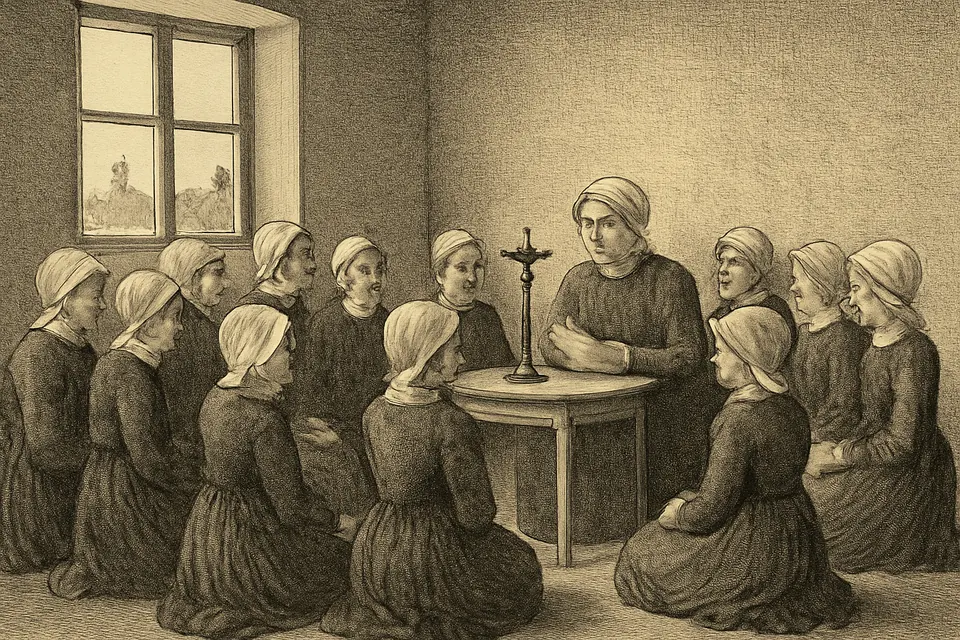
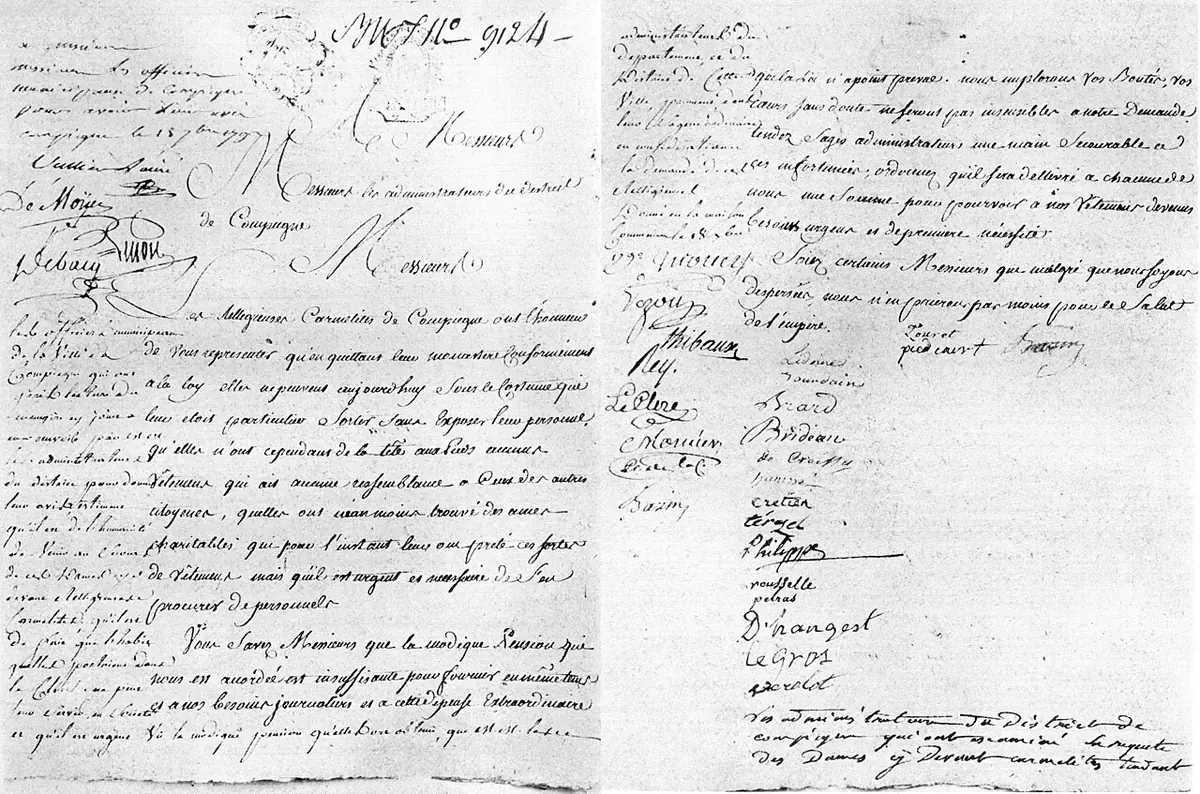
In 1790 the revolutionary government suppressed religious vows. Officials came to the Carmel and asked each nun if she wished to leave; every one refused. In September 1792 the community was expelled. The sisters put on secular clothes and went to live in four small groups in houses in the town, still praying the Divine Office together as best they could.
The act of offering
Around this time Mother Teresa of St. Augustine proposed that the community offer itself to God as a sacrifice. The Postulation of the Discalced Carmelites describes it as an offering of their lives as victims of atonement for peace in the Church and in France. The sisters renewed it daily.
Arrest and trial
In June 1794 the authorities searched their lodgings, found letters and signs that they were still living as a community, and arrested them. They were held in Compiègne, where the Thicket Priory Carmel records that they offered themselves daily for the peace of France and the Church, then taken to the Conciergerie prison in Paris. On July 17 they were tried before the Revolutionary Tribunal and condemned to death, according to the Carmelite Postulation, for their fidelity to the Church and their religious life and for their devotion to the Sacred Hearts of Jesus and Mary. They wore their forbidden habits that day, Thicket Priory notes, because their only secular clothes were being washed.
The scaffold
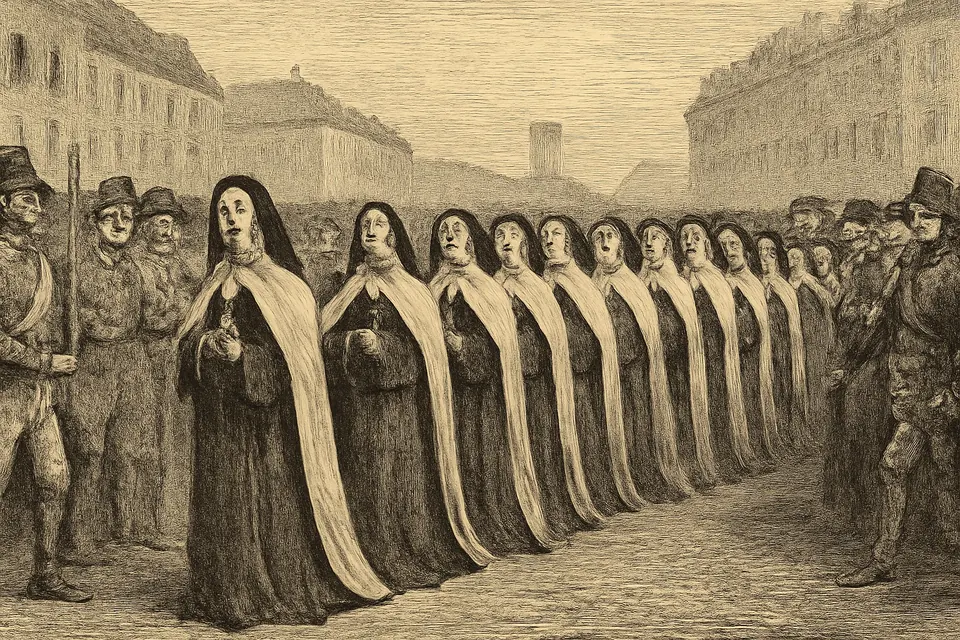
That evening they were driven across Paris in carts to the Place du Trône-Renversé, now the Place de la Nation, chanting the Office on the way. At the foot of the scaffold they knelt and sang the Veni Creator Spiritus, as at a religious profession, and renewed aloud their baptismal and religious vows. Then each sister came forward, knelt before the prioress, asked permission to die, and climbed the steps. The novice, Sister Constance, went first, singing Laudate Dominum, "O praise the Lord, all ye nations," Psalm 117 (116 in the Latin numbering). The prioress went last. Sister Mary of Jesus Crucified, 78 years old, said to the executioners, "I forgive you as heartily as I wish God to forgive me." The Catholic Encyclopedia records that absolute silence fell over the crowd while the executions went on.
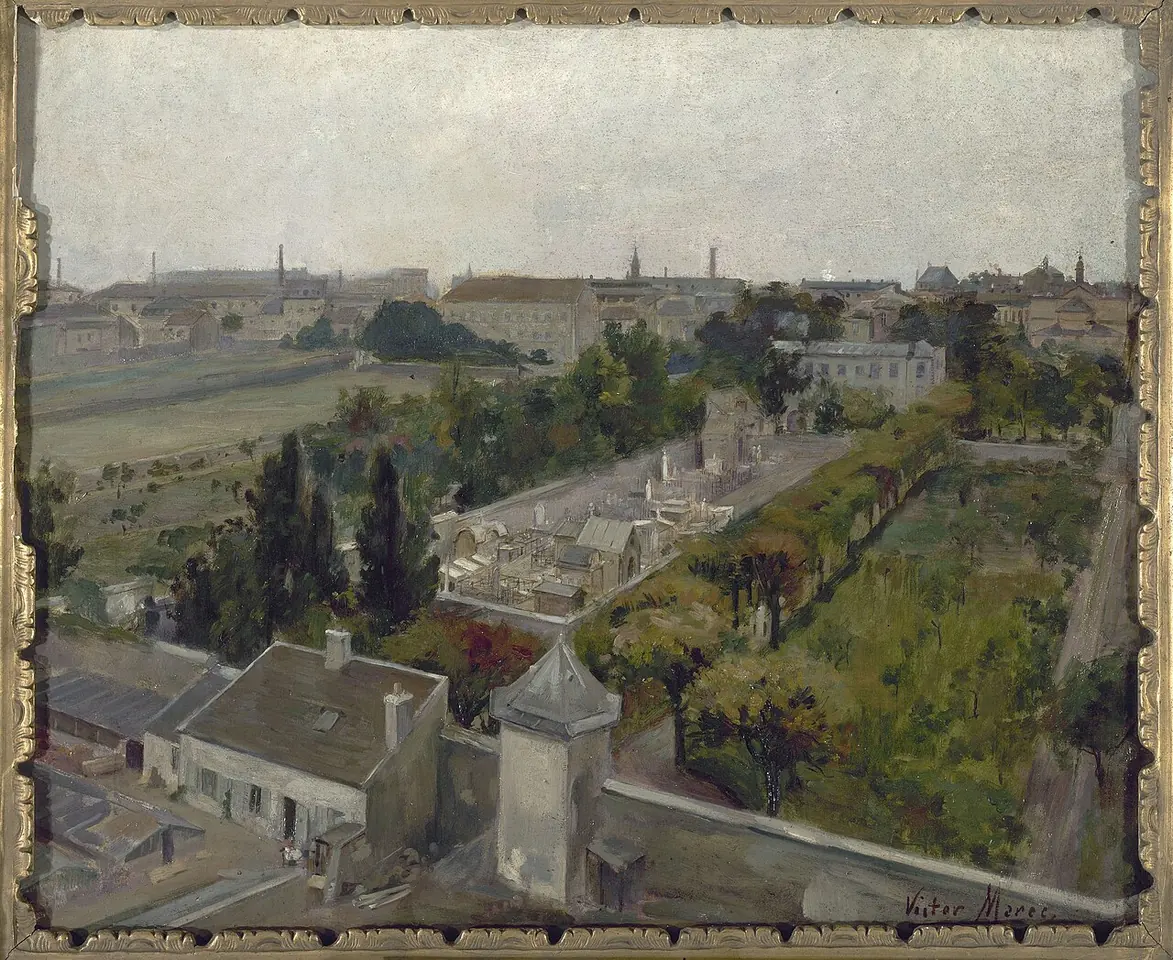
Their bodies were thrown into a sandpit at Picpus, on the eastern edge of Paris, with those of 1,298 victims of the Terror. No relics of their bodies have ever been recovered. Eleven days later Robespierre himself went to the guillotine, and the Terror ended.
The miracles and canonization of the Martyrs of Compiègne
Pope Pius X declared them martyrs in 1905 and beatified them on May 27, 1906. The Catholic Encyclopedia lists four cures proved during the beatification process, each approved: Sister Clare of St. Joseph, a Carmelite lay sister of New Orleans, cured of cancer when near death in June 1897; the Abbé Roussarie of the seminary at Brive, cured at the point of death on March 7, 1897; Sister St. Martha of St. Joseph, a Carmelite of Vans, cured of tuberculosis and an abscess of the leg on December 1, 1897; and Sister St. Michael, a Franciscan of Montmorillon, cured on April 9, 1898.
On December 18, 2024, Pope Francis extended their cult to the whole Church by equipollent canonization, a papal decree that declares saints without the usual canonization ceremony.
Symbols of the Martyrs of Compiègne in art
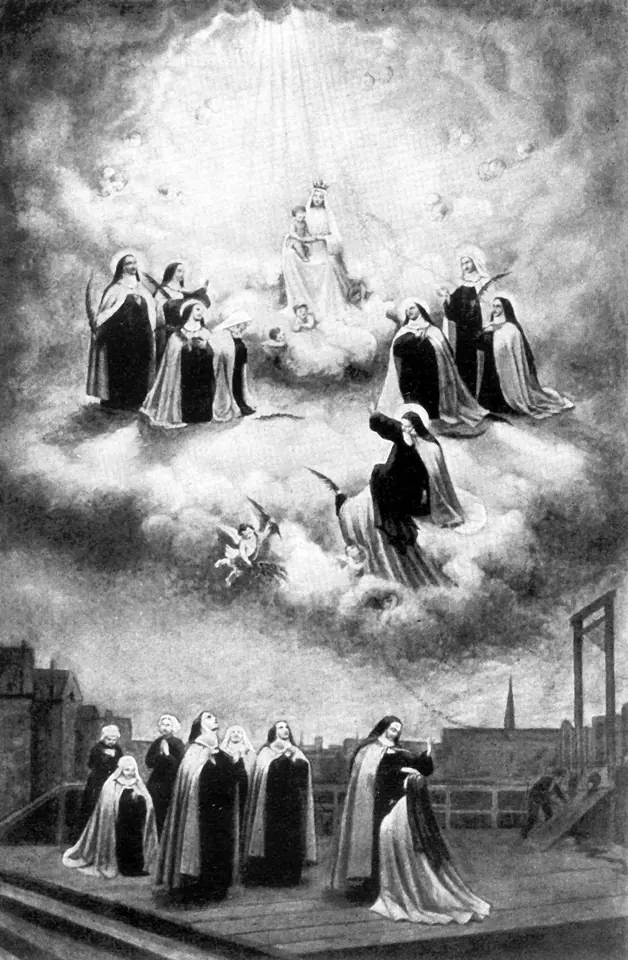
In paintings and holy cards the martyrs appear as a group of Carmelite nuns in brown habits, black veils and white mantles, usually standing or kneeling calmly near a scaffold. Look for:
- The Carmelite habit: the brown tunic and white cloak of Our Lady of Mount Carmel's order.
- Palms: the sign of martyrdom, often held by the sisters or offered by angels.
- The prioress before her sisters: often holding a small statue of the Virgin, receiving each one before she climbs the steps.
- The scaffold or guillotine: usually in the background, never with violence shown.
- Clouds and glory: in devotional prints of 1906, the sisters rise toward the Virgin and Child.
Feast day and where they are honored
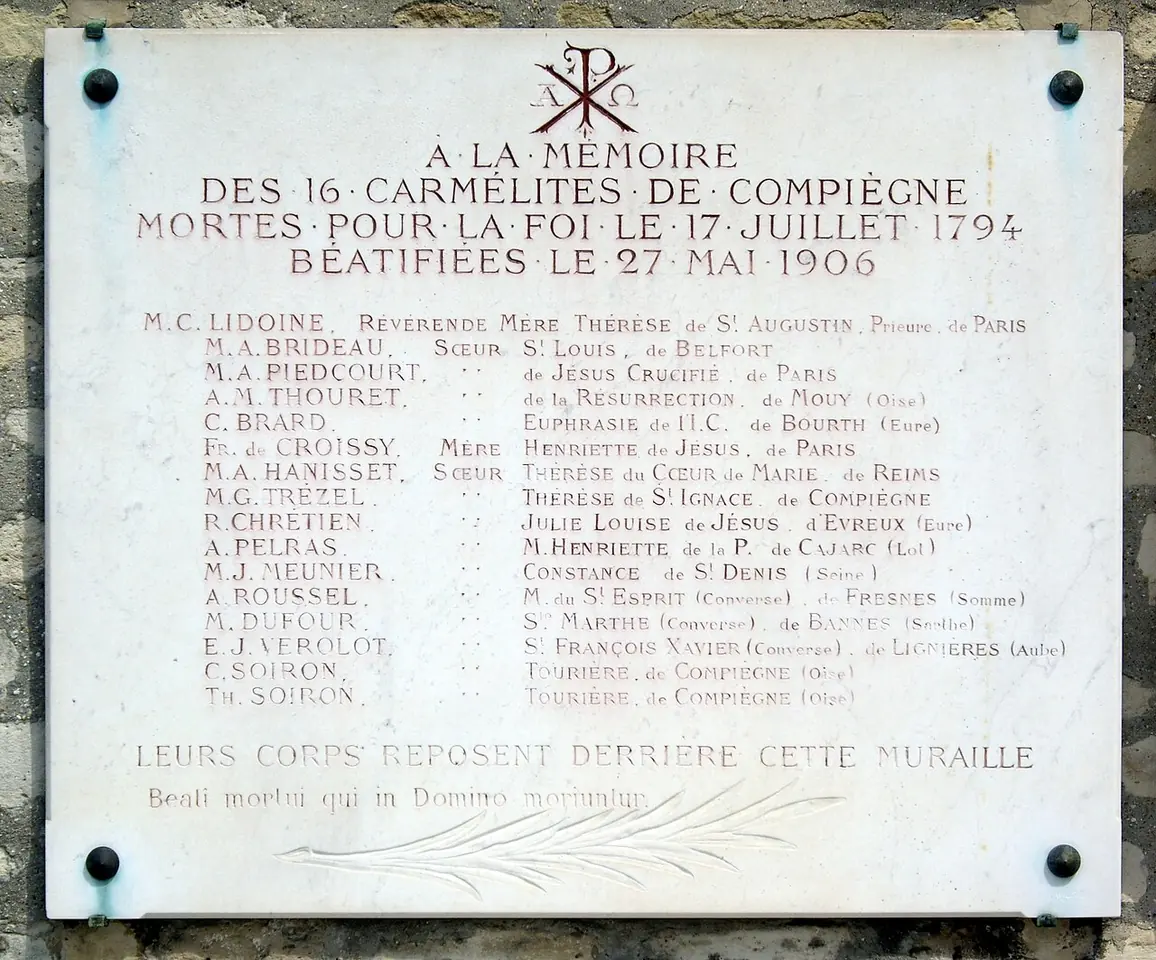
We keep their feast on July 17, the day of their martyrdom; see their neighbors on our feast days page. The Carmelites celebrate it as an obligatory memorial. At Picpus Cemetery, a marble plaque on the wall above the common grave lists their names. Five secondary relics, pieces of the clothing they left behind, are kept by the English Benedictine nuns of Stanbrook.
Prayer to the Martyrs of Compiègne
The sisters' own prayers were the Church's: the Veni Creator, the Salve Regina and the Psalms of the Office they chanted to the end. We have not found a short traditional English prayer to them that we can source, so we pray with the hymn they sang at the scaffold, the ninth-century Veni Creator Spiritus, which begins in Latin:
Veni, Creator Spiritus,
mentes tuorum visita
"Come, Creator Spirit, visit the minds of those who are yours."
Let us ask St. Teresa of St. Augustine and her companions to pray for the persecuted Church, for France, and for all religious, that we too may be faithful to the end.
Frequently asked questions
Who were the Martyrs of Compiègne?
Sixteen members of the Discalced Carmelite monastery of Compiègne, north of Paris, led by their prioress, Mother Teresa of St. Augustine. They were arrested in June 1794 for continuing their religious life after the Revolution had dissolved their convent, were condemned in Paris, and were guillotined together on July 17, 1794.
Are the Martyrs of Compiègne saints?
Yes. Pope Pius X beatified them on May 27, 1906. On December 18, 2024, Pope Francis extended their cult to the universal Church by equipollent canonization, a papal decree that declares saints without the usual canonization ceremony.
What did the Martyrs of Compiègne sing on the way to the guillotine?
Accounts agree that they sang hymns and psalms on the way and at the scaffold. The Catholic Encyclopedia says they knelt and chanted the Veni Creator, as at a religious profession, and renewed their vows. Other accounts add the Miserere, the Salve Regina and the Te Deum, and say the young novice Sister Constance climbed the steps singing Laudate Dominum.
Is Dialogues of the Carmelites a true story?
It is based on one. Francis Poulenc's opera (1957) comes from Georges Bernanos's play, which grew out of Gertrud von Le Fort's 1931 novella The Song at the Scaffold. The martyrdom is real; the main character, Blanche de la Force, was invented by Le Fort.
Keep exploring
Sources
- John B. Wainewright, The Sixteen Blessed Teresian Martyrs of Compiègne, Catholic Encyclopedia (1912). Names, birthplaces and professions; the Veni Creator and renewal of vows; Sister Mary of Jesus Crucified's words; the Picpus pit of 1,298 victims; the four cures proved for the beatification; the Stanbrook relics
- Postulation General of the Discalced Carmelites: Martyrs of Compiègne (Teresa of St. Augustine and 15 Companions). Their offering as victims for peace, the arrest of June 24, 1794, the decree of martyrdom (1905) and beatification (1906)
- EWTN News / CNA: Pope Francis declares French Martyrs of Compiègne saints via equipollent canonization (December 18, 2024)
- Thicket Priory Carmel: The Martyrs of Compiègne. The habits worn to the trial, the chanted Office on the way, and the relics of their clothing at Stanbrook Abbey