St. Amalberga of Temse, the Virgin of the Sturgeon

St. Amalberga of Temse (about 741–772) was a Flemish noblewoman who, the old story says, refused to marry the young Charlemagne, clung to a chapel altar when he tried to carry her off, and gave her life to God as a nun. Flemish tradition remembers her crossing the Scheldt River on the back of a great sturgeon. We keep her feast on July 10, and she is invoked against fever and pains in the arms and shoulders.
Who was St. Amalberga of Temse?
St. Amalberga of Temse was a young noblewoman of Flanders in the eighth century who gave herself to Christ and would not be moved, not even by a future emperor. Her family held the estate of Temse on the Scheldt River, between Ghent and Antwerp. She died about the year 772, barely past thirty, and the people of the river towns have loved her ever since. In Flemish she is Sint-Amelberga, and you will also find her as Amelberga, Amalburga or Amelia.
We keep her feast on July 10. The Roman Martyrology gives her a single line on that day: "At Ghent, St. Amelberga, virgin."
Her story comes to us through medieval Lives written long after her death, and they were gathered by the Bollandists in the Acta Sanctorum for July. Much of it is legend, and the chronology tangles easily. One writer makes her the niece of St. Gertrude of Nivelles and St. Begga, who lived a century earlier; another sends her for advice to St. Willibrord, who had died before she was born. What stands firm is a woman who chose Christ over a crown, and a people who never forgot her.
The suitor at the altar
The best-known story is about a royal marriage. The Catholic Encyclopedia tells it this way: she "is said to have been sought in marriage by Charles, afterwards Charlemagne." She refused again and again. At last Charles came in person and tried to carry her off by force. She ran into a chapel and threw herself down before the altar. He seized her arm and pulled so hard that he broke it, "he was unable to move her from the altar before which she had prostrated herself."
Agnes Dunbar, summarizing the Bollandists in 1904, notes that some versions name Charles Martel, or his son Pepin seeking her for his son Charles, and that the broken arm was an accident in his anger. Every version agrees on the ending: the royal suitor gave up, and Amalberga was left in peace. The Catholic Encyclopedia adds that Charles fell ill for his rudeness and was cured through her prayers.

A nun of Munsterbilsen
According to her Life, she then took the veil at the convent of Bilsen (Munsterbilsen, in today's Belgian Limburg), and she may later have led a community of women on her own lands, which is why some images give her an abbess's staff. She died, the Catholic Encyclopedia says, on July 10, "in her thirty-first year, five years after Charles had ascended the throne." Since Charlemagne became king in 768, that places her death about 772. Her body was carried down to Temse to be buried.
The miracles and legends of St. Amalberga
None of these has been examined by the Church. They are traditional, handed down in the Lives and in Flemish devotion:
- The sturgeon. Wanting to cross the Scheldt and finding no boat, she was carried over on the back of a great sturgeon. Dunbar records that the fishermen of the place used to bring a sturgeon to her chapel every year on July 10, and that a flock of sturgeons was said to escort the boat that carried her body to Temse.
- Fish in the famine. Twice in her life, the legend says, large fish appeared in the river in time of famine and fed the hungry.
- The well and the sieve. When the people of Temse complained that their only well stood in the field of a difficult owner, she carried water in a sieve to another field and set it down. A spring rose there, and the old well dried up. Pilgrims long came to her well and chapel asking for healing.
Many cures were credited to her prayers, and Flemish Catholics invoked her against fever, bruises and pains in the arms and shoulders. The last surely comes from the story of her broken arm.
Two saints named Amalberga
Be careful with the name. The Catholic Encyclopedia speaks of "very great confusion" in the records. There is an older St. Amalberga of Maubeuge, a married woman of the seventh century, the mother of St. Gudula of Brussels and St. Reineldis, who became a nun with her husband's blessing. Amalberga of Temse, our saint, was a virgin a century later. Both are kept on July 10. A third Amalberga, a virgin honored at Susteren, adds to the muddle. Calendars and holy cards mix them freely, so check the dates.
Symbols of St. Amalberga in art
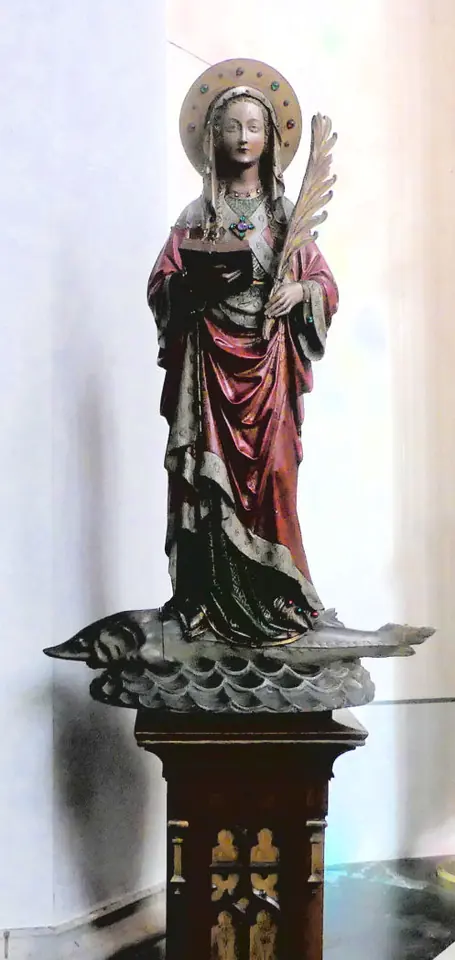
Amalberga is easy to spot once you know the fish:
- A sturgeon or large fish under her feet, for the crossing of the Scheldt. In Charles Cahier's 1867 engraving below, she stands on its back like a raft.
- A book and a palm, for a consecrated virgin and her faithful life. The palm is usually a sign of a martyr; here it marks her victory over the world.
- An abbess's staff, because she was believed to have led a community.
- A sieve, for the legend of the well. Dunbar suggests it may also be a pun on Temse, close to the French tamis, "sieve."
- Geese, which really belong to a different Amalberga kept in December, crept into some of her pictures by confusion.
A Bollandist engraving that Dunbar describes shows her standing on a crowned king lying flat on the ground, with a fish on either side, a well and a flock of geese behind.

Her relics and feast at Temse and Ghent
In 870, in the time of Baldwin Iron Arm, first count of Flanders, her body was moved from Temse to the Abbey of St. Peter on Mont Blandin in Ghent, where she joined the city's other great saint, St. Bavo. That is why the Martyrology lists her "at Ghent." The Church of Our Lady in Temse, whose founding local tradition credits to her, keeps a relic in a silver shrine crowned with her image and her fish.

Prayer to St. Amalberga
We know of no traditional prayer to St. Amalberga in wide use in English, and we will not invent one in her name. Let us ask her simply to pray for us: for the sick who burn with fever, for anyone in pain, and for every young person tempted to trade their heart for comfort or a good match, that they may cling to Christ as she clung to the altar. See the feast day calendar for the other saints of July.
Frequently asked questions
Who was St. Amalberga of Temse?
An eighth-century virgin of Flanders who owned the estate of Temse on the Scheldt, refused a royal marriage, became a nun, and died young, about 772. Her body was later taken to St. Peter's Abbey in Ghent.
When is the feast of St. Amalberga?
July 10. The Roman Martyrology lists her that day as "St. Amelberga, virgin" at Ghent. An older St. Amalberga, a widow and the mother of St. Gudula, shares the same day.
Why is St. Amalberga shown with a fish?
Because of the legend that a huge sturgeon carried her across the Scheldt when she found no boat. Fishermen at Temse once brought a sturgeon to her chapel on her feast in memory of it.
Is Amalberga of Temse the same as Amalberga of Maubeuge?
No. Amalberga of Maubeuge was a seventh-century wife and mother who became a nun. Amalberga of Temse was a virgin who lived about a century later. The Catholic Encyclopedia notes "very great confusion" between them, and a third Amalberga appears later still.
Keep exploring
Sources
- Catholic Encyclopedia (1907): St. Amalberga (the virgin). Charles's suit, the broken arm at the altar, her death in her thirty-first year
- Catholic Encyclopedia (1907): St. Amalberga (the widow). The confusion between the two saints and a third Amalberga; both kept on July 10
- Agnes B. C. Dunbar, A Dictionary of Saintly Women, vol. 1 (1904), at archive.org. Her patronages, the sturgeon, the well, the translation to Ghent in 870, and how she is shown in art (pp. 50–51)
- The Roman Martyrology in English, July (Boston Catholic Journal). July 10: "At Ghent, St. Amelberga, virgin."