St. Kilian, Irish Bishop and Martyr of Würzburg
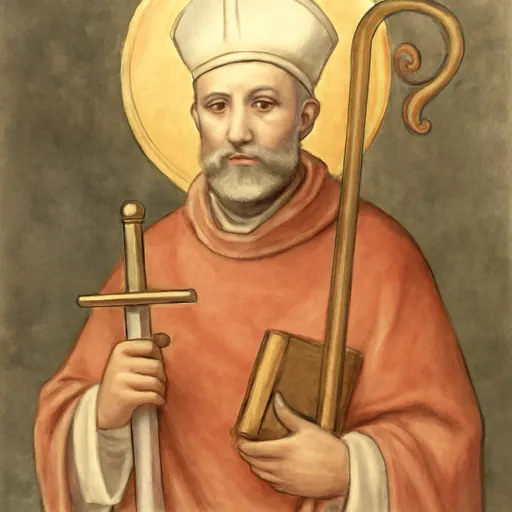
St. Kilian was a 7th-century Irish monk and missionary bishop who preached in Franconia and was killed at Würzburg about 689 with his companions Colman and Totnan. Tradition says he died for telling Duke Gozbert his marriage to his brother's widow was unlawful. His feast day is July 8, and he is the patron saint of Würzburg and Franconia.
Who was St. Kilian?
St. Kilian was an Irish monk and bishop who left his homeland in the 680s to preach Christ in the forests and river valleys of Franconia, the region around Würzburg in today's northern Bavaria. He made Würzburg, then a ducal castle on the river Main, the center of his mission and baptized Duke Gozbert and many of his people. In about 689 he was killed there with two companions, the priest Colman and the deacon Totnan. Franconians have honored the three ever since as the Frankenapostel, the apostles of Franconia, and we keep their feast on July 8.
This page is about the saint. The name Kilian is common in Ireland and Germany and belongs to many other people and things today; the St. Kilian of the Church calendar is this 7th-century missionary.

Very little about his life can be checked against outside records. Nearly everything we know comes from two Latin accounts of his martyrdom written in Würzburg in the generations after his death, and from the cult that grew up around his grave. This article follows those accounts and says plainly where history ends and legend begins. What no one questions, as the Catholic Encyclopedia puts it, is that he worked as a missionary in eastern Franconia and died a martyr there.
The sources for his life
Two texts tell Kilian's story, both called the Passio Kiliani. The older and shorter one, the Passio minor, opens with the words "Fuit vir vitae venerabilis Killena nomine," "there was a man of venerable life named Killena." The Diocese of Würzburg dates it to the 8th century, and the Catholic Encyclopedia connects it with the solemn raising of the relics in 752, which would make it the work of people who knew men who remembered him. The longer Passio maior, from the 9th century, retells the same story with more detail and more miracles, and where the two disagree the older one is the safer guide.
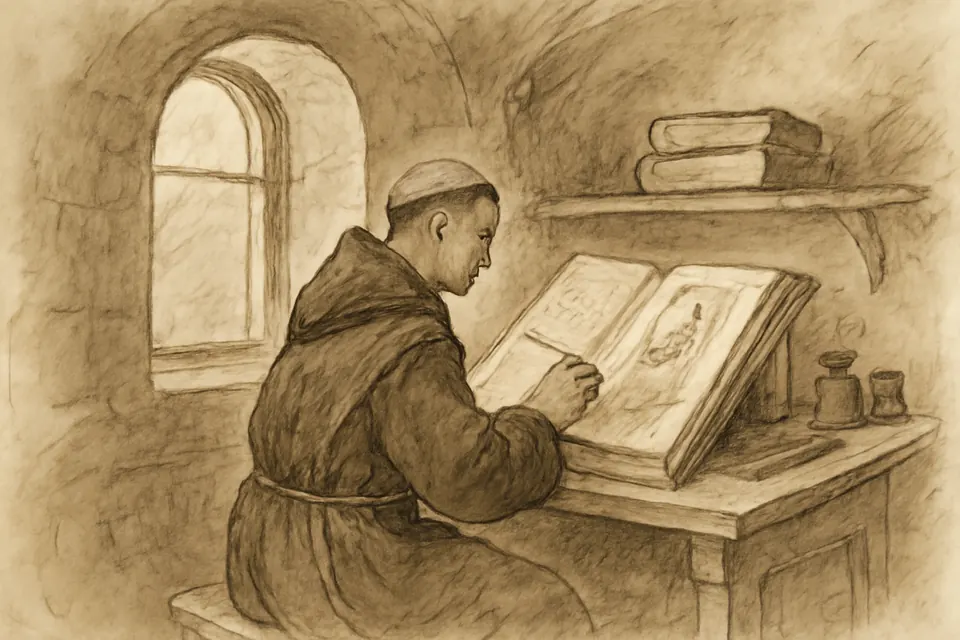
Other early witnesses are brief. A Würzburg necrology of the 8th century and the martyrology compiled by Hrabanus Maurus at Fulda in the 840s both record his death. The Irish Martyrology of Tallaght, from around 800, also names him. The Diocese of Würzburg notes that both Passiones follow the pattern of stories about wandering bishops and so idealize their hero, and that some historians doubt parts of them, including whether Kilian was ever consecrated a bishop. The diocese itself, and the old Catholic scholars it follows, accept the core of the account.
The life of St. Kilian
An Irish monk
Kilian was born around 640 to a noble family. The older Passio calls his homeland Scottia, which in the early Middle Ages meant Ireland; the later one says outright, "Scotia, which is also called Hibernia." Irish tradition, kept today by the people of Mullagh in County Cavan, places his birth at Cloughballybeg near Mullagh. His Irish name was probably Cillín or Ceallach, and Irish calendars spell it Cillian.
Later Irish tradition says he studied at the monastic school of Rosscarbery in County Cork and finished his training at Tuosist in County Kerry, near Kenmare, where he may have founded a small community of his own. A later writer, the abbot Trithemius, made him a monk of Iona, the island monastery of St. Columba, and even its abbot, but the Catholic Encyclopedia calls that a supposition that cannot be proved.
The older Passio says Kilian was made a bishop before he left Ireland. That fits Irish practice at the time. Irish bishops often had no fixed diocese and served under the authority of a monastery, traveling where they were needed. The Diocese of Würzburg calls him a "Regionalbischof," a regional or traveling bishop.
Leaving home for Christ
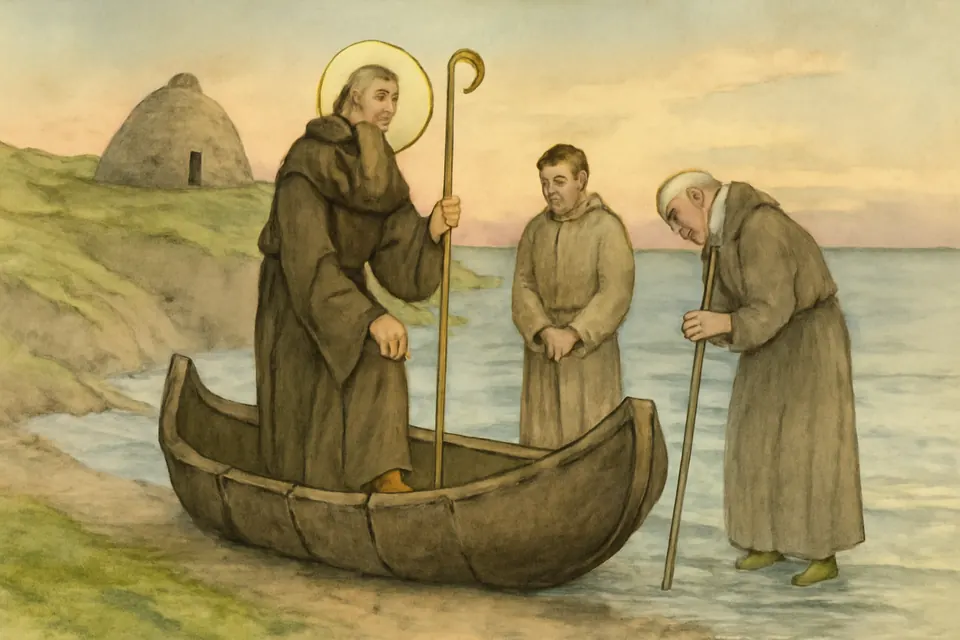
Kilian belonged to the great movement of Irish monks who left home for the love of Christ, which they called peregrinatio pro Christo, pilgrimage for Christ. They took Abraham as their model, who left his country at God's word without knowing where he was going. Before Kilian, St. Columbanus had founded monasteries in France and Italy, and St. Gall had settled in the Alps. Kilian took the same road.
Tradition in County Kerry says he sailed from Kilmakilloge harbor on the Kenmare River. The Catholic Encyclopedia says he left with eleven companions, making twelve in all, the number of the apostles. The Würzburg diocese reports the Irish tradition that they landed and made their way up the Main by Aschaffenburg to Würzburg.
Würzburg and the journey to Rome
Würzburg in the 680s was the seat of Gozbert, a duke ruling the region for the Frankish kings. The Catholic Encyclopedia says he and his people were still pagan. The Diocese of Würzburg paints a more mixed picture: Christianity had been reaching the Main valley through the Franks since the 6th century, and the ducal family may have been baptized once and then let the faith lapse. Either way, the land needed preachers, and the Irish were welcomed also for their skill in farming, forestry and keeping livestock.
Before beginning his work, Kilian went to Rome to ask the pope for a mission. He hoped to find Pope John V, but John had died in August 686, and Kilian received his faculties from the new pope, Conon. The Catholic Encyclopedia places the journey in the summer and autumn of 686. The later Passio says Kilian was consecrated bishop in Rome; the older one says he was already a bishop.
On the way back the group split up. Some went to look for other mission fields. Kilian returned to Würzburg with two companions, the priest Colman (Kolonat in German) and the deacon Totnan, whose Irish name may have been Tadhg. Würzburg became their base for preaching through eastern Franconia and into Thuringia.
The duke's baptism
The Passio says Kilian's preaching moved Duke Gozbert to ask for baptism, and many of his subjects followed him to the font. A mountain in the Rhön hills keeps its own memory of the mission. Local tradition at the Kreuzberg, "the holy mountain of the Franconians," says Kilian overturned a pagan altar there in 686 and set up a cross. The Würzburg diocese passes this on as tradition only.
The martyrdom of St. Kilian, Colman and Totnan
Geilana and the duke's marriage
Gozbert was married to Geilana, the widow of his brother. Such marriages were an old custom among the Germanic peoples, but the Church forbade them, following Leviticus 18:16. According to both Passiones, once the duke was baptized Kilian told him that his marriage was unlawful, and Gozbert promised to separate from her.
The Archdiocese of Paderborn points out that the old writers saw in this a parallel to St. John the Baptist, who was beheaded for telling Herod Antipas he could not have his brother's wife. The resemblance is real, and it may have shaped how the story was told. It is also the kind of thing a missionary bishop of that age would plainly have done.
Death at night prayer
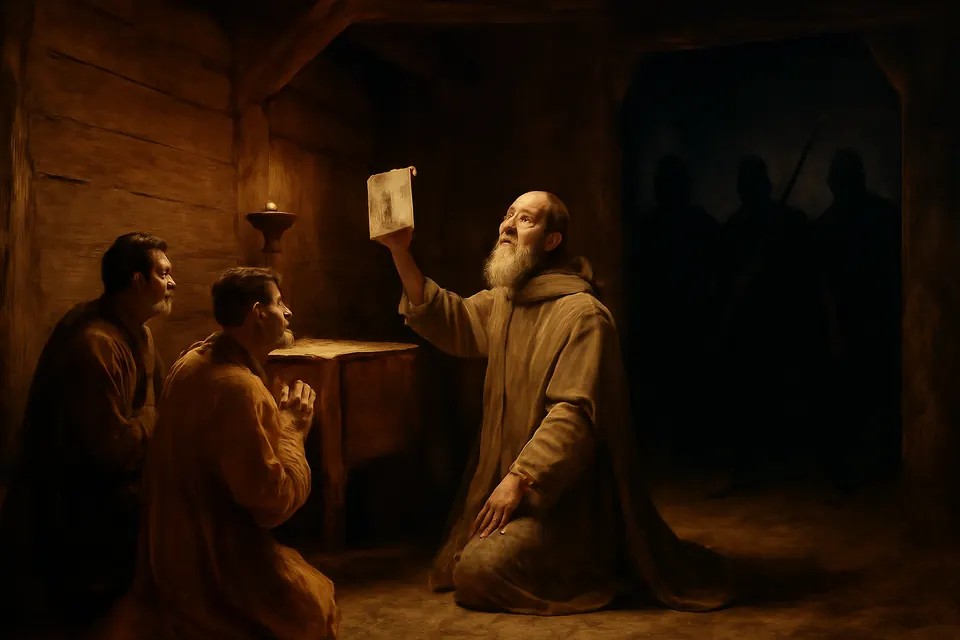
Geilana did not convert and did not forgive. The Catholic Encyclopedia, summarizing the early accounts, says she waited until the duke was away on campaign and then had the three missionaries secretly murdered. Their bodies were buried at once, on the spot, together with their chalice, vestments and books. The Diocese of Würzburg adds the details the Würzburg tradition loves: the killers found the three monks at night prayer in their cell, and the monks held up the Gospels against the drawn swords.
The year is usually given as 689 and the day as July 8, though the Catholic Encyclopedia notes that opinions on the year vary. The sources also disagree about who gave the order. The Passiones blame Geilana; the martyrology of Hrabanus Maurus blames the duke. The Paderborn article sums it up: the legends differ on whether it was Gozbert or Geilana, but either way Kilian and his companions died by the sword.
What the Passio says happened next
When Gozbert returned and asked where the missionaries had gone, Geilana said she did not know. Then, the early account says, the killer went mad, confessed and died miserably, and Geilana herself died insane. The later tradition reported by the Würzburg diocese adds that the murderers built a horse stable over the grave and the horses would not enter it. Some versions also say Gozbert was later killed himself. These details belong to the legend. The Catholic Encyclopedia, which defends the older Passio strongly, still admits that critics have questioned its account of the cause and circumstances of the deaths.
From a hidden grave to the cathedral
For more than fifty years after their deaths, the three martyrs lay in an unmarked grave. Their mission did not continue in any organized way. When the Anglo-Saxon missionary St. Boniface came to Thuringia in the 8th century, the Catholic Encyclopedia says, he still found traces of Kilian's work.
In 742 Boniface founded the Diocese of Würzburg and made his fellow Englishman Burchard its first bishop. The Catholic Encyclopedia says reports of cures at the burial place had already made it famous. Burchard raised the remains in 743 and laid them in the Church of Our Lady on the hill across the river, where the fortress of Marienberg now stands. With permission from Pope Zachary for their public veneration, he brought them back in a solemn translation, probably on July 8, 752. That date, the anniversary of the martyrdom, became the feast. In 788 the relics went to the new cathedral of the Savior, and the Diocese of Würzburg thinks the bodies were given to the Neumünster church around the 11th century, while the skulls stayed in the cathedral.

The Kilian Gospels
A book came out of the grave with them, or so Würzburg has believed for centuries. The Catholic Encyclopedia says Kilian's New Testament was kept in the cathedral treasury until 1803, when it passed to the university library. The library's catalog describes it as a Gospel book written in uncial script in several hands, with corrections and lectionary notes of the 7th or 8th century. Its silver cover dates from Bishop Lorenz von Bibra (1495 to 1519) and frames an ivory plaque carved at the Michelsberg monastery in Bamberg around 1090. The ivory shows the beheading of the three apostles of Franconia, with a vine and a tree springing from their blood and angels carrying their souls to heaven.
The Diocese of Würzburg passes on a tradition that the dark spots on the book's cover come from the martyrs' blood. Historians date the manuscript itself to the 7th century, which at least fits the story. We can't know for certain that Kilian held it, but it is very old, and Würzburg has treasured it as his for more than a thousand years.
The miracles of St. Kilian
No miracle connected with Kilian has been examined by the Church in the modern way. He died about nine centuries before formal canonization existed. Sorted by this encyclopedia's labels:
- Cures at the grave: traditional. The Catholic Encyclopedia says "wonderful cures" brought renown to the burial place before Burchard raised the relics.
- Lights over the grave: traditional. The Würzburg tradition says miraculous lights moved Burchard to bring the relics back to the place of martyrdom.
- The madness of the killer and of Geilana: traditional, from the older Passio. It is told as a judgment, not a miracle of healing.
- The horses that refused the stable: traditional, from the later Würzburg legend.
- The overturned altar on the Kreuzberg: traditional, a local story the Würzburg diocese reports as "supposed traces" of Kilian.
- Answered prayers: reported. Generations of pilgrims have come to Würzburg for the Kiliani blessing with the relics. The diocese records that up to 40,000 people took part in each Kiliani pilgrimage between 1936 and 1940. Their testimonies have not been examined by the Church.
Why St. Kilian is the patron saint of Würzburg and Franconia
- Würzburg and Franconia: he preached the faith there first, and died there. The Diocese of Würzburg calls Kilian, Colman and Totnan its patrons and the apostles of Franconia, and nearly fifty churches in the diocese are dedicated to him, in places such as Schweinfurt, Hassfurt and Aschaffenburg.
- Paderborn Cathedral: Paderborn in Westphalia began as a missionary diocese under Würzburg after 799, and its first bishop, Hathumar, was trained in Würzburg. The Archdiocese of Paderborn says that link is why Kilian, with Our Lady and St. Liborius, is a patron of its cathedral. His wooden figure stands at its south portal.
- Whitewashers and plasterers: the Diocese of Würzburg names him patron of the Tüncher, the whitewashers. The reason is not recorded.
- Rheumatism, gout and eye ailments: German folk devotion has long invoked him for these. Again, no story explains the custom.
- Tuosist, County Kerry: the parish honors him as its patron because Irish tradition says his voyage began from its harbor. A church at Lauragh is dedicated to him, and a pattern day is held at his holy well every July 8.
Viktor von Scheffel's Frankenlied made him a patron of winemakers too, but that is poetic license, a natural guess in one of Germany's great wine regions. See all the patron saints by cause.
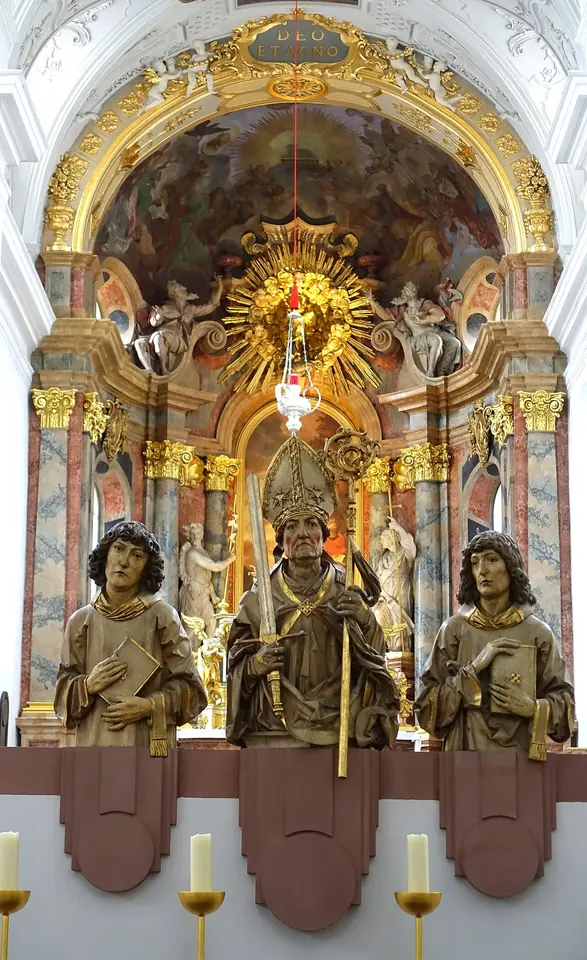
Symbols of St. Kilian in art
Kilian is easy to recognize once you know what to look for, and in Franconia you will see him everywhere: in churches, on fountains, on bridges and on the city seal of Würzburg.
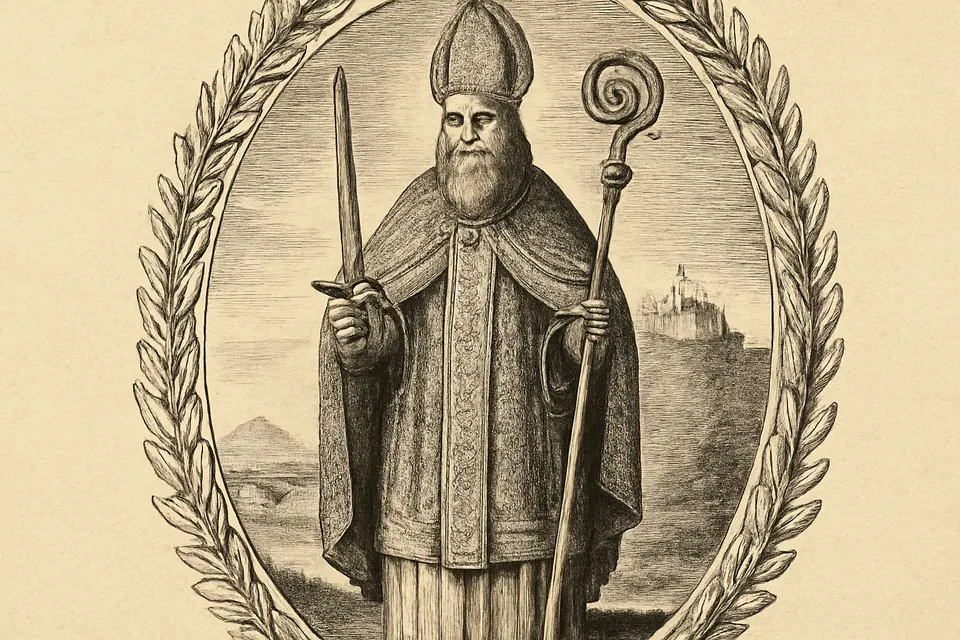
- Bishop's miter and crozier: he is almost always dressed as a bishop, in keeping with the Passio. The crozier is his pastoral staff.
- A sword: the instrument of his martyrdom. He may hold it upright, rest it over his shoulder or hold it by the blade. The Diocese of Würzburg names crozier and sword as his usual attributes.
- Two companions: a priest and a deacon, often younger and without miters, one sometimes holding a book or a chalice. When three such figures stand together in a Franconian church, they are Kilian, Colman and Totnan.
- A book: the Gospels he preached, and a reminder of the Kilian Gospels in Würzburg.
- The palm: the general sign of a martyr's victory.
Look at the pieces on this page together. The panel of about 1520 shows a bishop with sword and crozier. The Neumünster figures give him his two companions. The 11th-century ivory on the Kilian Gospels shows the martyrdom itself, with a vine rising from the blood, a Franconian touch.
Kilian is a saint of Western art, and from medieval panels to Baroque statues to modern prayer cards the signs stay the same. Some Orthodox communities also honor him today among the saints of the undivided Church.
Feast day and where St. Kilian is honored
The Church honors St. Kilian and his companions on July 8. The Roman Martyrology names them that day, and in the Diocese of Würzburg the feast is a solemnity. See the feast day calendar.
The Kiliani week in Würzburg
Würzburg's Kiliani octave goes back to Bishop Embricho in 1127, according to the diocese, and has had its present form since 1935. On the first Sunday the skulls of the three martyrs are carried in their crystal shrine through the city, from the church of St. Burkard across the Old Main Bridge, lined with its Baroque statues of saints, to the cathedral. There the shrine stays on view for nine days, and each day a bishop celebrates Mass for a different group of pilgrims: deaneries, associations, young people, even the showmen of the Kiliani fair. The Paderborn archdiocese notes that many pilgrims come to receive a blessing with the relics. The city's Kiliani folk festival runs at the same time.
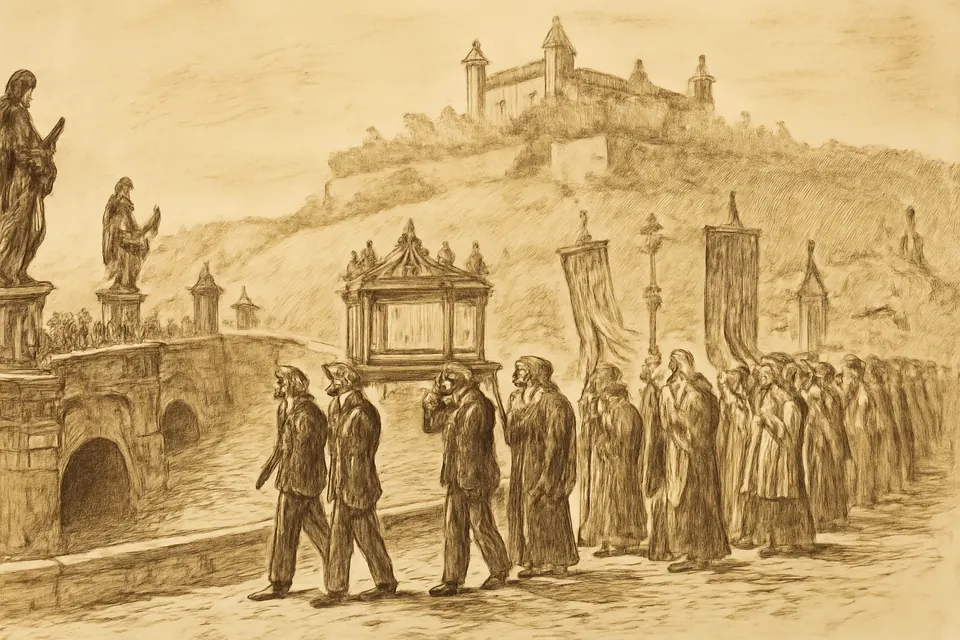
In the 15th century, after Pope Boniface IX granted an indulgence in 1401 to those who supported the cathedral on Kilian's day and the two days after, the showing of the relics drew pilgrims from far away. Devotion faded in the 16th century and revived strongly in the 19th.

The story of the relics
The relics themselves have been through a great deal. The silver busts that once held the three skulls were melted down for coins in 1794. During the secularization that followed, the wooden bases holding the skulls were judged worthless, stored in a vestry of the cathedral and forgotten. The heads were rediscovered in 1849 and carried again in the Kiliani procession of 1850. In 1943 the relics were hidden in the parish church at Gerolzhofen, which saved them: the shrine of 1874 was destroyed in the firestorm that burned Würzburg on March 16, 1945. In July 1949 the relics came home in a three-day procession through the Franconian countryside, and in 1952 the city held a great celebration of 1,200 years of Kilian's cult.
Today the bones of the three saints rest in a bronze shrine by Heinrich Gerhard Bücker in the Kiliansgruft, the crypt of the Neumünster, which the diocese calls "the heart and wellspring" of the Diocese of Würzburg. The skulls are kept in a rock-crystal shrine made by the goldsmiths Josef and Michael Amberg in 1967 and set into the high altar of the cathedral.
Würzburg Bishop Ulrich Boom said of the three skulls that they "show us that sometimes we have to put our heads on the line for the Gospel," and added that this means standing up for the poor, the weak and the powerless.
Ireland
In Mullagh, County Cavan, a church and a heritage center honor him. The center was built with help from the Diocese of Würzburg, and the parish celebrated the 1,300th anniversary of his death in 1989. At Lauragh in Tuosist, County Kerry, the people keep a pattern at his well each July 8. The bond runs both ways: Würzburg had a house of Irish monks from the 9th century to the 15th, and the city's university library still holds manuscripts with notes in Old Irish.
Prayer to St. Kilian
There is no single traditional English prayer to St. Kilian in common use. In Würzburg he is honored above all in the liturgy of his feast and in the Kilianslied, the hymn sung at the Kiliani pilgrimage. Bishop Paul-Werner Scheele quoted one of its lines when he preached on the martyrs: "Er hat besprengt mit seinem Blut den ausgestreuten Samen gut," "with his blood he has watered well the seed he had sown." Bishop Scheele saw in it St. Augustine's thought that where the blood of the faithful flows, the seed of the Church springs up.
We can ask St. Kilian's prayers in our own words, simply: St. Kilian, St. Colman, St. Totnan, pray for us. We turn to them especially for missionaries, for those who must tell hard truths to people in power, for Christian marriage, and for the Church in Ireland and Germany, which their story joins. Many add an Our Father, a Hail Mary and a Glory Be.
The farmers of Franconia keep his day in their own way, too. An old weather saying runs, "Kilian, der heilige Mann, stellt die ersten Schnitter an": St. Kilian, the holy man, sends the first reapers to the fields.
Frequently asked questions
Who was St. Kilian?
An Irish missionary bishop born around 640 who, with eleven companions, traveled to the Frankish lands and settled at Würzburg on the river Main. He converted Duke Gozbert and many of his people and was killed there in about 689 with the priest Colman and the deacon Totnan. Franconians call the three the Frankenapostel, the apostles of Franconia.
When is St. Kilian's feast day?
July 8, the traditional date of his martyrdom. The Diocese of Würzburg keeps it as a solemnity and celebrates a whole Kiliani week around it, when the skulls of the three martyrs are carried through the city. Ireland keeps the same date under the spelling Cillian.
What is St. Kilian the patron saint of?
Würzburg, the Diocese of Würzburg and the region of Franconia, and with Our Lady and St. Liborius he is a patron of Paderborn Cathedral. Old German custom also makes him the patron of whitewashers and plasterers and calls on him against rheumatism, gout and eye trouble. In Ireland he is the patron of the parish of Tuosist in County Kerry.
How did St. Kilian die?
The oldest account says Geilana, the duke's wife, had Kilian, Colman and Totnan secretly killed while the duke was away, because Kilian had told the duke their marriage was against the law of the Church. The killers buried the bodies on the spot with their books and vestments. A 9th-century martyrology by Hrabanus Maurus blames the duke himself instead.
Where are St. Kilian's relics?
In Würzburg. His bones and those of his companions rest in a bronze shrine in the crypt of the Neumünster church, built over the traditional place of their death. Their three skulls are kept in a rock-crystal shrine set into the high altar of Würzburg Cathedral and are shown and carried in procession during the Kiliani week each July.
Was St. Kilian Irish or Scottish?
Irish. The oldest Passio calls his homeland Scottia, which in the early Middle Ages meant Ireland, and the later Passio says plainly "Scotia, which is also called Hibernia." Tradition places his birth at Mullagh in County Cavan and his departure from Kilmakilloge harbor near Kenmare in County Kerry.
Why is St. Kilian shown with a sword?
The sword is the instrument of his martyrdom; the Würzburg tradition says the three were beheaded. With the sword he usually wears a bishop's miter and holds a crozier, and he is often shown beside two smaller figures, his companions Colman and Totnan.
What is the St. Kilian Gospel book?
A Latin Gospel manuscript written in uncial script in the 7th century, which Würzburg tradition holds was Kilian's own and was buried with him. It was kept in the cathedral treasury until 1803 and is now in the Würzburg University Library. Its cover holds an ivory carving of about 1090 showing the beheading of the three martyrs.
Keep exploring
- Patron saint pages
- Eyes
- Feast-day calendar
- Saints remembered in JulySaint of the dayWhat saint is my birthday?
- Relics
- Where the relics are kept (map)
- More
- Saints A to ZPatron saints A to ZExplore every section
Sources
- Catholic Encyclopedia (1910): St. Kilian
- Diocese of Würzburg: Heilige Kilian, Kolonat und Totnan
- Würzburg University Library, Virtual Library: the Kilian Gospels (M.p.th.q.1a)
- Archdiocese of Paderborn: Warum der heilige Kilian ein Patron des Paderborner Domes ist
- CatholicIreland.net: St Kilian of Kilmore (640-689), martyr
- Roman Martyrology, July 8