Blessed Adrian Fortescue, Knight and Martyr under Henry VIII
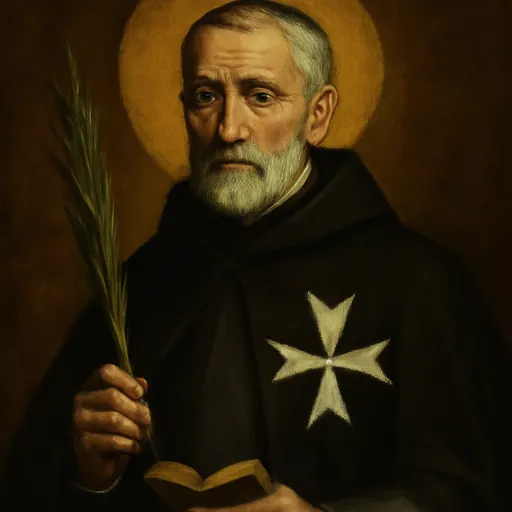
Blessed Adrian Fortescue (about 1476–1539) was an English knight, a cousin of Anne Boleyn's family, who served Henry VIII in war and at court, became a Knight of St. John and a Dominican tertiary, and was beheaded on Tower Hill in July 1539 after Parliament condemned him without trial. Pope Leo XIII confirmed him as Blessed in 1895. His feast is July 9.
Who was Blessed Adrian Fortescue?
Blessed Adrian Fortescue was an English knight who served Henry VIII loyally for decades and then died on the king's scaffold. He was a soldier, a justice of the peace, a careful country landlord, a Knight of St. John and a lay Dominican. In 1539 Parliament condemned him without a trial, and he was beheaded on Tower Hill. The Knights of St. John honored him as a martyr from the early 1600s, and Pope Leo XIII confirmed the title of Blessed in 1895.
The life of Blessed Adrian Fortescue
A Tudor gentleman
Adrian Fortescue was born about 1476, the son of Sir John Fortescue of Ponsbourne in Hertfordshire. His mother, Alice, was a daughter of Sir Geoffrey Boleyn, a Lord Mayor of London, so the future queen Anne Boleyn was his kinswoman. He married Anne Stonor and lived for many years at Stonor Park in Oxfordshire, her family's home. After her death he married Anne Rede, and he had daughters by his first marriage and sons and daughters by his second.
He was made a Knight of the Bath in 1503, took the motto Loyalle Pensée, and fought in the king's French campaigns of 1513 and the early 1520s. In 1520 he was with Henry VIII at the Field of the Cloth of Gold. Father John Morris, who studied his papers in the 1880s, found a man thrifty with money, exact with accounts, and fond of proverbs, which he copied out in his own hand. Among them:
Obey well the good Kirk and thou shalt fare the better.
Think ay thou shalt die, thou shalt not gladly sin.

Knight of St. John and Dominican
In 1532 he was received into the Order of St. John of Jerusalem, the knights we now call the Order of Malta. In July 1533 he was admitted as a Dominican tertiary at the Blackfriars in Oxford. His book of hours carries a rule of life written on the flyleaf in his own hand; the book has long been kept with devotion by his descendants.

Arrest, attainder and death
He attended Anne Boleyn's coronation in June 1533, but the king's break with Rome was another matter. On August 29, 1534, he was arrested without any stated charge and held for some months. He was arrested again in February 1539 and sent to the Tower of London. That spring Parliament passed an act of attainder against him: no trial, no defense, only a general charge of sedition and of refusing his allegiance. The same act condemned Cardinal Reginald Pole and others for adhering to the Bishop of Rome.

He was beheaded on Tower Hill in July 1539. The chronicles disagree on the day: the chronicle kept by the Franciscan friars of London gives the 9th, John Stow the 10th, and the Knights of St. John the 8th. His servants, condemned with him, were hanged, drawn and quartered at Tyburn. Where his body was laid is not known.

A martyr honored by the Knights of St. John
The Order of St. John never forgot him. Father Morris found a 1639 petition to the Grand Master by Nicholas Fortescue that already calls him "Blessed Adrian Fortescue" and says he was counted among the saints honored in the oratory of St. John's church in Valletta. Pope Leo XIII confirmed his title of Blessed on May 13, 1895. As a martyr he needed no approved miracle. Graces asked through his prayers are reported until one is examined for a canonization.
Symbols of Blessed Adrian Fortescue in art
Old paintings of him hang in Malta, including two among the blessed of the Order in St. John's Co-Cathedral in Valletta and one at the Collegio di San Paolo in Rabat.
- The white eight-pointed cross: the badge of the Knights of St. John, worn on a black cloak.
- Martyr's palm and halo: the signs of a martyr.
- Court dress or armor: for the soldier and courtier he was.
- Book of hours: for his lay Dominican devotion and the rule of life in his own hand.
- A sword or knife: a 1621 painting in Madrid showed him with a blade at his throat, a sign of the manner of his death.
Look for the Maltese cross: in a church of the Order, a bearded layman in Tudor dress with that cross and a palm is almost certainly Blessed Adrian.
Feast day and prayer
We keep his feast on July 9, the day the Order of Malta keeps. Some calendars give July 8. See more saints of July on our feast days page.
We have not found a traditional English prayer to Blessed Adrian to reprint, so we do not print one. Let us ask him to pray for lay people who serve in public life, for the Knights of Malta and their works for the sick, and for all whose loyalty to Christ costs them their place in the world.
Frequently asked questions
Who was Blessed Adrian Fortescue?
A Tudor gentleman from Hertfordshire and Oxfordshire, knighted in 1503, who fought for Henry VIII in France, attended the Field of the Cloth of Gold, and became a Knight of St. John in 1532. He was attainted without trial and beheaded in 1539, during the king's break with Rome.
Why was Adrian Fortescue executed?
The act of attainder charged him only in general terms with sedition and refusing his allegiance. The same act condemned Cardinal Reginald Pole and others for adhering to the Bishop of Rome, and Catholic tradition has always held that Fortescue died for the faith.
When is the feast of Blessed Adrian Fortescue?
July 9. The chronicles disagree on whether he died on the 8th, 9th or 10th of July 1539, so some calendars give July 8.
Was Adrian Fortescue related to Anne Boleyn?
Yes. His mother, Alice, was a Boleyn, which made him a kinsman of the queen. He attended her coronation in 1533.
Keep exploring
Sources
- John Morris, S.J., The Venerable Sir Adrian Fortescue, Knight of the Bath, Knight of St. John, Martyr (London: Burns and Oates, 1887). His proverbs in his own hand, the differing execution dates in the chronicles, the 1639 petition calling him Blessed, and the portraits in Malta
- J. H. Pollen, Bl. Adrian Fortescue, Catholic Encyclopedia (1909), Wikisource transcription. The arrests of 1534 and 1539, the terms of the attainder, and the 1895 beatification
- Great Dominicans: Blessed Adrian Fortescue, English Dominicans (Godzdogz). His reception as a Dominican tertiary at Blackfriars, Oxford, in July 1533, and his rule of life in his book of hours