Blessed Rosalie Rendu, the Daughter of Charity of the Paris Slums
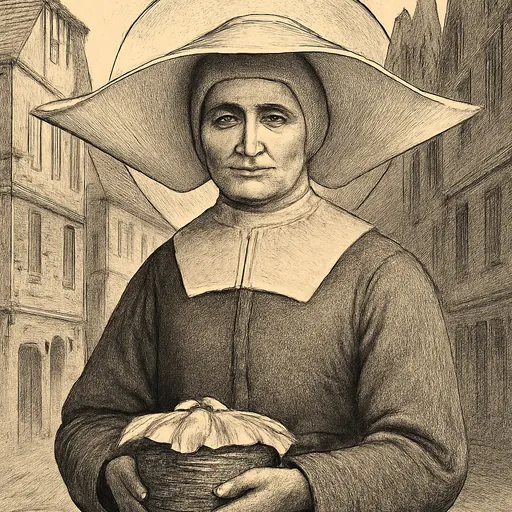
Blessed Rosalie Rendu (1786–1856) was a French Daughter of Charity who served the poor of the Mouffetard district of Paris for 54 years. She opened a clinic, school, orphanage, day nursery and home for the elderly, nursed cholera victims, and guided the young Frédéric Ozanam to the poor. She was beatified in 2003; her feast is February 7.
Who was Blessed Rosalie Rendu?
Blessed Rosalie Rendu was a Daughter of Charity who became, for half a century, the mother of the poorest quarter of Paris. Born Jeanne-Marie Rendu on September 9, 1786, at Confort near Gex in the Jura mountains, she entered the Daughters of Charity of St. Vincent de Paul at seventeen and was sent to the Mouffetard district, where she stayed 54 years. There she opened a free clinic, a pharmacy, a school, an orphanage, a day nursery, a club for young workers and a home for the elderly poor.
She died on February 7, 1856. St. John Paul II beatified her in Rome on November 9, 2003, saying that "her charity was inventive" and that her secret was simple: "to see the face of Christ in every man and woman." He named the source of her strength: "her intense prayer life and the continuous praying of the Rosary, which she never abandoned."
The life of Blessed Rosalie
A childhood among hidden priests
She was three when the French Revolution broke out. Priests who refused the government's oath went into hiding, and the Rendu home became a refuge for them. The bishop of Annecy lived there disguised as a hired hand called Pierre; one night young Jeanne-Marie found "Pierre" saying Mass. She made her First Communion by candlelight in the basement of the house. Her father died in 1796, and she helped her mother raise her younger sisters.
Fifty-four years in the Mouffetard
On May 25, 1802, she arrived at the motherhouse of the Daughters of Charity in Paris and took the name Sister Rosalie. Her health was poor, so her superiors sent her to work among the poor of the Mouffetard district. She never left. In 1815 she became superior of the community, which moved two years later to the rue de l'Épée-de-Bois.
She prayed as she walked. "Never have I prayed so well as in the streets," she said. To her sisters she taught St. Vincent's way of seeing the poor: "The poor will insult you. The ruder they are; the more dignified you must be. Remember, Our Lord hides behind those rags." And to a sister in trouble she gave what the Vatican biography calls the secret of her life: "If you want someone to love you, you must be the first to love; and if you have nothing to give, give yourself."
Cholera and the barricades
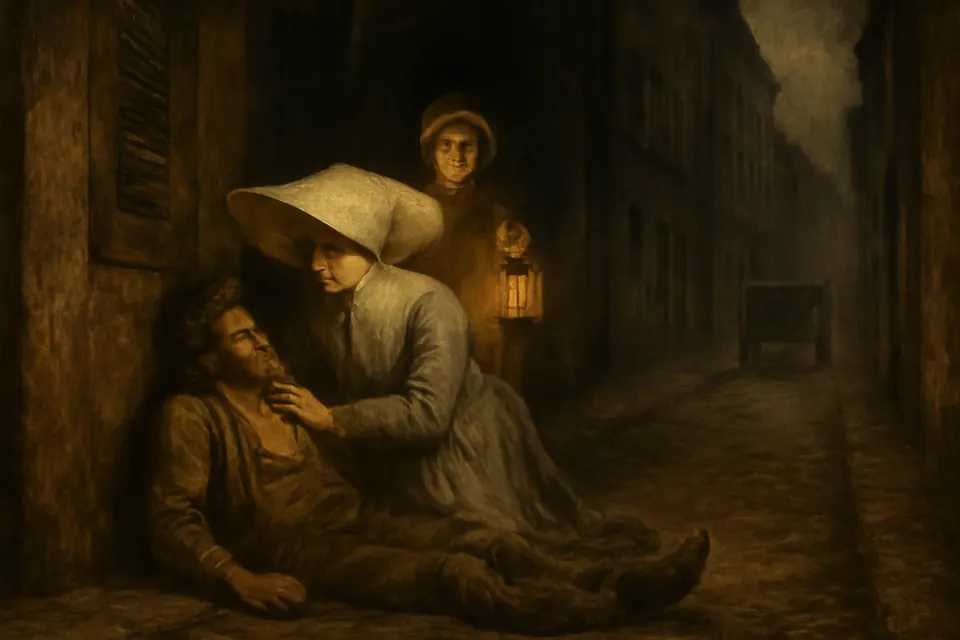
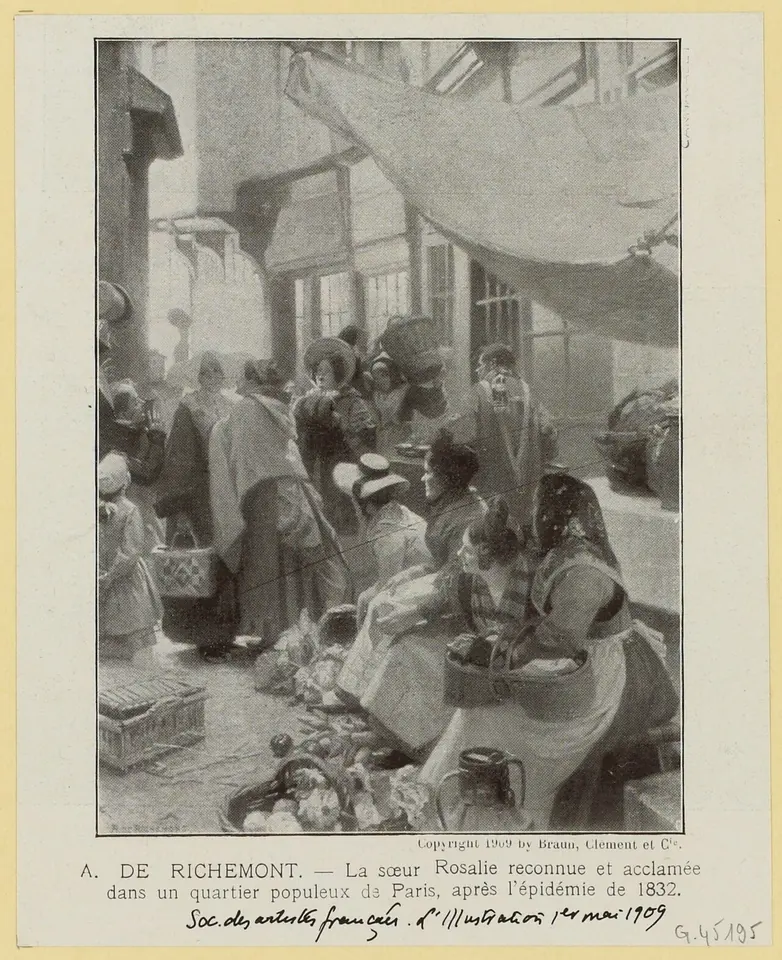
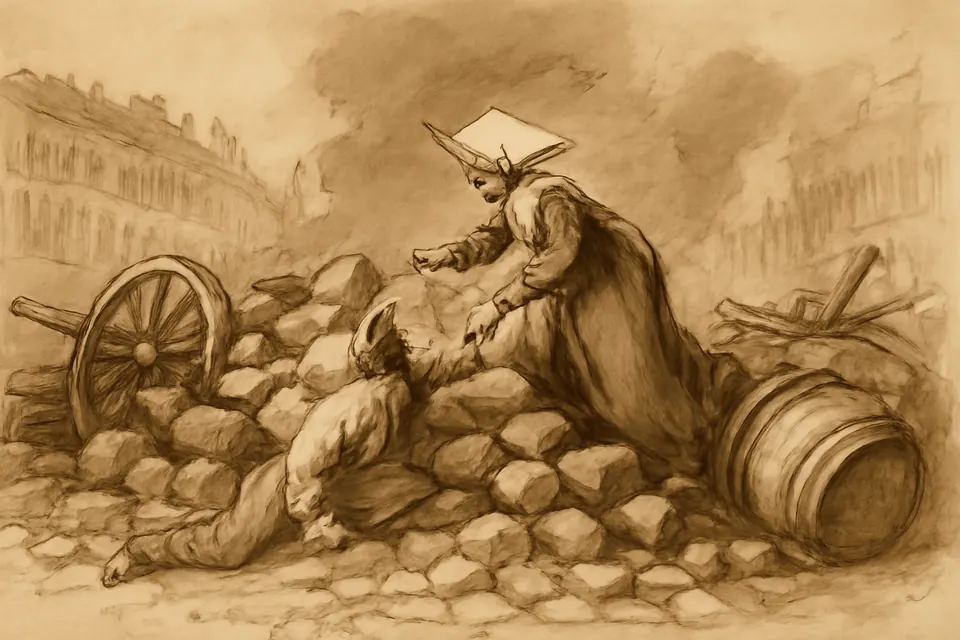
Cholera struck the district again and again, worst in 1832 and 1846, and Sister Rosalie and her sisters nursed the sick at the risk of their lives; she was seen picking up the dead in the streets herself. In the uprisings of July 1830 and of 1848 she climbed the barricades to help the wounded of both sides. Afterward she worked to save rebels she knew from harsh punishment.
Teacher of Frédéric Ozanam
Everyone came to her parlor: bishops, the Spanish ambassador, generals, and in time Napoleon III and the empress. Students came too. Among them was the young Blessed Frédéric Ozanam, who with his friends was founding the Conferences of St. Vincent de Paul. Sister Rosalie gave them the addresses of poor families, chosen with care, and guided their first visits. In 1852 Napoleon III awarded her the Legion of Honor; she wanted to refuse it, and accepted only when her superior general told her to.
Her death
In her last two years she slowly went blind. She died on February 7, 1856, after a short illness. Newspapers of every opinion mourned her, the Catholic L'Univers and the anticlerical Le Constitutionnel alike, and a great crowd followed her coffin from St. Médard to Montparnasse Cemetery.
Miracles of Blessed Rosalie
The healing approved for her beatification is approved. Sister Thérèse Béquet, a Daughter of Charity born in 1910 in Brittany, began suffering joint pain in 1942 and became an invalid, blind in one eye, with what doctors described as a serious, progressive neurological illness they could not name or treat. On February 1, 1952, while her whole community asked Sister Rosalie's intercession, she was healed from one moment to the next. The Vatican recognized the miracle in April 2003. What her own age saw was charity on a scale that seemed miraculous: thousands fed, nursed and taught by a woman with no money of her own.
Why she is honored by those who serve the poor
Sister Rosalie had no formal patronage given by the Church. She is naturally invoked by the poor, by social workers, and by charitable societies, above all the Society of St. Vincent de Paul, whose first members she trained. See more on our patron saints page.
Symbols of Blessed Rosalie in art
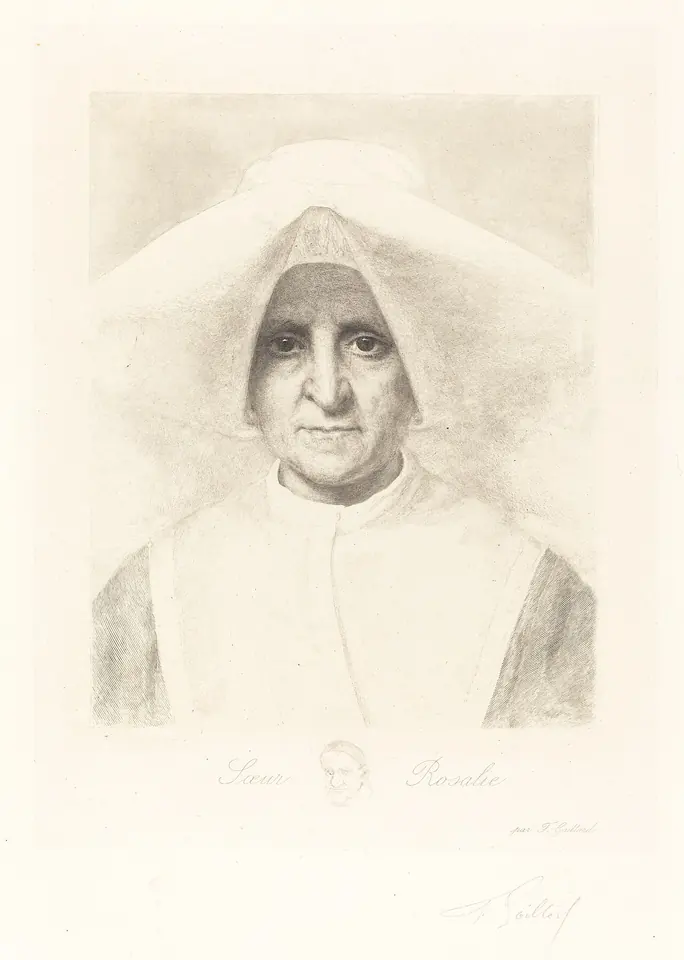
Images of Sister Rosalie show her in the dress of the Daughters of Charity of her time: a gray-blue habit, a white collar and the large white winged cornette that Parisians knew on every street. She is usually older, with a strong and kindly face, as in Gaillard's engraving. Popular prints show her among the poor of the Mouffetard, in market streets, at sickbeds or on the barricades.
Feast day and where she is honored
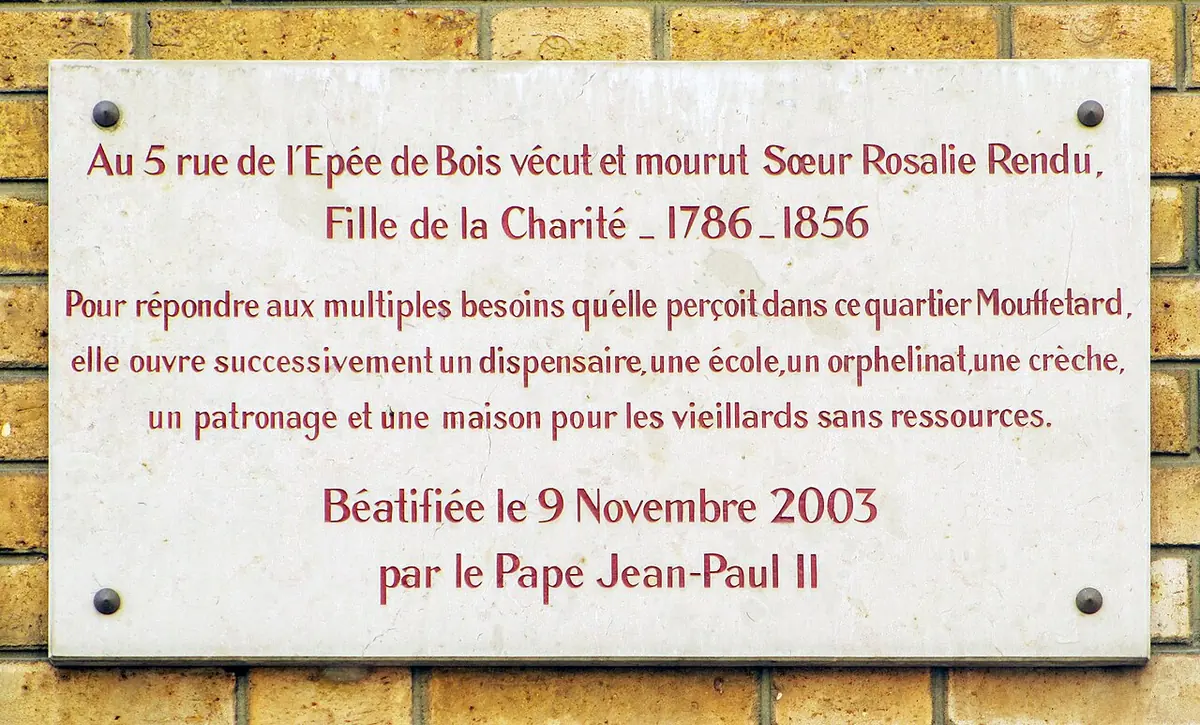
We keep her memorial on February 7. Her tomb is in Montparnasse Cemetery. Visitors crowded to the original grave so much that her body was moved to a more accessible place near the entrance, under a simple cross that says: "To Sister Rosalie, from her grateful friends, the rich and the poor." Flowers still appear there. In the 13th arrondissement, the Avenue de la Sœur-Rosalie bears her name. See other feasts on our feast days page.

Praying with Blessed Rosalie
We know of no traditional prayer to Blessed Rosalie. Let us ask her, in our own words, to teach us to find Christ hidden behind the rags of the poor, and to pray for all who serve them.
Blessed Rosalie Rendu, pray for us.
Frequently asked questions
Who was Sister Rosalie Rendu?
A Daughter of Charity of St. Vincent de Paul, born Jeanne-Marie Rendu in 1786 near Gex, who spent 54 years among the poor of the Mouffetard district of Paris and was beatified by St. John Paul II on November 9, 2003.
What was Rosalie Rendu's connection to Frédéric Ozanam?
Blessed Frédéric Ozanam and his student friends came to her for advice when they began the Conferences of St. Vincent de Paul. She gave them the addresses of poor families, chosen with care, and guided their first visits.
When is the feast of Blessed Rosalie Rendu?
February 7, the day she died in Paris in 1856.
Where is Sister Rosalie buried?
In Montparnasse Cemetery in Paris. Her simple tomb near the entrance is inscribed "To Sister Rosalie, from her grateful friends, the rich and the poor," and people still leave flowers there.
Keep exploring
Sources
- Vatican: Rosalie Rendu (1786–1856), biography for the beatification of November 9, 2003. Her childhood during the Revolution, her 54 years in the Mouffetard district, her works, the cholera of 1832 and 1846, the barricades, the Legion of Honor, the newspaper tributes, her tomb, and all her sayings quoted here
- FAMVIN: The miracle of Sr. Rosalie Rendu (May 7, 2003). The healing of Sister Thérèse Béquet in 1952
- FAMVIN: Another step toward beatification of Rosalie Rendu, DC (April 14, 2003). The Vatican's recognition of the miracle, April 2003
- St. John Paul II, Homily for the beatifications of November 9, 2003. Quoted