St. Aelred of Rievaulx, Abbot and Teacher of Friendship

St. Aelred of Rievaulx (1110 to 1167) was an English Cistercian monk who grew up at the court of King David I of Scotland, entered Rievaulx Abbey in Yorkshire and became its abbot in 1147, leading some 140 monks and hundreds of lay brothers. He is best known for his books The Mirror of Charity and Spiritual Friendship, and is often asked to pray for friendships. His feast day is January 12.
Who was St. Aelred of Rievaulx?
St. Aelred of Rievaulx was a 12th-century English monk and abbot whose writings on love and friendship are still read in monasteries, parishes and universities today. He spent his youth at the court of King David I of Scotland, gave it up to become a Cistercian at Rievaulx Abbey in the valley of the Rye in Yorkshire, and ruled that house as abbot for twenty years. The Catholic Encyclopedia says the eloquence of his sermons "earned for him the title of the English St. Bernard."
We know him well because his secretary and friend, the monk Walter Daniel, wrote his life soon after his death, and because Aelred left so much of himself in his books. He is a saint for anyone who believes that human affection, rightly ordered, can lead us to God.
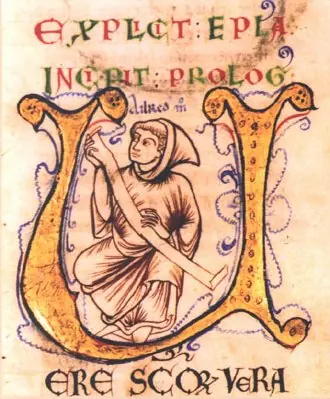
The life of St. Aelred
From Hexham to the Scottish court
Aelred was born at Hexham in Northumberland in 1110. His father, Eilaf, was a priest, one of the married clergy still found in the north of England at the time, the last of a line of hereditary priests of Hexham, in the land of St. Cuthbert and the old Northumbrian saints. As a boy he was taken into the household of David, the youngest son of St. Margaret of Scotland, who soon became king. Aelred grew up as a companion to David's son Henry and rose to be steward of the royal household. The king loved him and wanted to make him a bishop.
Into the cloister
In 1134, on an errand to York, Aelred visited the new Cistercian abbey of Rievaulx, founded just two years earlier by Walter Espec, and did not go back. He entered as a novice. He was soon made master of novices, and the Catholic Encyclopedia notes he "was long remembered for his extraordinary tenderness and patience towards those under his charge." In 1143 he was sent with twelve monks to found Revesby Abbey in Lincolnshire, and in 1147 the monks of Rievaulx elected him their abbot.
Abbot of a great house
Under Aelred, Rievaulx grew enormously. English Heritage reckons the community at about 650 at its peak in the 1160s. Walter Daniel counted 140 monks, and Powicke, the historian who edited Walter's text, adds 600 lay brothers and servants. On great feasts, Walter says, the church was so packed with brethren that it looked like a hive of bees. Aelred would not turn anyone away, and he ruled with a gentle hand. Many of the ruins standing today, including the great church, date from his time.

As head of the Cistercians in England he traveled constantly: to the general chapter at Cîteaux, to Scotland, to the court of Henry II. He was at Westminster in 1163 for the translation of St. Edward the Confessor, whose life he wrote, and in 1164 he went on a mission to Galloway.

His writings
At the request of St. Bernard of Clairvaux, Aelred wrote The Mirror of Charity, on the love of God and how it orders all our other loves. Late in life he wrote Spiritual Friendship, a dialogue with his monks, Walter Daniel among them, modeled on Cicero's book on friendship but rooted in Christ. He also wrote sermons, a rule of life for his sister, who was an anchoress, and histories, including an account of the Battle of the Standard and a life of St. Ninian.

Suffering and death
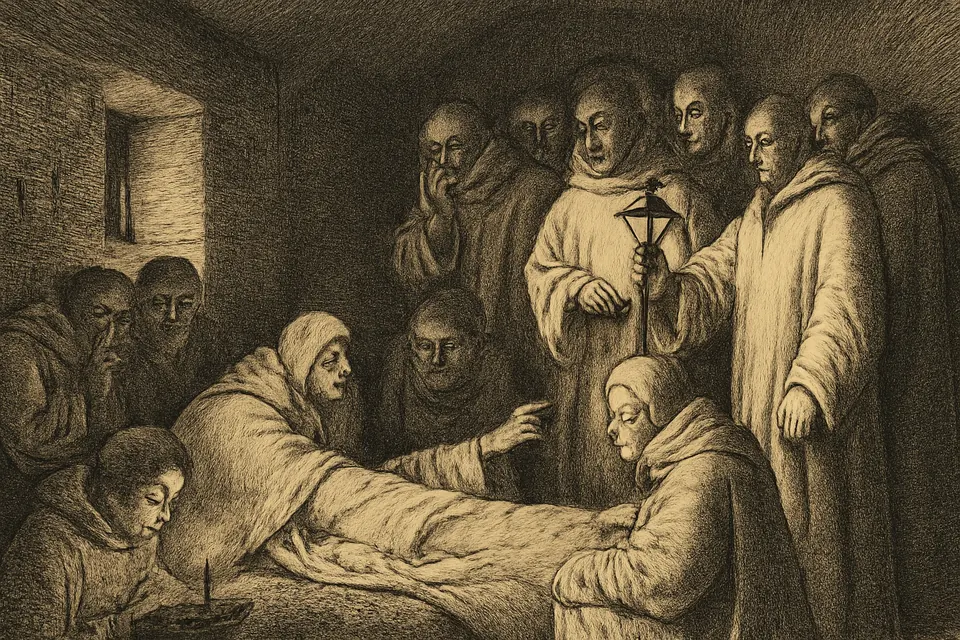
For his last ten years Aelred suffered badly from illness. The general chapter allowed him to live in a small building near the infirmary, where his monks crowded in to see him. He ate so little that he was described as "more like a ghost than a man." In his final days, Walter Daniel writes, twelve, twenty, forty, even a hundred monks gathered around him, "so greatly was that lover of us all loved by us" (our translation of his Latin). For three days he kept saying, in the English he spoke as a boy, "Festinate, for crist luue": "Hurry, for the love of Christ." He died on January 12, 1167.
Miracles of St. Aelred
Walter Daniel's Life records several wonders. The first comes from his infancy: a kinsman, the archdeacon William son of Thole, is said to have seen the baby's face shining like the sun as he lay in his cradle. Others are cures that Walter says happened through Aelred's prayers during his lifetime. These are reported: Walter was a witness and a friend, but no formal inquiry was ever held. The Church has never approved a miracle in his cause, because no formal cause was ever opened.
Why St. Aelred is invoked for friendship
Aelred's whole spirituality turns on love, and he did not think that loving particular people drew us away from God. In Spiritual Friendship he teaches that a friendship founded in Christ is a school of charity and a road to God, who is himself love. That is why Christians today ask him to pray for their friendships, for those who are lonely, and for communities trying to live in charity.

Symbols of St. Aelred in art
Aelred appears in art less often than many saints, so he is usually recognized by his habit and by inscriptions:
- White Cistercian habit: the undyed wool of the monks of Cîteaux.
- Abbot's crozier: his office at Rievaulx.
- A book or a pen: the writer of The Mirror of Charity and Spiritual Friendship.
The 19th-century engraving below shows him in a Gothic niche with crozier and book. Modern statues, like the one at St. Aelred's Church in Harrogate, show him simply as a monk with a book.

Feast day and Rievaulx today
We keep his feast on January 12, the day of his death. You can see the other saints of the season on our feast days page. His body was laid in a shrine at Rievaulx, and in the 1220s the monks enlarged the east end of the church to give it a worthy setting. The abbey was suppressed in 1538 under Henry VIII, and his relics were lost. The roofless church still stands in its wooded valley, cared for by English Heritage, and pilgrims come to pray where he prayed.

Prayer to St. Aelred
We have not found a traditional prayer to St. Aelred with a source we can verify, and we won't invent one under his name. His own last words make a fine short prayer for any Christian who longs for God: "Hurry, for the love of Christ."
Let us ask St. Aelred to pray for our friendships, that they may lead us closer to Christ, for monks and nuns, and for everyone who is ill and waiting on the Lord as he did.
Frequently asked questions
What is St. Aelred of Rievaulx known for?
For his book Spiritual Friendship, a dialogue in which he teaches that true friendship begins in Christ and leads to God, and for The Mirror of Charity, which he wrote at the request of St. Bernard of Clairvaux. As abbot he was famous for his gentleness, and Rievaulx grew under him into one of the largest monasteries in England.
When is St. Aelred's feast day?
January 12, the day he died in 1167. The Cistercian Order keeps his feast, and he is listed on that day in the Roman Martyrology.
Was Aelred of Rievaulx canonized?
Not by a formal papal process. He was honored as a saint at Rievaulx from soon after his death, his relics were kept in a shrine in the abbey church, and the Cistercian Order has long celebrated his feast.
What were St. Aelred's last words?
His biographer Walter Daniel, who was with him, says that for three days he kept saying, in English, "Festinate, for crist luue," "Hurry, for the love of Christ," looking toward the cross and the King of Glory he said he saw before him.
Sources
- Herbert Thurston, St. Ælred (Catholic Encyclopedia, 1907). His father a married priest of Hexham; King David's court; novice master; Revesby 1143; "more like a ghost than a man"; the English St. Bernard
- F.M. Powicke, Ailred of Rievaulx and his biographer Walter Daniel (Manchester, 1922). Walter Daniel's Life, including the deathbed and "Festinate, for crist luue"; 140 monks and 600 lay brethren and servants; death in 1167
- English Heritage: History of Rievaulx Abbey. Postulant in 1134, abbot in 1147, the 650-strong community, his lodging and infirmary, the 1220s extension for his shrine, suppression in 1538