St. Juliana of Lazarevo, the Merciful
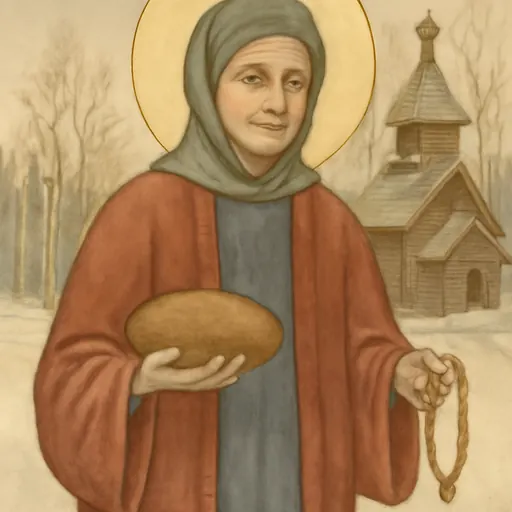
St. Juliana of Lazarevo (Juliania Osorina, died 1604) was a Russian noblewoman of Murom, a wife, mother of thirteen and widow, who gave nearly everything she had to the hungry and the sick, above all in the Great Famine of 1601–1603. The Orthodox Church honors her as a righteous saint. Her feast day is January 2 (January 15 on the civil calendar).
Who was St. Juliana of Lazarevo?
St. Juliana of Lazarevo was a Russian noblewoman of the 16th century who never entered a convent. She married at sixteen, bore thirteen children, buried six of them as babies and two more as young soldiers, ran a large household of servants, and spent her widowhood giving away everything she had until there was not a single grain left in her barns. The Orthodox Church honors her as righteous, the title it gives to holy men and women who lived in the world.
The Orthodox Church in America calls her "an astonishing example of a self-denying Russian Christian woman." We know her unusually well because her own son, Kallistrat Osorin, known in the family as Druzhina, wrote her Life within a few decades of her death. Few saints anywhere have a biography written by a son about his mother, and it gives her story a warmth and a homely detail that older lives of saints rarely have.
Let us come to know her, and ask her to teach us mercy in our own homes.
The life of St. Juliana of Lazarevo
An orphan girl in the Murom countryside
Juliana, called Ulyana in the old Russian of her Life, was born in the early 1540s into the Nediurev family, minor nobility in the service of the Moscow court. Her father, Justin Nediurev, was a steward at Vladimir; her mother, Stefanida, came from Murom. Both died while she was small. At six she was sent to her widowed grandmother in the Murom district, and when her grandmother died six years later, to an aunt.
Her aunt scolded her for fasting so strictly, and her cousins laughed at her. She bore it without complaint, kept to herself, and spent her free hours sewing clothes for widows and orphans. The village had no church, and her son notes with some wonder that she grew devout without hearing sermons or having a spiritual father.
Wife of George Osorin
At sixteen she was married to George (Yuri) Osorin, a well-to-do landowner who held the village of Lazarevo near Murom. The wedding took place in the village church of St. Lazarus. Her husband's parents loved their gentle daughter-in-law and soon handed her the running of the house.
The couple prayed together morning and evening, making a hundred or more prostrations. Juliana could not read, so George read aloud to her from the Scriptures and the lives of the saints. When he was away on the tsar's service, as at Astrakhan in the 1560s, she sewed and embroidered at night and gave the money to the poor and to church building. She would never call her servants by insulting names, gave them only as much work as they could bear, and often took the blame for their mistakes.
In the famine of 1570–1572 she quietly gave the poor the bread her mother-in-law gave her for her own meals. When plague followed, she nursed the sick herself, in secret, without fear of catching it.
Mother of thirteen
Juliana and George had thirteen children, ten sons and three daughters, and six died in infancy. In 1588 their eldest son was killed, and soon afterward their son Gregory fell in battle against the Crimean Tatars. In her grief Juliana asked her husband to let her become a nun. He begged her to stay and raise the younger children, and she obeyed. From then on the two lived as brother and sister, and she fasted more strictly, slept only a little, and prayed through much of the night with her prayer rope in her hand, saying the Jesus Prayer.
A widow who gave everything
George died around 1592. Juliana honored his memory with prayers, memorial liturgies and alms, and then gave herself wholly to God and to the poor. Her son says she gave so freely that often not a single coin was left in the house, and then she borrowed in order to keep giving.
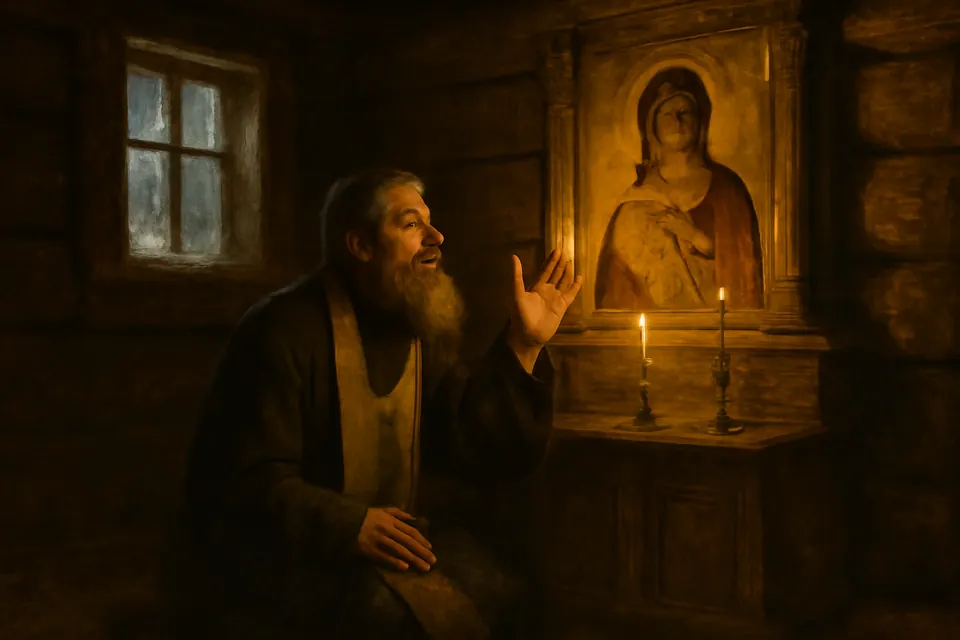
One hard winter her sons gave her money for warm clothes. She gave it to the poor and, having no coat, stopped walking to church. Then the village priest, praying before the icon of the Mother of God, heard a voice tell him to go to "merciful Juliana" and ask why she no longer came to pray in church, adding that her prayer at home was pleasing to God and that the Holy Spirit rested on her. The priest went and fell at her feet. Juliana was upset that he had told the story to others on his way, forbade him to repeat it, and went to church that day to venerate the icon with tears.
The Great Famine
In 1601 the harvest failed across Russia. Nothing grew in Juliana's fields, and her horses and cattle died. She forbade anyone in her household to steal, sold her livestock, her clothes and her dishes for grain, and went on feeding her servants and the beggars at her gate until there was not one grain left in the house.
Then she moved to her late husband's small estate of Vochnevo and set her servants free, so that they would not starve in her service and could seek food elsewhere. Some left. The most loyal stayed and suffered with her. She taught her children and servants to gather goosefoot weed and tree bark, grind them into flour and bake bread. That bread fed the household and the beggars too. The poor told other benefactors they would rather go to Juliana, because her bread was "very sweet." Wealthy neighbors sent to try it, tasted it, and decided her servants must be fine bakers. Her son adds that they did not understand that it was sweet through her prayer.
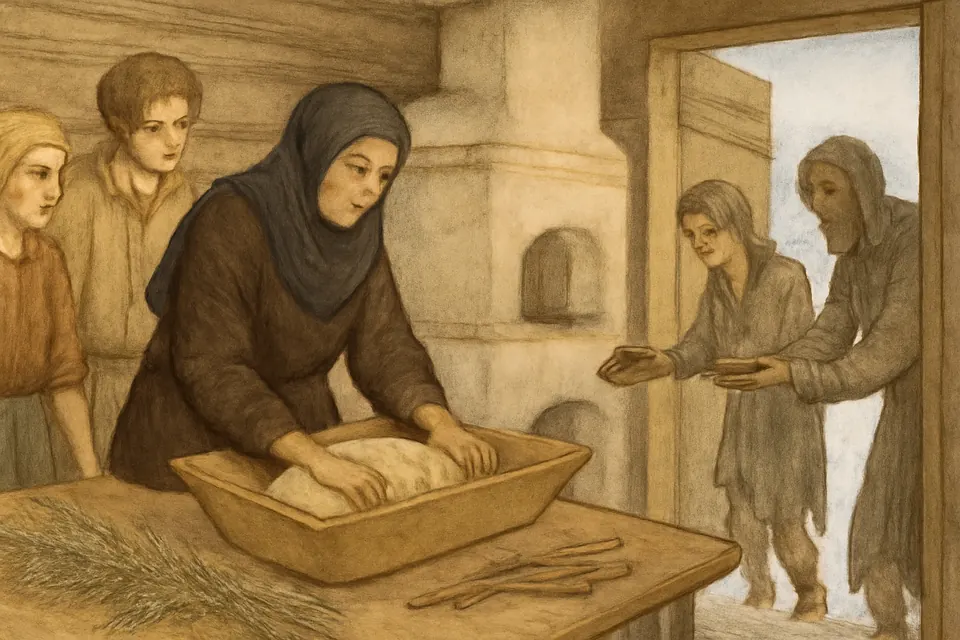
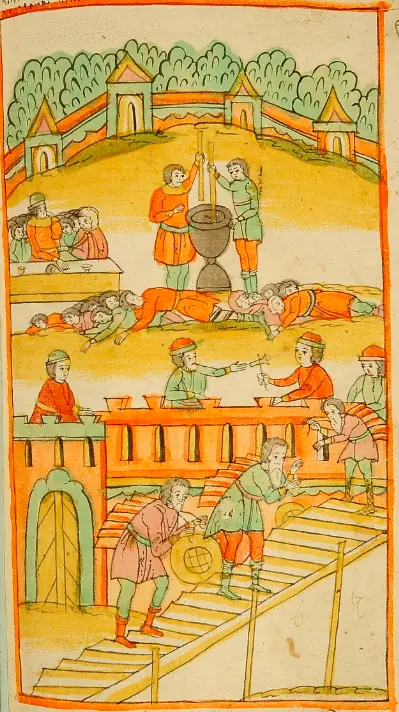
This was not a small kindness. The monk Avraamy Palitsyn, who lived through those years, wrote that the rich of Russia locked up their grain and turned their servants out to starve, and he saw in that hardness the sin that brought the Time of Troubles on the country. Juliana did the opposite.
Her death
On December 26, 1603, she fell ill. Even then she kept praying at night, telling her family that God asks spiritual prayer of the sick too. On January 2, 1604, she received Holy Communion from her spiritual father, the priest Afanasy, said goodbye to her children and servants, and taught them about love, prayer and almsgiving. Then, her son writes, she crossed herself three times, wound her prayer rope around her hand and said her last words: "Glory to God for all things! Into Thy hands, O Lord, I commend my spirit." Those present saw a golden circle around her head, like the halo painted on icons. She was carried home to Lazarevo and buried beside her husband on January 10.
The miracles of St. Juliana of Lazarevo
- The voice from the icon and the sweet bread: traditional. Both come from the Life written by her son, our only source for her daily life.
- St. Nicholas's help: traditional. Twice, her Life says, St. Nicholas the Wonderworker drove off demonic attacks against her.
- The golden circle at her death: traditional, recorded by her son.
- The myrrh and healings of 1614: reported. When her son George was buried beside her on August 8, 1614, her coffin was found intact and full of fragrant myrrh, and many sick people were healed after being anointed with it. By 1649, 21 miracles at her tomb had been written down.
- Answered prayers today: reported. The church in Murom where her relics now rest keeps a record of healings and graces received through her prayers.
Why St. Juliana is honored by wives, mothers and widows
The Russian Church has no formal list of patronages like the West, but the faithful know whom to ask. Juliana was a wife who obeyed her husband even in her deepest wish, a mother who buried children, a widow who did not close in on herself, and a mistress of a house who treated her servants as brothers and sisters. Her troparion praises her for "feeding the hungry and caring for the poor, nursing the sick and strengthening the weak." Orthodox sisterhoods of mercy, groups of women who nurse and visit the sick, have been founded in her name in Murom, Vladimir and Siberia.
Symbols of St. Juliana of Lazarevo in art
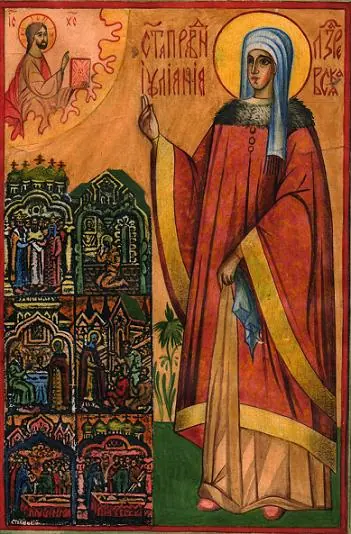
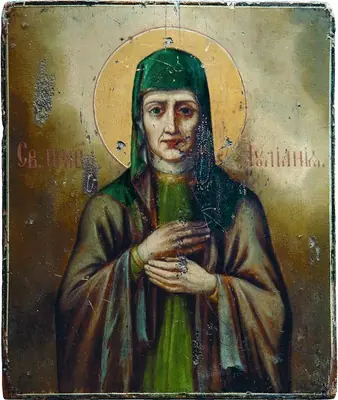
In icons Juliana stands full length as a Russian noblewoman of her century, in a long robe and a veil or kerchief over her hair. An old Russian icon painters' manual compares her look to St. Elizabeth, the mother of John the Baptist, and describes a green kerchief, a crimson outer robe and a blue under-robe, with her right hand pressed to her breast and her left holding a lestovka, the old Russian leather prayer rope. The prayer rope recalls her Life, which says she always held one in her hands and prayed the Jesus Prayer without ceasing.
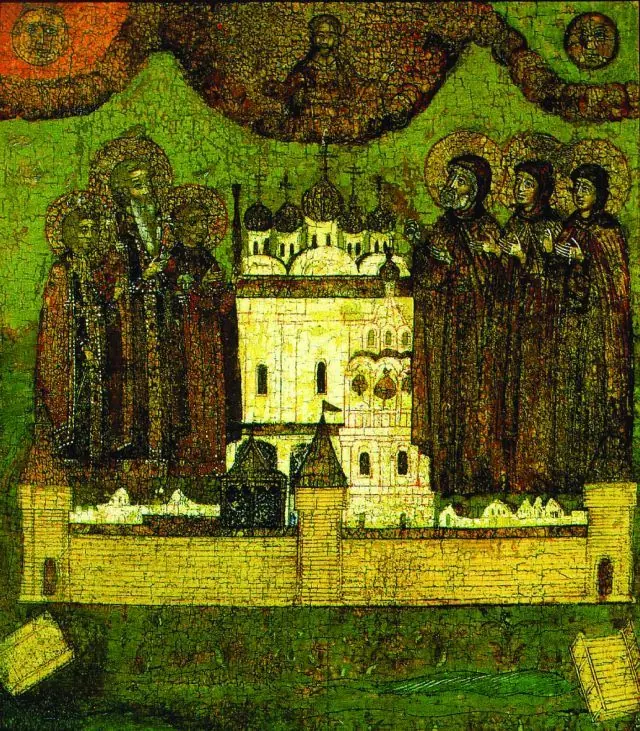
Icons made from the 1890s onward often show her richer, in red court dress on a gold ground, to mark her noble birth. Many also show Christ blessing her from a cloud in the upper corner, as in Stelletsky's icon above. In icons of the saints of Murom she stands beside the city's other wonderworkers, the princes Constantine, Michael and Theodore and Sts. Peter and Fevronia.
Where St. Juliana is honored
After her relics were found, a wooden church of the Archangel Michael was built over the graves at Lazarevo, and her son spread her memory through the Murom country. The cult had its trials. In 1801 the bishop of Vladimir banned services of intercession to her, and in 1811 her relics were damaged when the church burned; the stone church that replaced it still stands. Prayers to her were allowed again in 1867–1868, and in 1893 her descendants founded a brotherhood in her name; St. John of Kronstadt was among the founders of this and a second Juliana brotherhood.
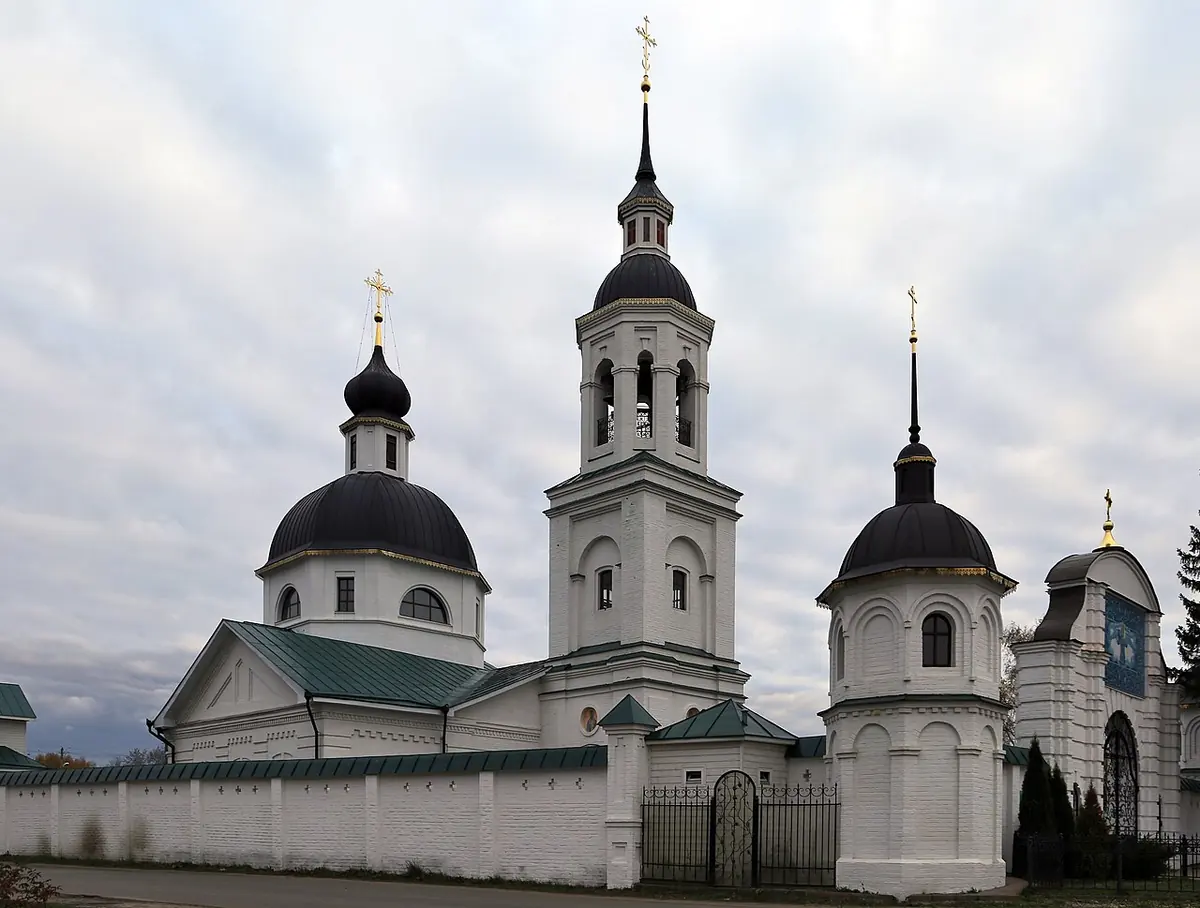
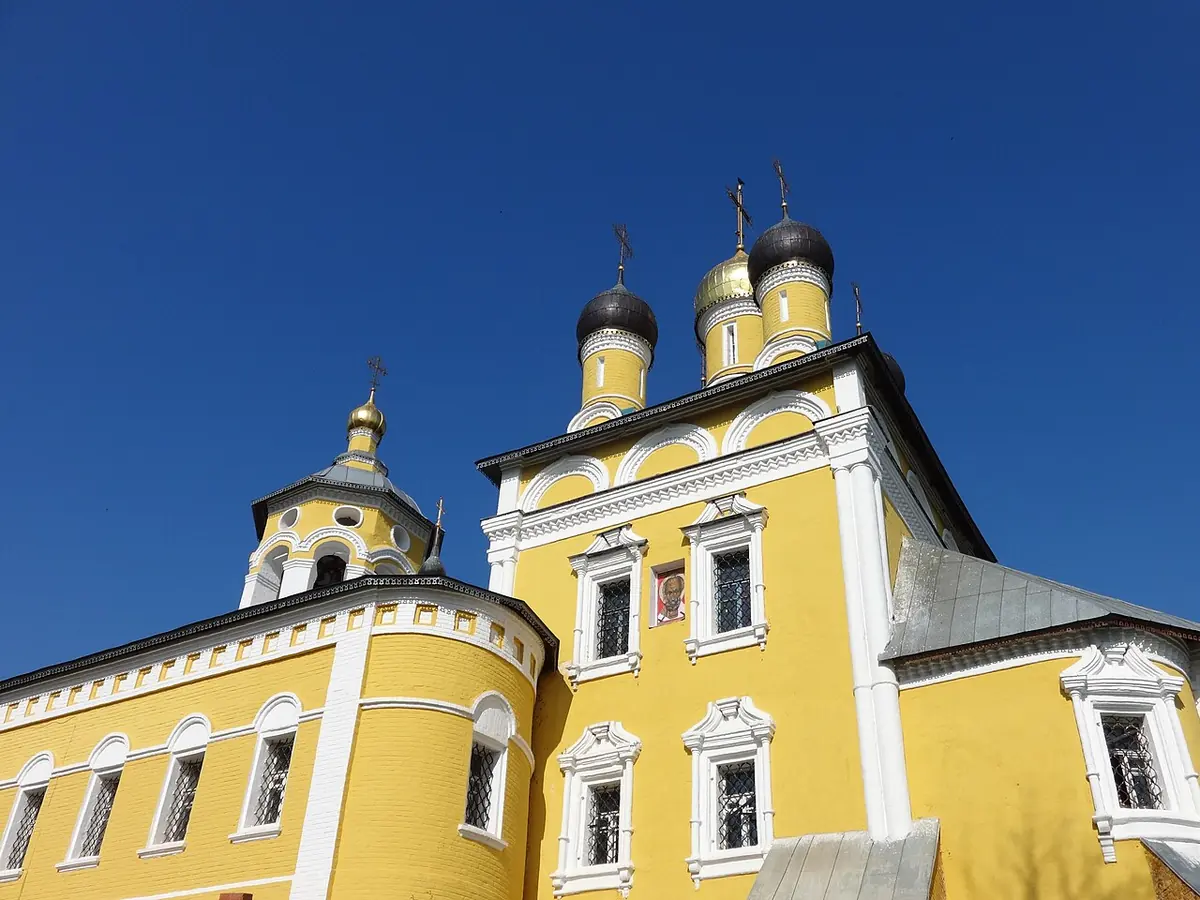
In 1924 the Soviet authorities opened her reliquary, and in 1930 they placed it in the anti-religious section of the Murom museum, where believers kept coming to pray until it was moved out of sight. On January 20, 1989, it was given back to the Church, and on July 9, 1993, it was carried to the church of St. Nicholas on the Embankment in Murom, where it rests today. A spring near Lazarevo bears her name, and a chapel was blessed in the village for the 400th anniversary of her death in 2004.
Her family has not died out. The Osorins, later spelled Osorgin, named their sons George and their daughters Juliana for generations. Georgy Osorgin was shot in the Solovki camp in 1929 after sending the Holy Gifts to an imprisoned archbishop, the hieromartyr Peter Zverev, and his brother Mikhail helped found the St. Sergius Orthodox Theological Institute in Paris.

Prayer to St. Juliana of Lazarevo
The Church's own hymn to her is the troparion of her feast (Tone 4). It praises her as an example of the perfect servant of the Lord, a woman who fasted, kept vigil and prayed, fed the hungry, cared for the poor and nursed the sick, and now intercedes for us. The OCA prints the full text on its website.
We can also pray as she did, with a prayer rope in hand, saying the Jesus Prayer: "Lord Jesus Christ, Son of God, have mercy on me." When the house is full and the money is short, when a child is sick or a loved one has died, let us ask St. Juliana of Lazarevo to pray for us, and to make our bread, like hers, sweet for the poor.
Holy righteous Juliana, pray to God for us.
Frequently asked questions
Who was St. Juliana of Lazarevo?
She was Juliania (Ulyana) Osorina, a 16th-century Russian noblewoman who married the landowner George Osorin of the village of Lazarevo near Murom. She raised a large family, ran a busy household, cared for the sick through plagues, and fed the poor through famines until she herself had nothing. Her son Kallistrat wrote her Life a few years after her death.
When is the feast of St. Juliana of Lazarevo?
January 2, the day she died in 1604. The Russian Orthodox Church keeps the Julian calendar, so the date falls on January 15 on our civil calendar. She is also remembered among the saints of Ryazan on June 10 and among the saints of Vladimir on June 23.
Why is St. Juliana of Lazarevo a saint if she was never a nun?
That is exactly why her Life was written. She wanted to become a nun after two of her sons were killed, but her husband asked her to stay, and she lived out her whole life as a wife, mother and widow. Her son wrote to show that holiness is possible in the world, in marriage and in running a home, through prayer, fasting and mercy.
Where are the relics of St. Juliana of Lazarevo?
In the church of St. Nicholas on the Embankment in Murom, on the high bank of the Oka River. They were moved there on July 9, 1993, after decades in the Murom museum, and the parish keeps a record of the healings and answered prayers reported there.
Is St. Juliana of Lazarevo the same as St. Juliana of Nicomedia?
No. St. Juliana of Nicomedia was a virgin martyr of the early Church in Asia Minor. St. Juliana of Lazarevo lived in 16th-century Russia and died peacefully at home as an old widow.
Keep exploring
- Patron saint pages
- MarriageMothersNurses
- Feast-day calendar
- Saints remembered in JanuarySaint of the dayWhat saint is my birthday?
- Relics
- Where the relics are kept (map)
- More
- Saints A to ZPatron saints A to ZExplore every section
Sources
- Orthodox Church in America: Righteous Juliana of Lazarevo, Murom (Lives of the Saints, January 2)
- Orthodox Church in America: Righteous Juliana of Lazarevo, Murom, Troparion and Kontakion. The troparion in tone 4
- A. V. Kuzmin and O. A. Sukhova, "Iuliania," Pravoslavnaya Entsiklopediya, vol. 28 (Moscow, 2012), pp. 545–555. Her family, thirteen children, the icon's voice, the famine bread, her death and last words, the 1614 uncovering, 21 miracles by 1649, the 1801 ban, the 1811 fire, the 1924 opening, the transfers of 1930, 1989 and 1993, church-wide glorification in the 1970s, and her iconography
- M. O. Skripil, "Povest ob Uliyanii Osorinoy" (The Tale of Uliyania Osorina: historical commentary and texts), Trudy Otdela drevnerusskoy literatury 6 (1948), pp. 256–323, Pushkin House (archived copy). Scholarly edition of the Life written by her son