St. Macarius of Egypt
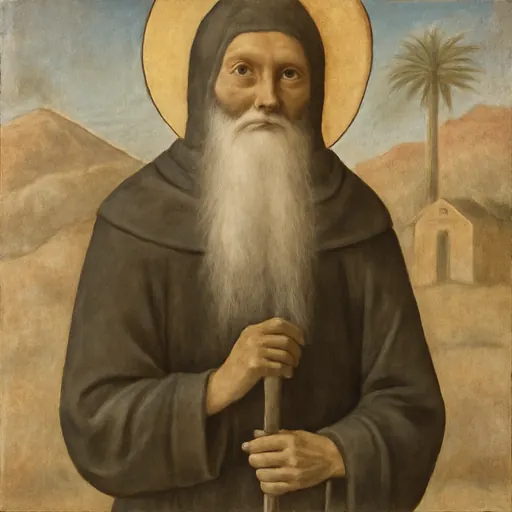
St. Macarius of Egypt (about 300–390), called Macarius the Great, was a disciple of St. Anthony and the founder of the monastic desert of Scetis, today's Wadi El Natrun. He lived sixty years in the desert and was famous for his humility, his gift of healing and his short, wise sayings. We keep his feast on January 15 (January 19 in the Orthodox Church), and he is a patron of monks and hermits.
Who was St. Macarius of Egypt?
St. Macarius of Egypt, known as Macarius the Great, was one of the first and most loved of the Desert Fathers. A disciple of St. Anthony the Great, he went into the wilderness of northern Egypt in the fourth century and became the father of the monks of Scetis, the valley we now call Wadi El Natrun. The monastery that still bears his name there has had monks for some sixteen hundred years.
We keep his feast on January 15. The Orthodox Church remembers him on January 19, and the Coptic Church on the day of his death, 27 Paremhat (April 5).

From camel driver to monk
The Monastery of St. Macarius tells his early life from its Coptic sources. He was born about the year 300, the son of a priest, in a village of the Nile Delta. As a young man he drove camels loaded with natron, the salt dug from the lakes of the valley where he would later live. The monastery's tradition says that once, asleep by his camels, he saw a cherub who promised him that this desert would be his inheritance and that he would have many spiritual children.
He was married young, according to the OCA, and soon widowed, and he cared for his parents until they died. Then he went to live near an old hermit outside his village and learned to pray and to weave baskets.
There he was falsely accused of fathering a child by a young woman of the village. The villagers dragged him out of his cell, beat him and mocked him. He said nothing in his defense and sent the money from his baskets to support her. When her labor would not come to an end, she confessed who the real father was. Before the villagers could come to apologize, Macarius had fled into the desert, because he feared their praise more than their blows.
The father of Scetis
About 330 he settled in Scetis. The name, the monastery explains, comes from the Coptic for "weighing of the heart," from the tradition that the cherub measured his heart and gave him the desert. Disciples came to live in mud-brick cells around his own. He visited Anthony twice, in 343 and 352, and Anthony gave him the monastic habit and his staff. At forty he was ordained a priest.
Palladius, who went to the Egyptian desert a year after Macarius died, says he "lived a full ninety years" and spent sixty of them in the desert. He was so wise so young that the monks called him the "aged youth." He was "said to be in a continual ecstasy," Palladius writes, and to spend more time with God than with the things of earth.
When crowds disturbed his prayer, he dug a tunnel from his cell to a hidden cave half a stade away (about a hundred yards). One of his disciples told Palladius that Macarius said twenty-four prayers on the way there and twenty-four on the way back.
The humility of Abba Macarius
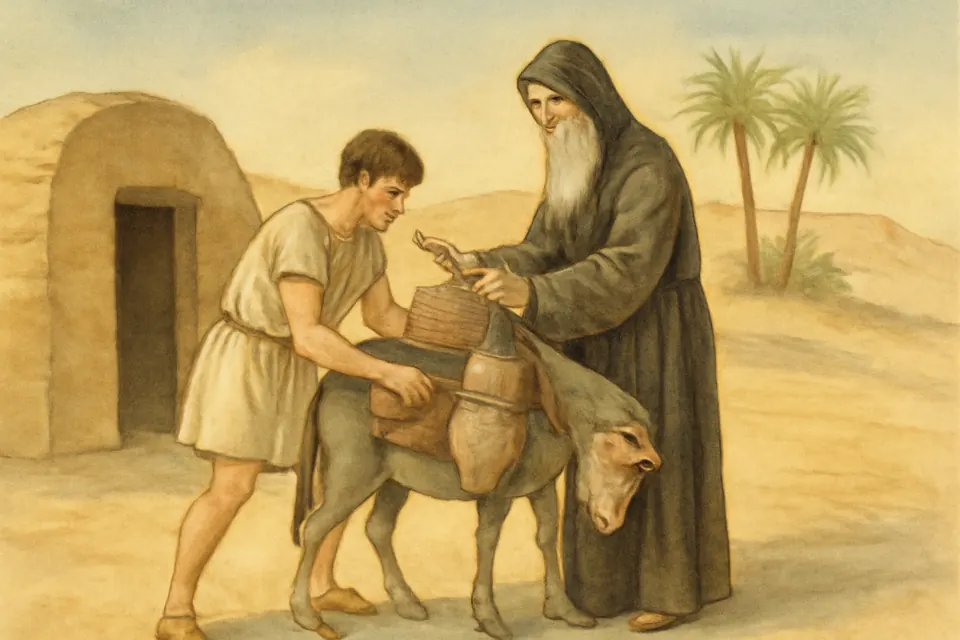
The stories told about Macarius are almost all about humility. The OCA tells how he once came back to his cell to find a thief loading his things onto a donkey. Without saying the things were his, he helped tie on the load, telling himself, "We bring nothing at all into this world; clearly, it is not possible to take anything out from it. Blessed be the Lord for all things!"
When a young monk asked how to be saved, Macarius sent him to a cemetery to insult the dead and then to praise them. "They were silent to both praise and reproach," the young man reported. "If you wish to be saved," said Macarius, "be as one dead."
The monks said of him, in the words the monastery quotes from the sayings of the Fathers, that he became "a god upon earth, because, just as God protects the world, so Abba Macarius would cover the faults which he saw, as though he did not see them; and those which he heard, as though he did not hear them."
In 373, under the Arian emperor Valens, Macarius and his disciple Macarius of Alexandria were exiled to an island of the Nile inhabited only by pagans. When he freed the daughter of the local priest from an evil spirit, the whole village was baptized, and the two old men were allowed to come home. He died about 390 at Scetis.
The miracles of St. Macarius
The wonders told of Macarius are traditional, handed down by the monks of the desert. Palladius, who heard them from Macarius's own disciples, admits he hesitates to write them down "lest I should incur the suspicion of being a liar."
- The woman thought to be a mare. A husband brought his wife to Macarius, convinced that a magician had turned her into a horse. Macarius told the monks, "You are horses, since you have the eyes of horses." He blessed water, poured it over her and prayed, and everyone saw her as a woman again. He told her never to stay away from Communion.
- The tormented boy. A mother brought him a young man possessed by a demon of insatiable hunger. Macarius prayed and fasted with him for seven days and sent him home cured, with a sensible diet and work to do.
- The dead raised. Palladius records a report, "current in the desert," that Macarius raised a dead man to convince a heretic who denied the resurrection of the body.
Why St. Macarius is a patron of monks and hermits
Macarius is a patron of monks and hermits because he was one of the founders of monastic life. The pattern of Scetis, with monks living alone in their cells all week and gathering for the liturgy on Saturday and Sunday, spread through Egypt and, through St. John Cassian, to the West.
Symbols of St. Macarius in art
- Long white beard and monk's habit: in icons he is an old monk, often with a beard reaching to his waist, as in the fresco above.
- The staff: the staff of St. Anthony that he received, a sign that he carried Anthony's work forward.
- The cherub: Coptic icons often show a cherub at his side, the guardian of his vocation in Coptic tradition.
- Palm branches or baskets: the work of his hands.
- A skull: for the story in which he spoke with the skull of a pagan priest about the souls of the dead.
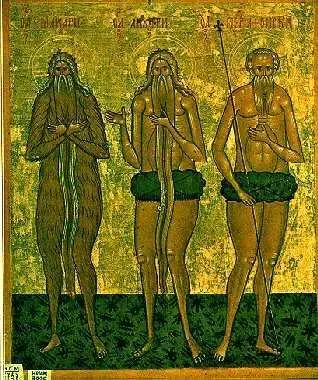
In some Byzantine icons he stands among the naked hermits of the desert, covered only by his hair, as in the icon of three hermits above. To recognize him, look for an ancient monk with a very long beard, sometimes with a cherub.

Where St. Macarius is honored
The Monastery of St. Macarius the Great in Wadi El Natrun keeps his body. The monastery records that his own villagers carried it off in 480 and kept it until 793, when the Coptic patriarch John IV brought it back. It now rests on the north side of the church named for him. Find more saints on our feast days calendar and patron saints page.
Prayer of St. Macarius
Several prayers in the Orthodox Prayers Before Sleep and morning prayers are traditionally attributed to St. Macarius, and the Fifty Spiritual Homilies have come down under his name. The prayer he taught is the shortest of all. When the monks asked him how to pray, he answered, in the OCA's translation:
Prayer does not require many words. It is needful to say only, "Lord, as Thou wilt and as Thou knowest, have mercy on me." If an enemy should fall upon you, you need only say, "Lord, have mercy!"
Let us pray it with him, and ask St. Macarius to obtain for us a humble heart.
Frequently asked questions
Who was St. Macarius of Egypt?
An Egyptian monk of the fourth century who went into the desert at about thirty, learned from St. Anthony, and gathered the first monks of Scetis. He was ordained a priest, lived to about ninety, and was so humble and wise that the other monks called him a "god upon earth."
What is the difference between Macarius of Egypt and Macarius of Alexandria?
They were contemporaries and friends. Macarius of Egypt, "the Great," was the elder and founded the monks of Scetis; Macarius of Alexandria, a former seller of sweets in the city, was his disciple and shared his exile. Palladius wrote a chapter on each.
What prayer did St. Macarius teach?
When monks asked him how to pray, he said that many words are not needed, only "Lord, as Thou wilt and as Thou knowest, have mercy on me," and in temptation simply "Lord, have mercy!"
When is the feast of St. Macarius of Egypt?
January 15 in the West, January 19 in the Orthodox Church, and 27 Paremhat (April 5) in the Coptic Church, the day of his death.
Keep exploring
Sources
- Palladius, The Lausiac History, chapter 17: Macarius of Egypt (tr. W. K. Lowther Clarke, 1918). His ninety years, sixty in the desert, the "aged youth," his tunnel and cave, the woman thought to be a mare, and the healed boy
- Monastery of St. Macarius the Great: St Macarius the Great. The cherub, the name Scetis, his visits to Anthony in 343 and 352, his exile in 373, his death on 27 Paremhat, and the history of his body
- Orthodox Church in America: Venerable Macarius the Great of Egypt (January 19). His sayings, including his teaching on prayer, the thief and the donkey, the two married women, and the prayers attributed to him