St. Dorothea of Caesarea, Virgin Martyr of the Roses and Apples

St. Dorothea of Caesarea (also St. Dorothy) was a young Christian woman martyred at Caesarea in Cappadocia during the persecution of Diocletian. On her way to death, a lawyer named Theophilus mocked her by asking for fruit from her Bridegroom's garden; tradition says a child brought him roses and apples in winter, and he became a Christian and a martyr himself. Her feast is February 6, and she is a patron saint of gardeners.
Who was St. Dorothea of Caesarea?
St. Dorothea of Caesarea, also called St. Dorothy, was a young Christian virgin who gave her life for Christ at Caesarea in Cappadocia, in central Turkey today, during the last great persecution of the Roman Empire under Diocletian. The Catholic Encyclopedia dates her death to February 6, 311; other accounts place it around 304. We keep her feast on February 6.
Her story has come down to us as a legend more than a history. What is certain is that she was honored as a martyr very early: she appears, together with Theophilus, in the ancient martyrology attributed to St. Jerome, and the West has venerated her since the seventh century.

The legend of St. Dorothea
Before the judge
In the oldest version of her story, Dorothea was brought before the governor Sapricius, tried, tortured and sentenced to death because she would not give up Christ. Later retellings add much more: that her family had fled Rome for Cappadocia to escape persecution, that a governor wanted to marry her, and that she survived a cauldron of boiling oil and nine days in a dark prison without food. These details grew over the centuries, and the Ökumenisches Heiligenlexikon notes that from the fourteenth century her passion spread in many German verse and prose versions.
Roses and apples in winter
As she was led to execution, she said she was going gladly to her Bridegroom, in whose garden she would gather roses and apples forever. A pagan lawyer named Theophilus called out to her in mockery:
Bride of Christ, send me some fruits from your bridegroom's garden.
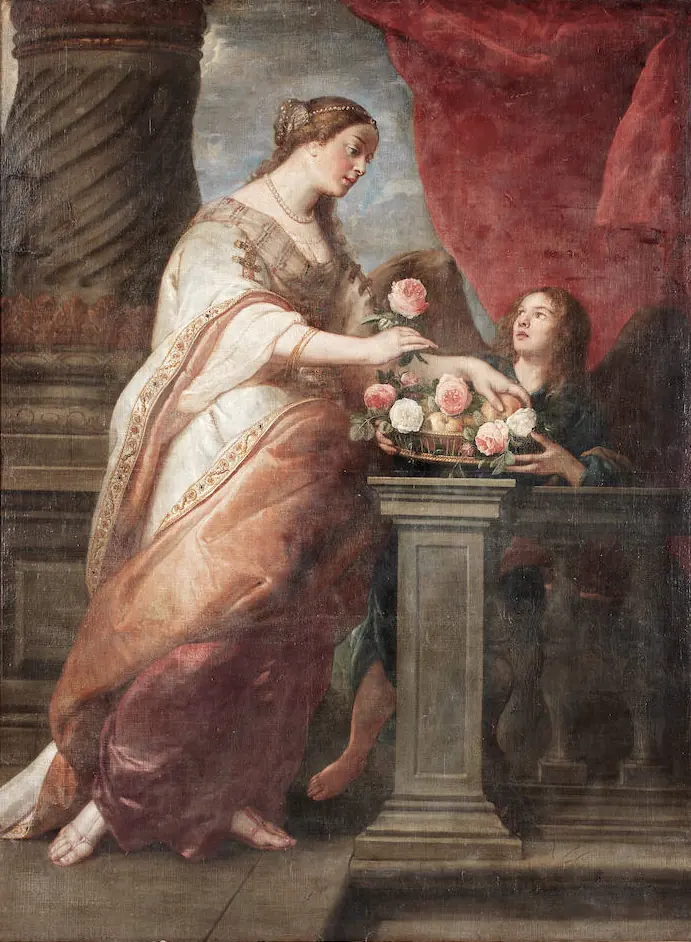
Before she was beheaded, according to the Catholic Encyclopedia's summary of the oldest version, she sent him by a six-year-old boy her headdress, which was found to be filled with a heavenly fragrance of roses and fruits. In later versions the child, often understood to be an angel, carries a basket of roses and apples, and it is the depth of winter. Theophilus at once confessed that he was a Christian. He was put on the rack and martyred too.

This is a traditional miracle: it comes to us through the legend, not through any record we can test. Its meaning is clear all the same. The man who laughed at the garden of heaven received a gift from it, and the gift converted him.
Why St. Dorothea is the patron saint of gardeners
Because of the basket of roses and fruit, she is the patron saint of gardeners, and on her feast trees were blessed in some places, as the Catholic Encyclopedia records. In German-speaking lands she was also invoked by florists, brides and newlyweds, as well as by brewers, miners and mothers in childbirth. In medieval Germany she was one of the four virgines capitales, the chief virgin martyrs, with St. Barbara, St. Margaret and St. Catherine of Alexandria. See more on our patron saints page.
Symbols of St. Dorothea in art
- Basket of roses and apples: the fruits of the heavenly garden she sent to Theophilus.
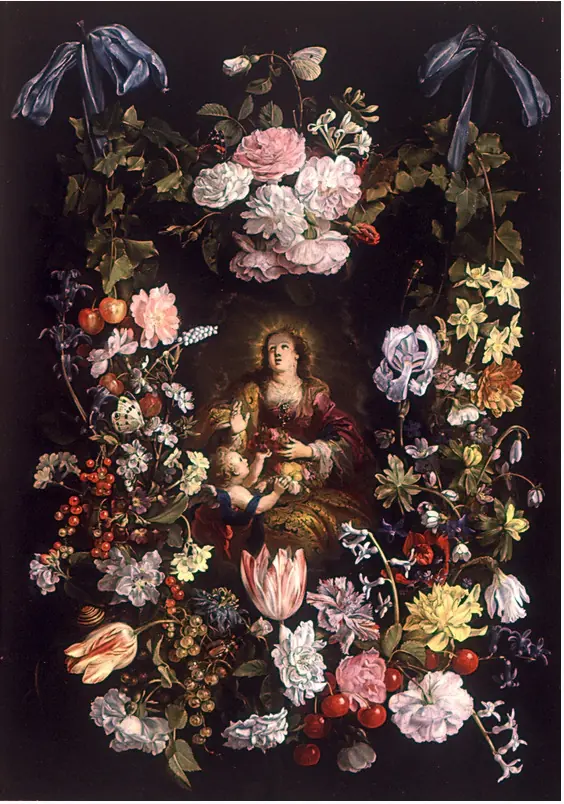
- Wreath or crown of flowers: the bride of Christ.
- An angel or a small child: the messenger who carried her gift.
- Palm and sword: her martyrdom by beheading.
She was one of the most popular saints of late medieval art. In German and Swiss altarpieces she is a richly dressed young woman with a basket on her arm, often standing beside Barbara, Margaret and Catherine. Baroque painters such as Gaspar de Crayer added the angel, and Flemish flower painters like Philips de Marlier framed her in garlands. If you see a young woman saint with a basket of roses, check for apples and a child: that is Dorothy. (St. Elizabeth of Hungary, the other "roses" saint, wears a crown and a widow's veil.)
Feast day, customs and relics
We keep her feast on February 6. It was dropped from the General Roman Calendar in the 1969 reform, but she is in the current Roman Martyrology, and the Orthodox Church keeps her on the same day. The Heiligenlexikon records old customs: Dorothea plays in medieval eastern Germany, and at Eger (today Cheb, in the Czech Republic) schoolchildren publicly sang songs to her on her day from at least 1455 and were given small gifts. A head relic was kept in the town hall chapel of Breslau (Wrocław) from 1445, and relics are honored in Rome and Bologna. Lisbon keeps a feast of the translation of her relics to the Jesuit church of São Roque on January 25.
Her February feast also left its mark on country sayings in German lands, where she is linked with the last heavy snows of winter. The Heiligenlexikon collects many of them; the best known runs St. Dorothee bringt den meisten Schnee: "St. Dorothy brings the most snow." It is a gentle irony for a saint whose gift was roses in the snow.
The great painters loved her too. Ambrogio Lorenzetti painted her on the wing of a Marian altarpiece around 1325, now in Siena, and Titian placed her beside the Virgin and Child with St. George in a painting now in the Prado.

Praying with St. Dorothea
We have not found a traditional English prayer to St. Dorothea with a source we can cite, so we ask her help simply: "St. Dorothea, pray for us."
Let us ask her to pray for gardeners and for all who work the land, for couples preparing for marriage, and for those who mock the faith, that like Theophilus they may one day receive a sign of the garden they laughed at.
Frequently asked questions
Who was St. Dorothea of Caesarea?
A virgin martyr of the early fourth century who died for Christ at Caesarea in Cappadocia, in what is now central Turkey, under Diocletian. She is best known for the legend of the roses and apples she sent from heaven to the lawyer Theophilus.
What is St. Dorothy the patron saint of?
Gardeners above all, because of her basket of flowers and fruit. In German-speaking lands she is also invoked by florists, brides and newlyweds.
When is St. Dorothea's feast day?
February 6. She was taken off the General Roman Calendar in the 1969 reform, but she remains in the Roman Martyrology, and the Orthodox Church keeps her on the same day.
Why is St. Dorothy shown with a basket of roses?
Because of the oldest form of her legend: Theophilus asked her to send him fruits from her Bridegroom's garden, and before her death a child brought him a headdress (in later versions, a basket) filled with the scent of roses and fruit.
Keep exploring
- Patron saint pages
- Marriage
- Feast-day calendar
- Saints remembered in FebruarySaint of the day
- More
- Saints A to ZPatron saints A to ZExplore every section
Sources
- St. Dorothea, Catholic Encyclopedia (1909), New Advent. The oldest version of her legend, Theophilus's words to her, her patronage of gardeners, the blessing of trees on her feast, and her cult in the West since the seventh century
- Dorothea von Cäsarea, Ökumenisches Heiligenlexikon. Her first mention in the Martyrology of St. Jerome, the later German versions of her passion, the virgines capitales, her removal from the calendar in 1969, relics, the Breslau head relic, the Eger school custom and her patronages (in German)