St. Jonah of Kiev, Elder and Founder of the Holy Trinity Monastery
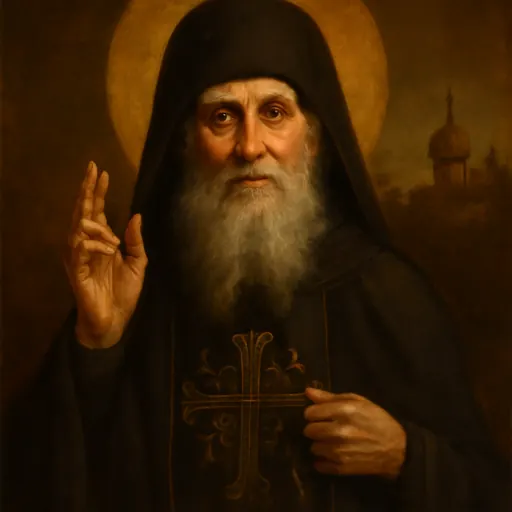
St. Jonah of Kiev (1802–1902) was an Orthodox monk and elder, a disciple of St. Seraphim of Sarov, who founded the Holy Trinity Monastery in Kyiv, now called the Ionin Monastery after him, and was sought out by thousands for counsel and prayer. He died at about a hundred on January 9, 1902 (Julian calendar), and we keep his feast on January 22. The Ukrainian Orthodox Church glorified him in 1996, and his relics rest in the monastery he founded.
Who was St. Jonah of Kiev?
St. Jonah of Kiev was an Orthodox monk who lived to about a hundred, founded a monastery on the green heights above the Dnieper in Kyiv, and spent half a century receiving the crowds who came to him for counsel. The Orthodox call such a man a starets, an elder. He died on January 9, 1902, by the old Julian calendar, which is January 22 on the civil calendar, and the Orthodox keep his feast on the day of his repose. He is a saint of the Ukrainian Orthodox Church, glorified in 1996, and is not on the Roman calendar.
He was born Ivan Miroshnichenko in 1802 in Kryukiv, a small town across the river from Kremenchuk in the Poltava province. His family was poor, and he learned little beyond reading, but he read constantly, mostly lives of the saints and books of devotion.
A disciple of St. Seraphim
As a young man he went to the great elder St. Seraphim of Sarov and served him, by the account of the Encyclopedia of Modern Ukraine, for eight years. The memoirs his monks later collected say that Seraphim, near the end of his life, sent him to the Beloberezh hermitage near Bryansk. He entered there as a novice in 1836, became a monk in 1843 with the name Jonah, and was ordained a deacon in 1845. The memoirs add that at Beloberezh he was granted a vision he understood as a call to build a monastery on the Dnieper.
Founding the Holy Trinity Monastery
In 1851 he came to Kyiv and joined the St. Nicholas Monastery. He was ordained a priest in 1858 and two years later moved to the Vydubychi Monastery, on the wooded riverbank south of the city. Kyivans already came to him for advice.
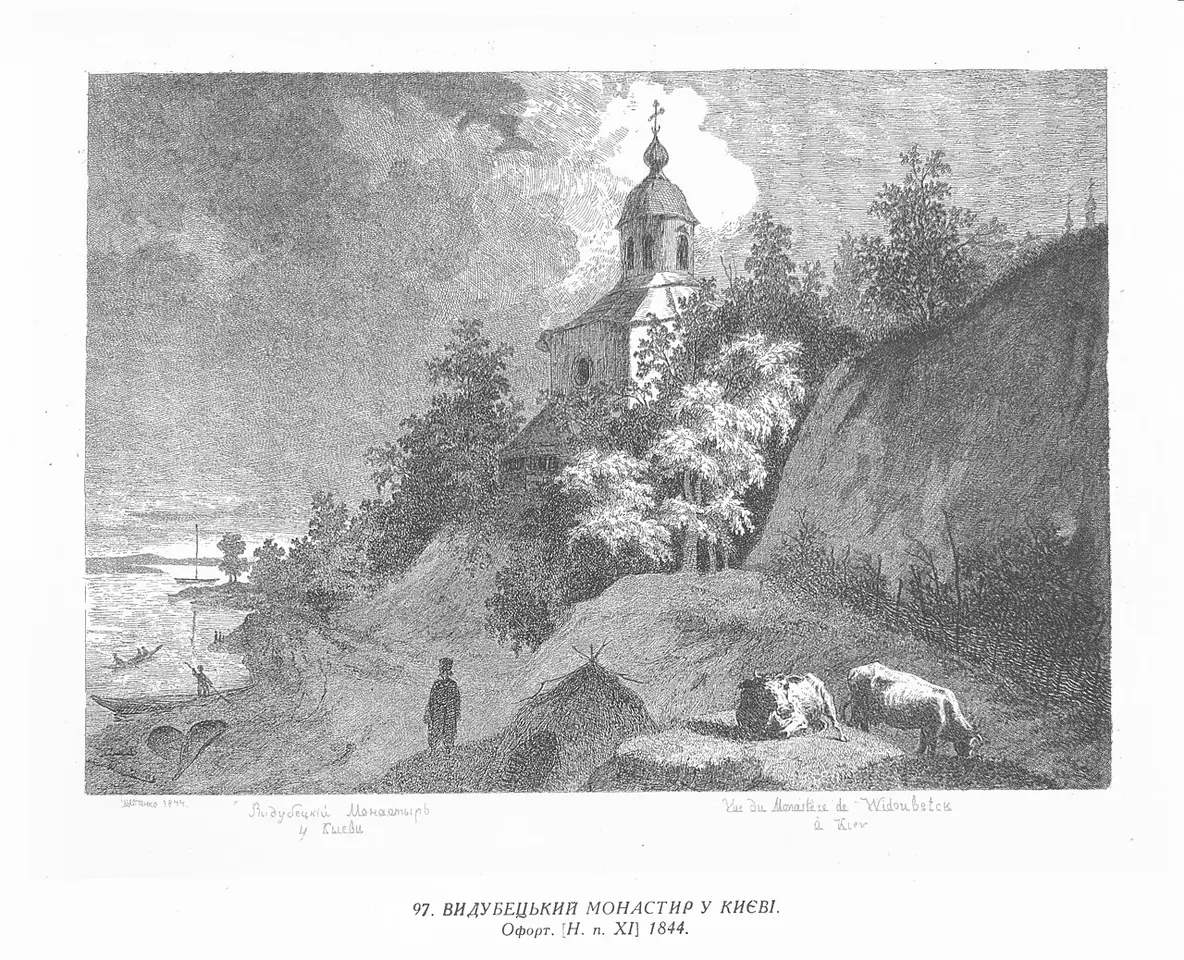
Above Vydubychi, in the area called Zvirynets, he chose a plot of land, bought with the help of his spiritual daughter, Princess E. A. Vasilchikova. The memoirs date one of his great visions to March 1, 1861: the Mother of God surrounded by radiant light. In 1864 a small wooden church of the Holy Trinity went up, with a cell beside it, and in 1866 the community of his disciples was approved as a monastery under a strict common life. He became its abbot, a hegumen in 1872 and an archimandrite in 1886.
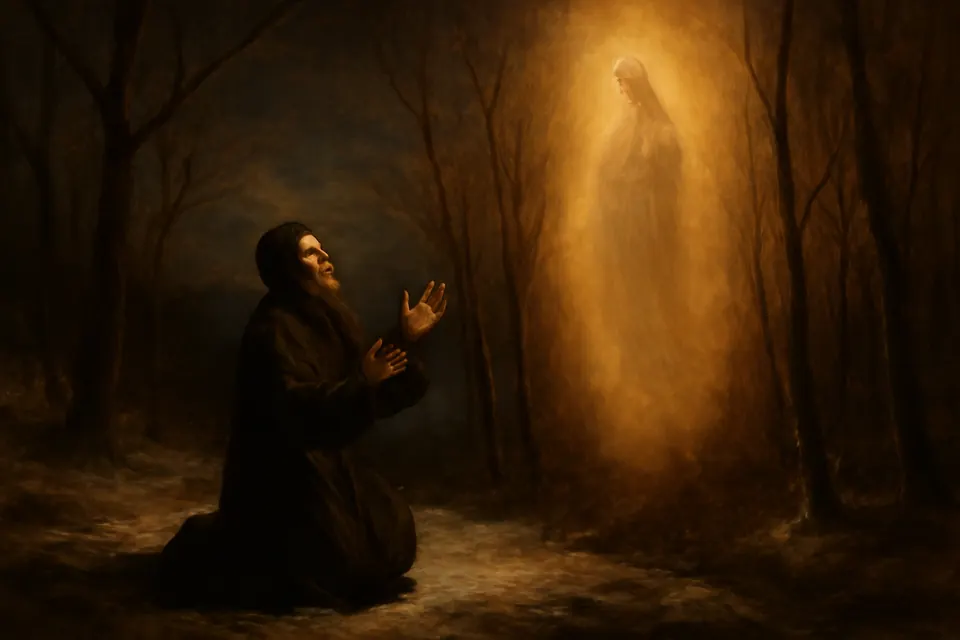
He did not want his visions forgotten. He had an icon painter record them, revising each picture until it matched what he had seen. They show the Holy Spirit overshadowing the monastery, and the Mother of God, Christ and the saints blessing it.
Mezhyhirya and old age
From 1886 he also restored and led the ruined Mezhyhirya Transfiguration Monastery north of Kyiv, once the great monastery of the Zaporozhian Cossacks, for about a decade.

His counsel was plain and sometimes stern. When an old woman complained of her hardships, he took her by the sleeve and told her to remember how she had lived before, and to endure with thanks to God. He seldom blessed pilgrimages to Jerusalem; the heavenly Jerusalem mattered more. In his workshop he carved wooden spoons. He took the great schema, the strictest monastic rank, with the name Peter.
Miracles and wonders
The stories gathered about him are told by his monks and visitors. None has been the subject of a formal investigation.
- Reported: soon after he became an archimandrite, an old monk named Makary saw Jonah's face shine like a child's during the Gospel at the liturgy, too bright to look at, before it returned to normal.
- Reported: in 1892 cholera struck the Circassian village of Tokhtamukay in the North Caucasus, killing twenty or more people a day. A Muslim resident, Medzhid Khadzhibiev, telegraphed Kyiv asking for prayers and was told that Father Jonah was praying for the village. He later wrote in a newspaper that the deaths fell sharply and that from August there were no new cases.
- Reported: many visitors told of his clear sight into their hearts and of healings through his prayers; their accounts fill a long section of the memoirs gathered by his monks.

His death and relics
In his last years his legs failed him and he developed dropsy. In his final days he ate nothing and received Holy Communion daily. He died at half past midnight on January 9, 1902. At his funeral on January 12, according to the memoirs, about 30,000 people came, and he was laid in the crypt of the monastery church.
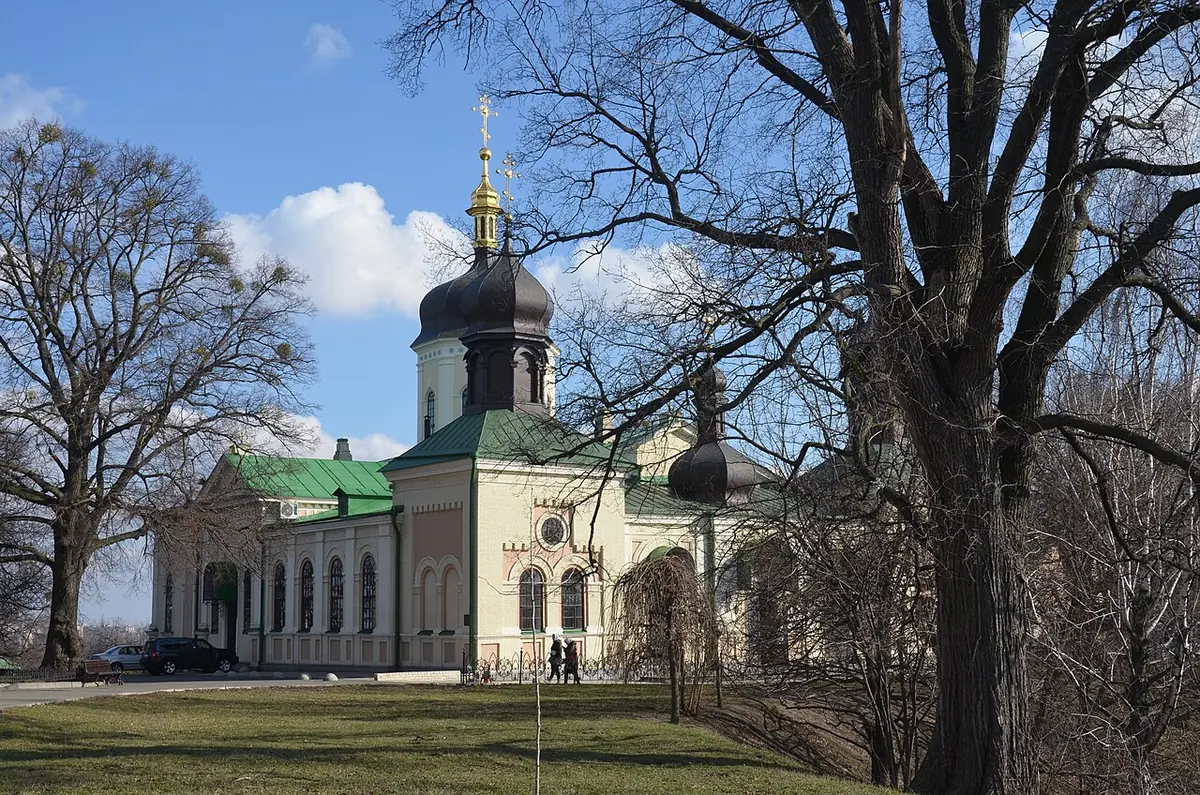
The Soviet authorities closed the monastery in 1927 and gave its grounds to the botanical garden. In 1966 his relics were moved from the damaged crypt to the Zvirynets cemetery. The monastery came back to life from 1991, and in 1993 his relics were returned to the Holy Trinity church. The Synod of the Ukrainian Orthodox Church numbered him among the saints in 1996.
Symbols of St. Jonah of Kiev in art
Icons of St. Jonah are recent, since he was glorified only in 1996. Look for:
- An aged monk with a long white beard: he lived to about a hundred.
- The black robes of the great schema: embroidered with crosses, the dress of the strictest monastic rank he took at the end of his life.
- A monastery church in his hand or behind him: the Holy Trinity monastery he founded.
- A prayer rope or a raised hand of blessing: the elder receiving those who came to him.
Feast day and prayer
The Orthodox keep his feast on January 9 (22), the day of his repose. The Holy Trinity Ionin Monastery, beside the botanical garden in Kyiv, keeps his relics and his little wooden house, where his icons and the sofa on which he died are still shown. See the feast day calendar for other saints of January.
The Orthodox Church honors him with a troparion and kontakion in its services, but we have not been able to confirm a reliable English text, so we do not print one here. Let us ask St. Jonah, who taught the suffering to give thanks and who prayed even for those of another faith, to pray for Kyiv and for all who seek wise counsel. Holy Father Jonah, pray to God for us.
Frequently asked questions
Who was St. Jonah of Kiev?
Born Ivan Miroshnichenko in 1802 in Kryukiv, near Kremenchuk, he served St. Seraphim of Sarov as a novice, became a monk in 1843 and came to Kyiv in 1851. There he founded the Holy Trinity monastery on the Zvirynets heights, restored the Mezhyhirya monastery, and became one of the best-loved elders of the Russian Empire. He took the great schema with the name Peter and died in 1902.
When is the feast of St. Jonah of Kiev?
His feast is the day of his repose, January 9 on the Julian calendar, which is January 22 on the civil calendar.
Where are the relics of St. Jonah of Kiev?
In the Holy Trinity Ionin Monastery in Kyiv, beside the botanical garden. In 1966, during the Soviet era, they were moved from the damaged crypt to the Zvirynets cemetery, and in 1993 they were brought back to the monastery church.
Was St. Jonah of Kiev a disciple of St. Seraphim of Sarov?
Yes. The Encyclopedia of Modern Ukraine says he was the hermit Seraphim's disciple for eight years, and the memoirs of his monks say Seraphim sent him to the Beloberezh hermitage near Bryansk, which he entered in 1836.
Keep exploring
Sources
- V. V. Zuieva, "Iona," Encyclopedia of Modern Ukraine (2011). Birthplace, dates of his monastic life, the founding dates and his glorification in 1996
- V. V. Zuieva, "Kyiv Holy Trinity Ionin Monastery," Encyclopedia of Modern Ukraine. The monastery's history, its closure in 1927, and the moving of his relics in 1966 and 1993
- Vospominaniya o startse Ione Kievskom (Memoirs of Elder Jonah of Kiev), at azbyka.ru. In Russian. His death and funeral, his visions as painted at his direction, the cholera account of 1892, his cell
- Velikie russkie startsy (Great Russian Elders), 2011: Elder Jonah of Kiev, at azbyka.ru. In Russian. The founding of the monastery, Mezhyhirya, and the shining of his face at the liturgy