Blessed Basil Moreau

Blessed Basil Moreau (1799 to 1873) was a French priest of the Diocese of Le Mans who founded the Congregation of Holy Cross, the family of priests, brothers and sisters that went on to found the University of Notre Dame and schools around the world. He was beatified in Le Mans on September 15, 2007, and his feast day is January 20.
Who was Blessed Basil Moreau?
Blessed Basil Moreau was a French priest who founded the Congregation of Holy Cross, the religious family of priests, brothers and sisters known around the world for its schools, parishes and missions. Born in 1799 in a village near Le Mans, he grew up in a Church wounded by the French Revolution and spent his life rebuilding it through preaching and Christian education. The priest he sent to America, Father Edward Sorin, founded the University of Notre Dame. A brother of his congregation, St. André Bessette, became one of the best-loved saints of Canada.
He was beatified in Le Mans on September 15, 2007, the feast of Our Lady of Sorrows, whom he had chosen as patroness of all Holy Cross. His feast day is January 20.
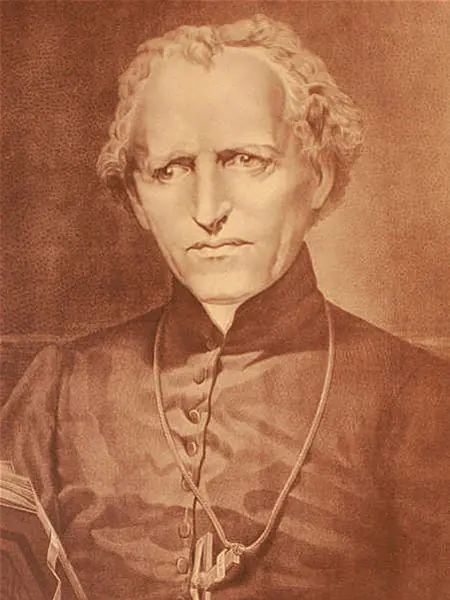
The life of Basil Moreau
A boy from Laigné-en-Belin
Basile-Antoine-Marie Moreau was born on February 11, 1799, at Laigné-en-Belin in the Diocese of Le Mans, the ninth of the fourteen children of Louis and Louise Moreau. Notre Dame News describes the family as poor wine peddlers. The village pastor noticed the boy's prayerfulness and intelligence, and his parents sent him to the seminary. He began studies at St. Vincent's Seminary in Le Mans in 1816 and was ordained a priest on August 12, 1821.
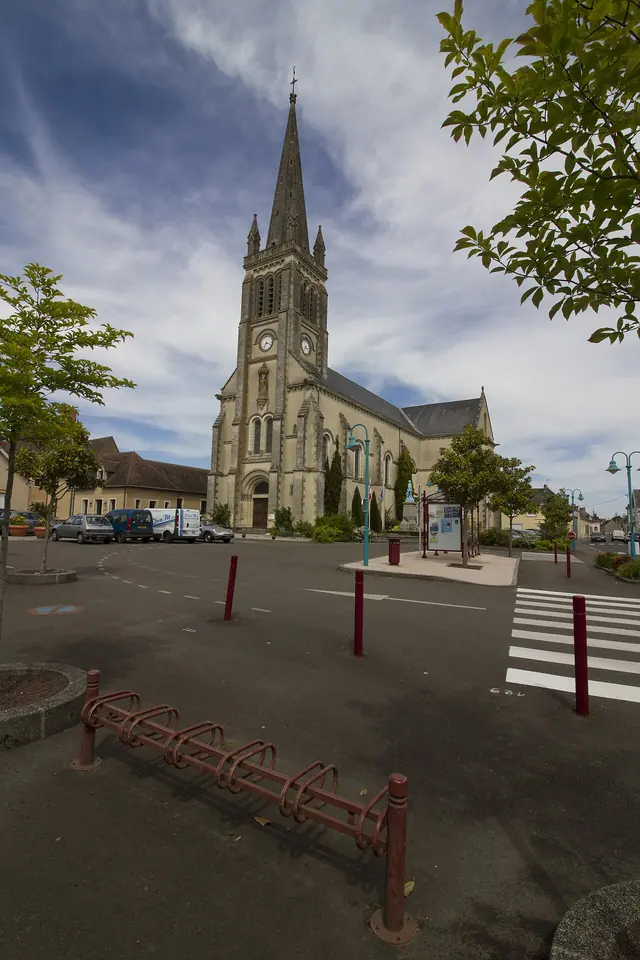
Teacher of priests
His bishop sent him on to Paris for further study at Saint-Sulpice and a year of spiritual formation at the Solitude of Issy. He came back to teach philosophy, then dogma, then Sacred Scripture at the seminary of Le Mans. His students remembered him as a demanding teacher and a man of deep prayer. Notre Dame News quotes his advice to them about the poor:
If you have a marked preference for certain people, it should be for the poorest, the most abandoned the least gifted by nature. If you surround them with the most assiduous attention, it is because their needs are greater, and it is only justice to give more to those who have received less.
The Auxiliary Priests and the Brothers of St. Joseph
The Revolution had left the French Church in ruins. The Congregation of Holy Cross notes that nearly two-thirds of France's clergy and religious had been exiled or killed. In August 1835 Moreau gathered a band of Auxiliary Priests to preach missions in neglected towns and villages. That same month his bishop asked him to take over the Brothers of St. Joseph, a struggling group of teaching brothers founded by Father Jacques Dujarié for rural parish schools.
On March 1, 1837, Moreau joined the priests and the brothers in a Fundamental Act of Union. The new Association of Holy Cross took its name from Sainte-Croix, the district of Le Mans where it lived. In 1841 he founded the Marianites of Holy Cross, sisters devoted to education and evangelization, so that Holy Cross would be a single family of priests, brothers and sisters, modeled on the Holy Family of Nazareth.
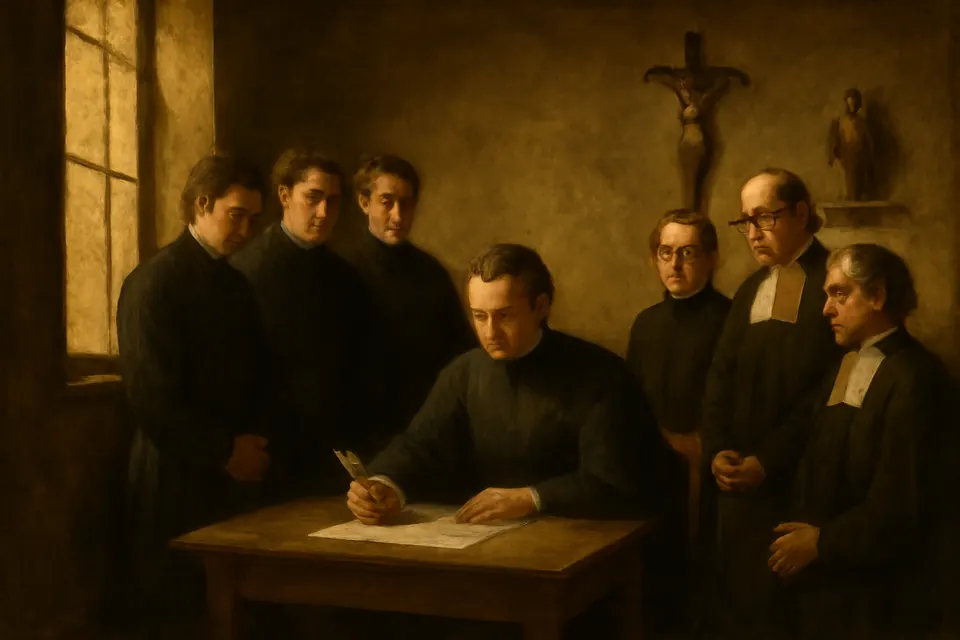
Sent to the ends of the earth
Moreau gave each branch a patron: the priests the Sacred Heart of Jesus, the brothers the heart of St. Joseph, the sisters the Immaculate and Sorrowful Heart of Mary. He also had the conventual church of Notre-Dame de Sainte-Croix built in Le Mans as the spiritual home of the whole family; it was consecrated in June 1857.
Requests for help soon came from abroad. On April 28, 1840, Holy Cross religious left for Algeria, the congregation's first foreign mission. In 1841 Moreau sent Father Edward Sorin and a group of brothers to the Diocese of Vincennes in Indiana, and in 1842 they founded the school that became the University of Notre Dame. Holy Cross went on to Canada, where Brother André Bessette would later build St. Joseph's Oratory in Montreal, and to Bengal, in present-day Bangladesh.
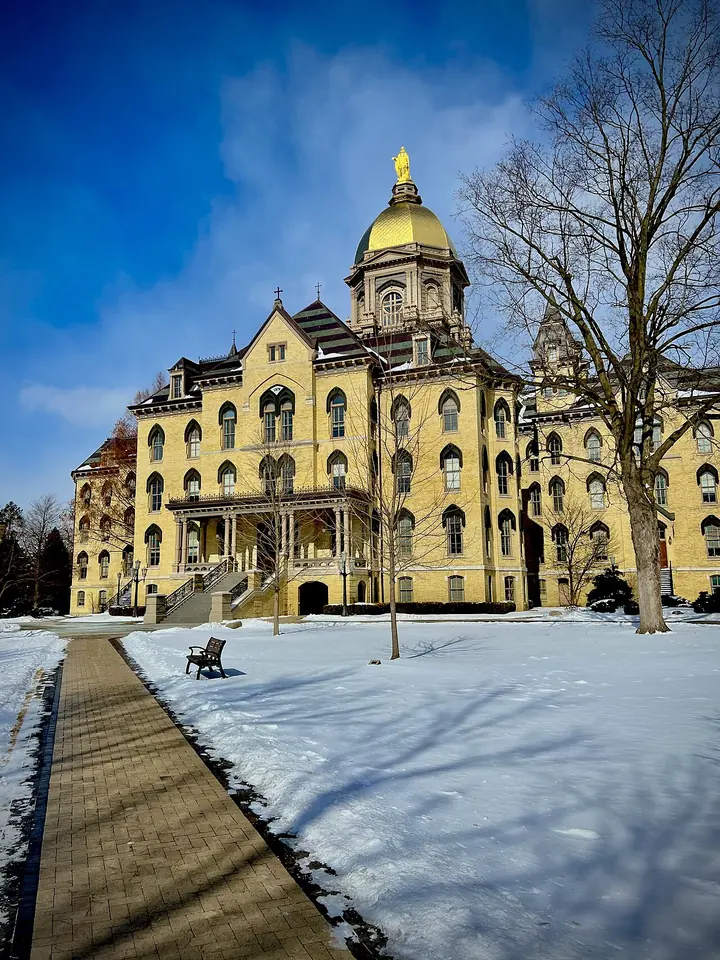
On May 13, 1857, Pope Pius IX approved the constitutions Moreau had written, making Holy Cross a religious congregation of priests and brothers. Rome required the sisters to form separate institutes. The Holy Cross sisters today belong to three congregations: the Marianites of Holy Cross, the Sisters of the Holy Cross based in Indiana, and the Sisters of Holy Cross based in Montreal.
The cross he preached
Moreau's last years brought him the cross he had always preached. The Holy Cross timeline records a "Dark Night of the Soul" in 1855. Financial crises and quarrels divided the congregation, and some members accused him of poor administration. The 2003 decree on his virtues says plainly that "certain members of the Institute for which he had worked tirelessly accused him unjustly." In 1866 Rome accepted his resignation as superior general.
He lived his last years apart from the community he had founded, still preaching parish missions in the countryside around Le Mans until his health gave way. The Marianite sisters cared for him at the end. He died in Le Mans on January 20, 1873, at seventy-three, and was buried in the church he had built.

The miracle and the beatification
The cause for Moreau's beatification was opened in 1946 and presented in Rome in 1955. On April 12, 2003, Pope John Paul II declared that he had lived the Christian virtues to a heroic degree, giving him the title Venerable.
The miracle that opened the way to beatification is approved. In 1948 Laurette Comtois, a young mother in Quebec who had just lost a premature baby, fell gravely ill with double pleurisy. Her cousin, Sister Juliette Beauchemin, was a novice of the Sisters of the Holy Cross. She gave Laurette's father a relic of Father Moreau and promised the prayers of the whole novitiate, and the family began a novena. On the fourth day Laurette was cured. Her doctor told her, "You are so lucky to have passed through a double pleurisy in four days!" She answered, "It's thanks to Fr. Moreau and the prayers of the sixty novices that I am healed."
In 2006 the Holy See declared "that the rapid complete and lasting healing of Mrs Laura Comtois is a miracle accomplished by God through the intercession of the Venerable Servant of God, Basile Antony Marie Moreau." Pope Benedict XVI approved the beatification on April 28, 2006, and it took place in Le Mans on September 15, 2007. Sister Juliette and two of Laurette's daughters were there. Other favors reported through his prayers since then are reported, not yet approved; Holy Cross continues to work for his canonization.
Why Blessed Basil Moreau is honored by educators
Moreau has not been named a patron by the Holy See, but Holy Cross schools, colleges and parishes around the world look to him as their founder and model, and many Catholic teachers ask his prayers. He wrote a treatise on teaching, Christian Education (1856), and the Congregation of Holy Cross sums up his vision in his own words:
We shall always place education side by side with instruction; the mind will not be cultivated at the expense of the heart. While we prepare useful citizens for society, we shall likewise do our utmost to prepare citizens for heaven.
For Moreau, education was the way to bring the Gospel back to a country that had turned away from it. See more holy teachers on our patron saints page.
Symbols of Blessed Basil Moreau in art
As a modern blessed, Moreau is known mostly from photographs and portraits, and from new stained glass and statues in Holy Cross schools. Look for:
- A black cassock and long gray hair: the French diocesan priest, as in his portraits from the 1860s.
- The cross and anchor: the emblem of Holy Cross, joining the cross with the anchor, the old Christian sign of hope. It hangs at his chest in his official portrait.
- The motto Ave Crux Spes Unica: "Hail the Cross, our only hope," often written beneath his image.
- Our Lady of Sorrows or the Holy Family: the patroness he gave Holy Cross and the model on which he built it.
- Hearts: the Sacred Heart of Jesus, the Immaculate Heart of Mary and the heart of St. Joseph, the patrons of his three branches.
Feast day and where he is honored
We keep the memorial of Blessed Basil Moreau on January 20, the day of his death. Holy Cross communities call it Moreau Day and celebrate it in schools, parishes and universities from Indiana to Bangladesh. See the saints of the season on our feast days page.
His tomb is in the crypt of the church of Notre-Dame de Sainte-Croix in Le Mans, where Holy Cross established the International Shrine of Blessed Basile Moreau in 2013 and 2014. The church is still a parish, and pilgrims come to pray at his tomb and to see where Holy Cross began.
The congregation he founded has given the Church a canonized saint, Brother André Bessette, the humble doorkeeper of Notre-Dame College in Montreal, canonized in 2010.

Prayer to Blessed Basil Moreau
The Congregation of Holy Cross publishes this prayer for his intercession:
Lord Jesus, source of all that is good, you inspired Basile Moreau to found the religious family of Holy Cross to continue your mission among the People of God. May he be for us a model of apostolic life, an example of fidelity, and an inspiration as we strive to follow you.
Lord Jesus, you said, "Ask and you shall receive." We come to ask you that you hear our prayer. It is through the intercession of Basile Moreau that we ask … (state your intention)
May we learn to imitate his holiness and service and look to him confidently in times of need. Amen.
The collect from the Mass of his memorial, also given by Holy Cross, asks for the courage he had:
O God, who in your ineffable Providence, chose your priest, Blessed Basile, to imitate the virtues of the Holy Family and respond to the needs of the Church, grant, we beseech you, that, supported by his prayers and example, we may have the strength to boldly confess the Cross of Christ as our only hope. We ask this through our Lord Jesus Christ, your Son, who lives and reigns with you and the Holy Spirit, one God, forever and ever. Amen.
Let us ask Blessed Basil Moreau to pray for every teacher and student, and to help us find hope in the cross.
Frequently asked questions
Who was Blessed Basil Moreau?
A French priest, born in 1799 near Le Mans, who rebuilt Catholic life after the French Revolution through preaching and education. In 1837 he united a group of auxiliary priests with the Brothers of St. Joseph to form the Association of Holy Cross, added the Marianite sisters in 1841, and sent his religious to Algeria, the United States, Canada and Bengal. He died in Le Mans on January 20, 1873.
What miracle led to Basil Moreau's beatification?
The healing of Laurette Comtois, a young mother in Quebec, from double pleurisy in 1948. Her cousin, a Holy Cross novice, gave the family a relic of Moreau and the novices prayed a novena; on the fourth day she was cured. In 2006 the Holy See declared the healing "rapid complete and lasting" and a miracle through his intercession.
Did Basil Moreau found Notre Dame?
Not directly. He sent Father Edward Sorin, C.S.C., and a group of Holy Cross brothers to Indiana, where Sorin founded the University of Notre Dame in 1842 as a work of Holy Cross. The university is still run in the Holy Cross tradition.
When is Blessed Basil Moreau's feast day?
January 20, the day he died in 1873. Holy Cross communities around the world celebrate it as Moreau Day.
What does "Ave Crux Spes Unica" mean?
It is Latin for "Hail the Cross, our only hope," the motto of the Congregation of Holy Cross. Moreau taught his religious to find hope in the cross, and Our Lady of Sorrows is the patroness of all Holy Cross.
Keep exploring
- Patron saint pages
- Teachers
- Feast-day calendar
- Saints remembered in JanuarySaint of the dayWhat saint is my birthday?
- Same name
- Other saints named Basil →
- Relics
- Where the relics are kept (map)
- More
- Saints A to ZPatron saints A to ZExplore every section
Sources
- Congregation of Holy Cross: Blessed Basile Moreau, Timeline
- Congregation of Holy Cross: Blessed Moreau, On the Way with Him (the Comtois healing and the decrees)
- Congregation of Holy Cross: Prayers to Blessed Basile Moreau
- Congregation of Holy Cross: Charism
- Notre Dame News: Father Basil Moreau to be beatified Sept. 15 in France (2006)
- Congregation of Holy Cross: Congregation Establishing a Shrine in Honor of Blessed Basile Moreau in France (2013)