Blessed Sebastian Valfrè, the Apostle of Turin
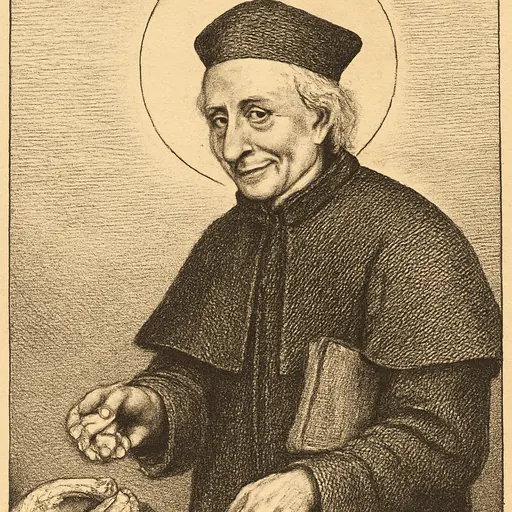
Blessed Sebastian Valfrè (1629–1710) was a priest of the Oratory of St. Philip Neri in Turin, called the Apostle of Turin, who spent fifty years teaching the faith to the poor, the sick, soldiers, prisoners and galley slaves. He was confessor to Duke Victor Amadeus II, refused to become archbishop, and mended the Shroud of Turin in 1694. His feast is January 30.
Who was Blessed Sebastian Valfrè?
Blessed Sebastian Valfrè was a priest of the Oratory of St. Philip Neri in Turin and one of the first to bring Philip's way of life to Piedmont. For half a century he taught the catechism wherever people were poor or forgotten: hospitals, poorhouses, prisons, barracks and the galleys. Dukes asked his advice, and the Duke of Savoy proposed him as Archbishop of Turin, but he humbly refused. The Catholic Encyclopedia calls him the "Apostle of Turin." He died on January 30, 1710, and Pope Gregory XVI beatified him in 1834.
The life of Blessed Sebastian Valfrè
A farm boy from Verduno
Sebastian was born at Verduno in the hills of Piedmont on March 9, 1629, to a family of poor farmers. A priest from the same village testified in the beatification process that his own mother, urging him to fast in Lent, told him the servant of God Sebastian Valfrè had fasted all Lent on bread and water at about ten years of age. The boy studied for the priesthood, joined the young Oratory in Turin, and was ordained there; in time he became a member of the theology faculty of the university.
Catechist of the whole city
His 1834 biography lists the places he taught: poorhouses for girls, a refuge for women, the catechumens, a hospital for wounded soldiers, the senate's prisons, and the convicts chained in the citadel. The Marquis Morozzo, who ran the great hospital of Charity with more than 1,500 poor, testified that Sebastian labored there "indefatigably" and that many of those poor people reached "a high degree of virtue."
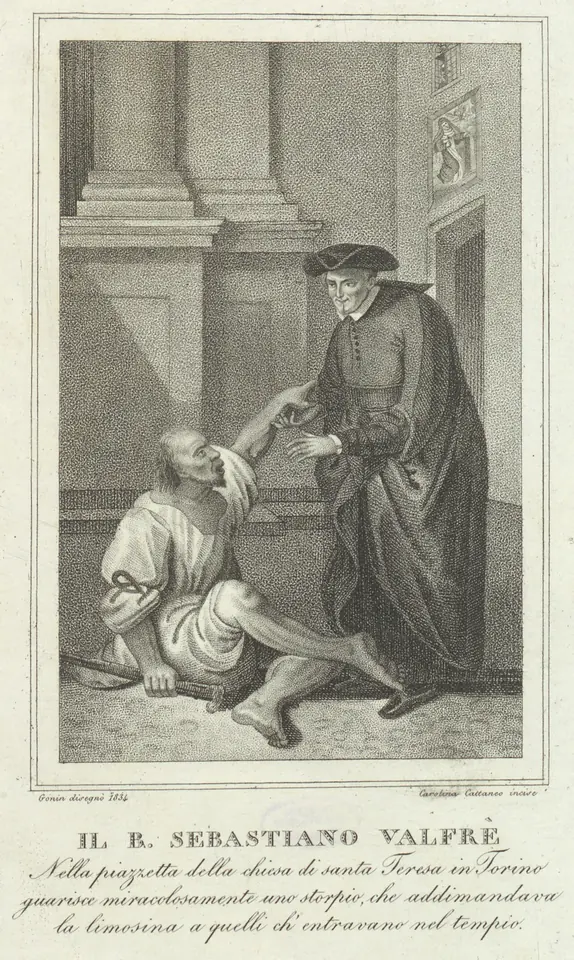
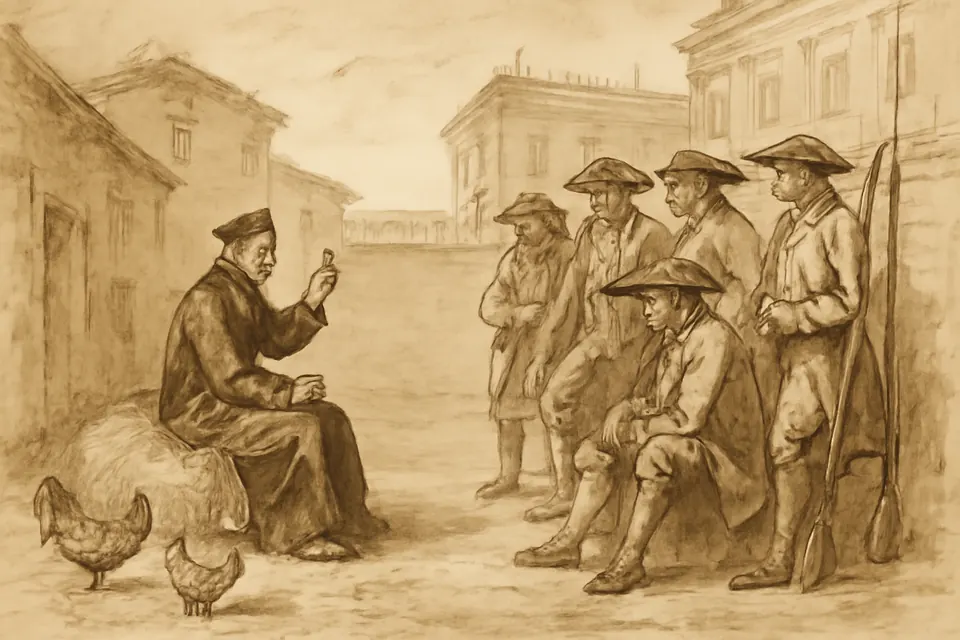
He gave alms with every lesson and asked the poor to make the sign of the cross as he gave. Before the siege of 1706, seeing soldiers idling under the arcades of Piazza San Carlo, he gathered them in the farmyard of the Count della Villa, sat on a chair set on the dung heap, and taught them the faith, ending, as always, with alms.
Confessor to a duke
Duke Victor Amadeus II, later king, made him his confessor and trusted his counsel. Sebastian used the trust for the poor and never for himself. When the court almoner once embraced him and said, "You, Father Valfrè, are a real saint," he turned it aside with a joke and left the room.
The siege of 1706
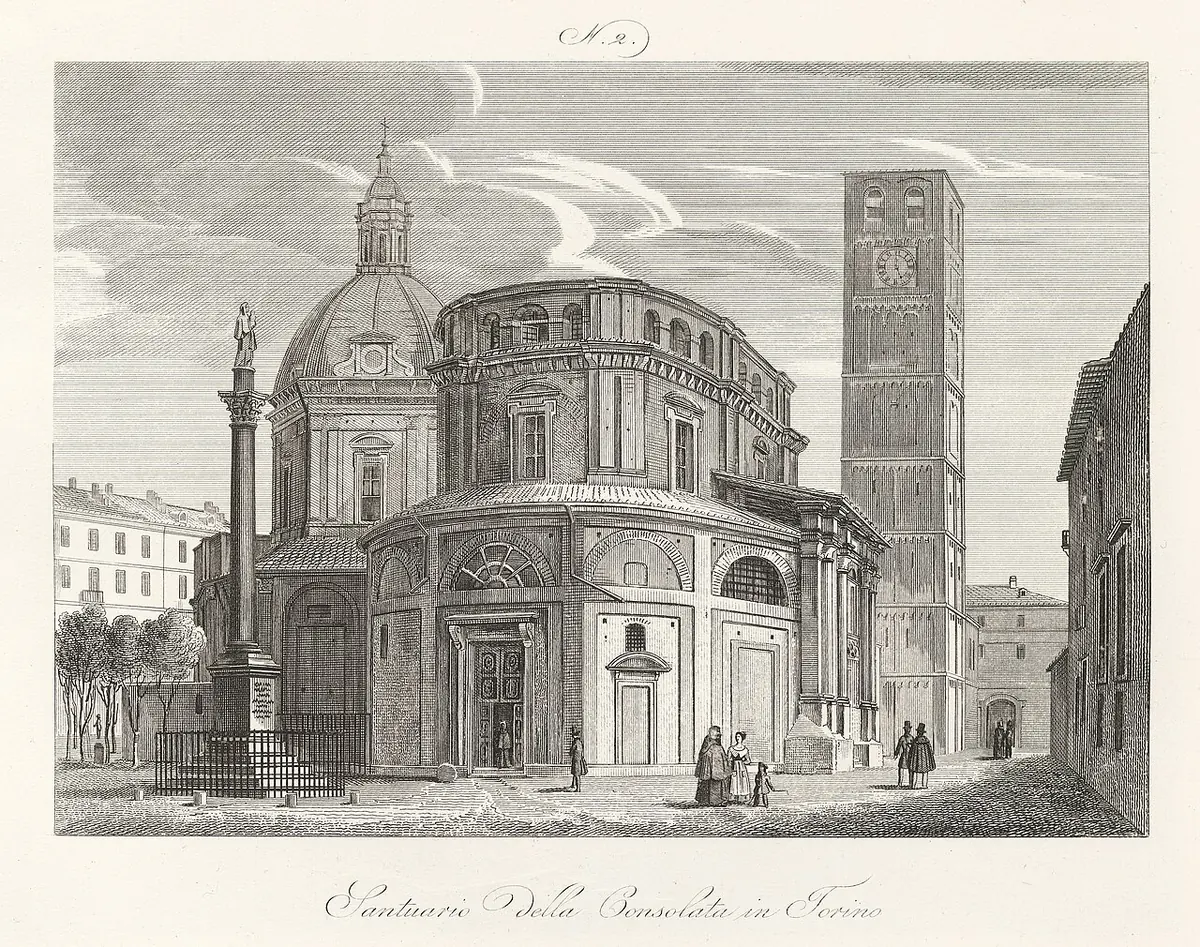
In 1706 a French army besieged Turin. Sebastian went through the city telling everyone to trust in the Virgin: "Have recourse to the Virgin... diligently visit her sanctuary 'della Consolata;' invoke this good mother in your distress, and you will certainly be heard." To a priest who had lost all hope he said, "let us go on praying, for to-morrow we shall be delivered." The siege was lifted on September 7, the eve of Our Lady's Nativity. When the duke asked how to give thanks, Sebastian wrote in February 1707 that the deliverance had come through Mary's intercession, so the thanks should go to her.
Blessed Sebastian and the Shroud of Turin
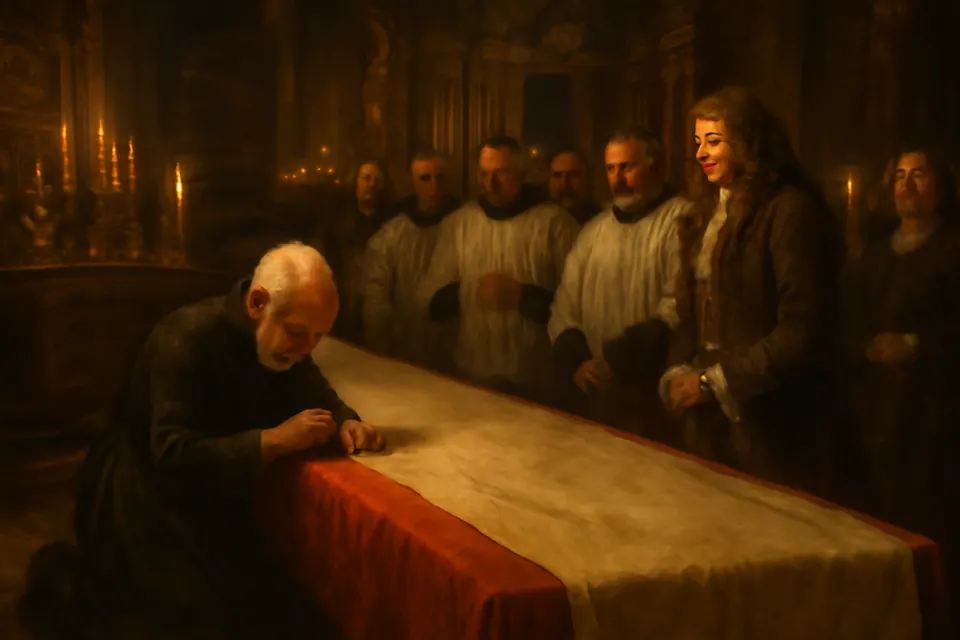
He loved to meditate on Christ's Passion, and all his life he urged people to go and venerate the Shroud of Turin. In 1694, when the veils that wrapped the Shroud were to be changed, the sovereign wanted him present. A tear was found near one end, and Sebastian was asked to mend it with his own hands.
His death and miracles
In January 1710, already past eighty, he went into the citadel on a bitter Sunday and catechized the convicts for three quarters of an hour standing on ice and snow. He fell ill soon after and died peacefully on the morning of January 30. The king said: "I have lost a great friend, the congregation a great support, and the poor a great protector and a father." Crowds filled the church crying, "A great saint is dead!"
Two approved miracles opened the way to his beatification. Sister Maria Felice Panuzia, a seventy-year-old nun paralyzed since November 1709, prayed to him after his death and rose and walked on February 1, 1710. Domenica Lucia Fassi, sixteen, was cured in 1734 of a fever with convulsions that had brought her near death. Pope Gregory XVI declared on May 26, 1831, that it was safe to proceed to the beatification.

Symbols of Blessed Sebastian Valfrè in art
- Black cassock and biretta: the dress of an Oratorian priest.
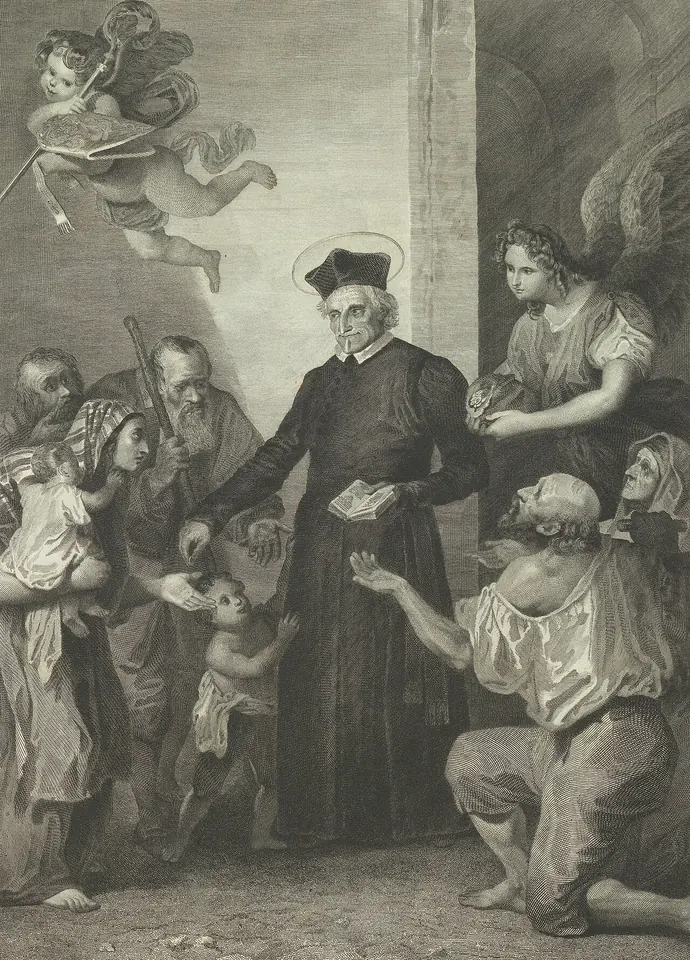
- Alms and the poor around him: his title of father of the poor.
- A beggar healed at his feet: the miracles told of him, as in Gonin's print.
- The Shroud: his devotion to the Passion and the repair of 1694.
Feast day and prayer
We keep his feast on January 30; see the feast days calendar. The collect of the Archdiocese of Turin for his memorial begins: "O Dio, tu illumini il cammino della Chiesa con l'esempio dei tuoi santi" ("O God, you light the Church's way by the example of your saints"), and asks that his life may move us always to imitate the Son. Let us ask Blessed Sebastian to pray for catechists, for prisoners, and for all who serve the poor.
Frequently asked questions
Who was Blessed Sebastian Valfrè?
A farmer's son from Verduno in Piedmont who became one of the first priests of the Oratory in Turin. He was a tireless catechist and almsgiver, adviser to the Savoy court, and so loved that the city cried 'A great saint is dead!' when he died in 1710.
What did Sebastian Valfrè have to do with the Shroud of Turin?
He urged the people to venerate the Shroud, and in 1694, when its wrappings were changed, the duke had him present; finding a tear near one end, he was asked to repair it himself.
When is the feast of Blessed Sebastian Valfrè?
January 30, the day he died. It is an optional memorial in the Archdiocese of Turin.
What miracles were approved for his beatification?
Two cures: Sister Maria Felice Panuzia, a paralyzed nun of St. Pelagia's in Turin, healed on February 1, 1710, two days after his death; and Domenica Lucia Fassi of Villafranca, cured of a grave fever with convulsions in 1734.
Keep exploring
Sources
- The Lives of the Blessed Sebastian Valfrè, of the Oratory of Turin; Father Antonio de' Santi... and Others (London: Richardson, 1849), translated from the Roman life of 1834. His childhood fast, the catechism of soldiers and galley slaves, the siege of 1706 and his letter of 1707, the Shroud in 1694, his death, the king's words, and the two approved miracles
- Beato Sebastiano Valfrè, sacerdote, memoria facoltativa, Arcidiocesi di Torino, Ufficio liturgico. His refusal of the see of Turin, his burial in San Filippo, the January 30 memorial and its collect
- Henry Sebastian Bowden and Augustin Ingold, Oratory of Saint Philip Neri, Catholic Encyclopedia (1911), Wikisource transcription. Valfrè as the 'Apostle of Turin' and founder of the Oratory there