St. Meinrad of Einsiedeln

St. Meinrad of Einsiedeln was a ninth-century Benedictine monk of Reichenau who became a hermit in the forests of central Switzerland. On January 21, 861, he was killed by two robbers to whom he had given hospitality, and his hermitage grew into Einsiedeln Abbey and the shrine of Our Lady of the Hermits. We keep his feast on January 21; his emblem is two ravens.
Who was St. Meinrad of Einsiedeln?
St. Meinrad of Einsiedeln was a Benedictine monk and priest who left a great abbey to live alone with God in the forests of central Switzerland, and who died there in 861 at the hands of two robbers he had welcomed as guests. He is called the Martyr of Hospitality. His little cell became the seed of Einsiedeln Abbey, one of the oldest and best-loved places of pilgrimage in Europe, where the statue of Our Lady of the Hermits is still honored today.
We keep his feast on January 21, the day he died. In art he is easy to know: a monk in a black habit with two ravens.
From Reichenau to the forest
Meinrad was born late in the eighth century in the Sülichgau, in what is now Württemberg in southern Germany. Older Einsiedeln tradition counts him a member of the family of the Counts of Hohenzollern. As a boy he was sent to the abbey school of Reichenau, the island monastery on Lake Constance, where his kinsmen Hatto and Erlebald were abbots. He became a monk there and was ordained a priest.
For a time he taught at a small school belonging to the abbey at Babinchowa, on the upper shore of Lake Zurich. But the life of the Desert Fathers drew him. Like St. Anthony the Great in Egypt, he wanted to give himself entirely to prayer.
Hermit on the Etzel
He first settled on the slopes of the Etzel, a wooded pass above the lake, and lived there about seven years. According to the Catholic Encyclopedia, he carried with him a statue of the Virgin Mary that the Abbess Hildegard of Zurich had given him, and he built a small chapel for it. People found him anyway. So many came for prayer and counsel that he went farther into the dark forest, to the place where Einsiedeln (the name means "hermitage") stands today.
There he lived in poverty and silence. Whatever gifts pilgrims left, he passed on to the poor.

The Martyr of Hospitality
On January 21, 861, two men came to the hermitage. The New Catholic Encyclopedia says only that he was murdered "by two robbers to whom he had given hospitality." The later Einsiedeln tradition fills in the scene: Meinrad knew why they had come, said Mass, received them kindly, gave them bread and drink, and then was beaten to death. The robbers found nothing of value. The treasure they expected was not there.
The monks of Reichenau carried his body back to their island and buried him there. In 1039 his relics were brought home to Einsiedeln.
The miracles and legends of St. Meinrad
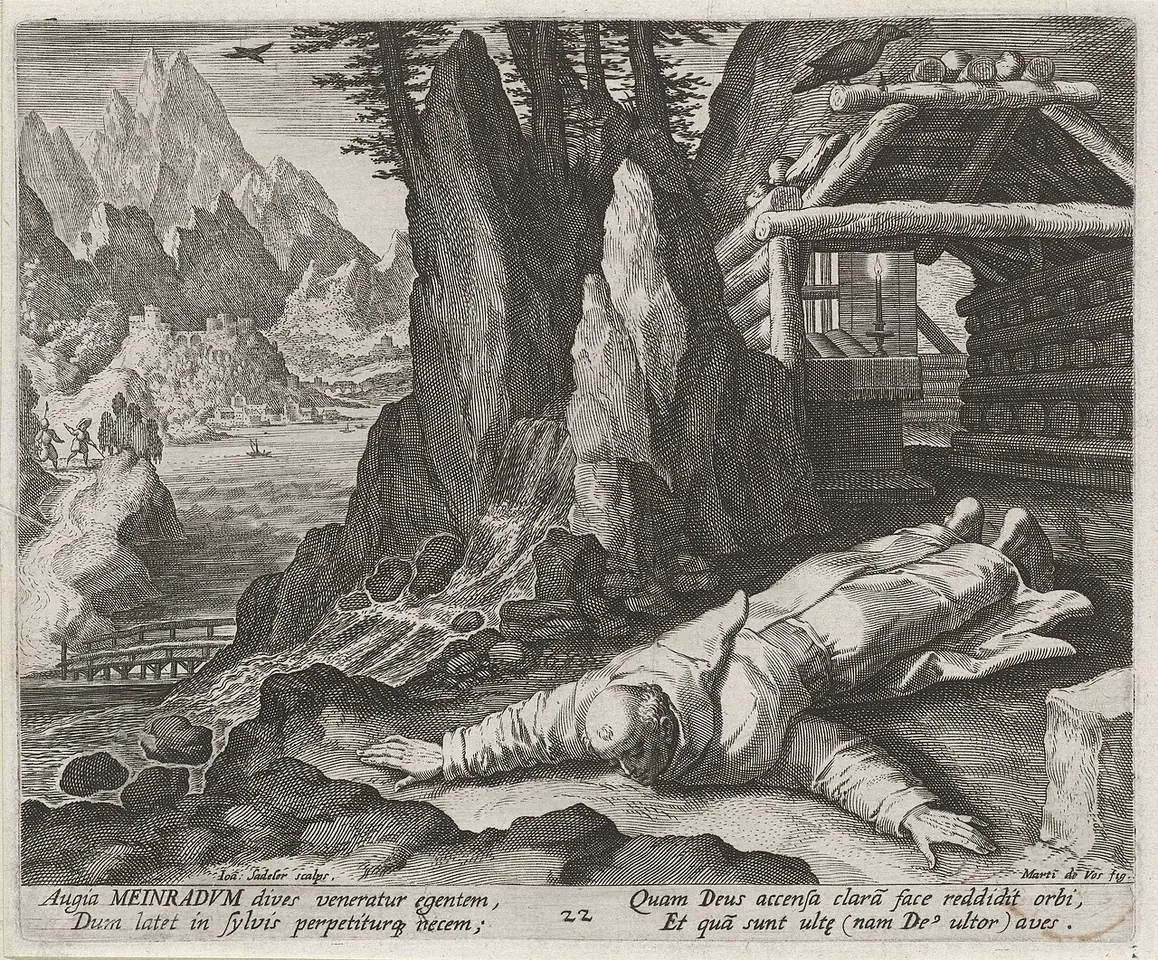
- Traditional: the two ravens. Tradition holds that Meinrad had raised two young ravens at his cell. After his death they followed the murderers, crying and beating their wings, all the way to Zurich, where people noticed the strange birds, recognized them as the hermit's ravens and seized the men. The robbers confessed and were executed.
- Traditional: the angelic consecration. In the century after Meinrad, the hermit Eberhard, once provost of Strasbourg, built a monastery and a church on the site of his cell. Legend says that in 948 Christ himself consecrated the chapel, attended by the Four Evangelists, St. Peter and St. Gregory the Great. The Catholic Encyclopedia records that later popes ratified the tradition, and September 14 is still the great pilgrimage day of the "Engelweihe."
Neither story has been formally examined in the way modern miracles are. We hold them as the Church's long tradition at Einsiedeln.

Why St. Meinrad is honored at Einsiedeln
Meinrad founded no abbey and wrote no books. He went into the woods to pray, and he died forgiving and welcoming. Yet the place never forgot him. For eighty years after his death, the Catholic Encyclopedia says, his cell was never without hermits following his example, and from them Einsiedeln Abbey grew. It became a principality of the empire, a center of learning and music, and a shrine that drew pilgrims from all over Catholic Europe. St. Wolfgang of Regensburg was a monk there, and St. Nicholas of Flüe prayed there.
The statue that Meinrad honored in his chapel is the root of the devotion to Our Lady of the Hermits. The chapel built on the spot of his cell still stands, encased in black marble, inside the great Baroque abbey church. The statue there today is a later medieval one; its face and hands have long been dark, which is why it is known as one of Europe's Black Madonnas.

Symbols of St. Meinrad in art
- Two ravens: his own emblem, the birds of the hermitage that betrayed his murderers.
- Black Benedictine habit: he was a monk of Reichenau all his life.
- Club: the weapon of his martyrdom, sometimes shown in the robbers' hands.
- Statue of Our Lady: the image he brought to the Etzel, linking him to Our Lady of the Hermits.
- Log cell in the forest: as in Sadeler's engraving of 1594, part of a famous series of hermit saints.
If you see a monk with two black birds in a church in Switzerland, southern Germany or Alsace, it is almost certainly St. Meinrad. Don't confuse him with St. Benedict, who is shown with one raven carrying away a poisoned loaf.
Feast day and where he is honored
We keep St. Meinrad's feast on January 21. At Einsiedeln Abbey, in the canton of Schwyz, his relics rest with the community that grew from his hermitage. A chapel dedicated to him crowns the Etzel Pass, where he first lived alone, on the old pilgrim road to Einsiedeln and on toward Santiago de Compostela. In the United States, Saint Meinrad Archabbey in southern Indiana was founded in 1854 by monks from Einsiedeln and bears his name.

See the feast day calendar for the other saints of January.
Prayer to St. Meinrad
There is no single traditional prayer to St. Meinrad in the standard English prayer books. Benedictines keep his memory in the liturgy of his feast, and pilgrims ask his help in their own words at Einsiedeln. Let us ask St. Meinrad to pray for hermits and monks, for all who open their doors to strangers, for those who suffer violence in return for kindness, and for every pilgrim on the road to Our Lady.
Frequently asked questions
Who was St. Meinrad?
A monk and priest of the abbey of Reichenau on Lake Constance who left to live as a hermit, first on the slopes of the Etzel and then deeper in the forest. Two robbers he had welcomed killed him in 861. Einsiedeln Abbey was later built on the site of his cell.
Why is St. Meinrad shown with two ravens?
Tradition holds that he kept two ravens at his hermitage and that after his murder they followed the killers to Zurich, where the men were recognized and arrested. The New Catholic Encyclopedia calls them his beloved pets and the betrayers of his murderers.
When is St. Meinrad's feast day?
January 21, the anniversary of his death in 861.
Why is he called the Martyr of Hospitality?
Because he died at the hands of the men he had just fed and sheltered. He welcomed them as guests even though, by tradition, he knew why they had come.
Keep exploring
Sources
- New Catholic Encyclopedia: Meinrad of Einsiedeln, St. (Encyclopedia.com). His birthplace, his years at Babinchowa and on the Etzel, the date of his death and the 1039 translation of his relics
- Catholic Encyclopedia (1909): Abbey of Einsiedeln. The statue from Abbess Hildegard, the hermit Eberhard, the legend of the angelic consecration in 948 and the pilgrimages