St. Savina of Milan
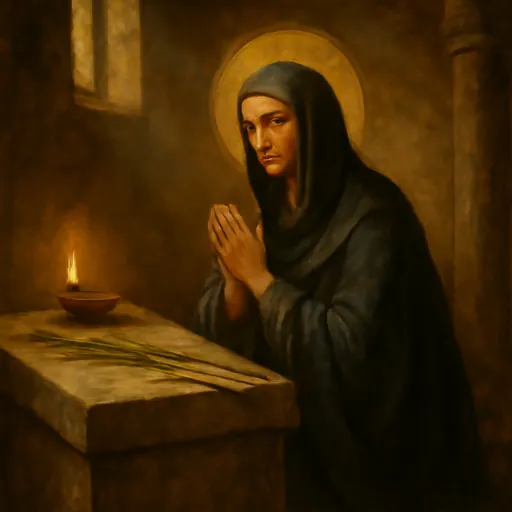
St. Savina of Milan was a Christian widow of the early fourth century who buried the soldier-martyrs Nabor and Felix, beheaded at Lodi, and later carried their bodies to Milan. The Roman Martyrology says she died there while praying at their tomb, about 311. We keep her feast on January 30, and her relics rest beside theirs in Sant'Ambrogio.
Who was St. Savina of Milan?
St. Savina of Milan was a Christian widow who lived through the last great persecution of the Roman Empire. When two soldiers, Nabor and Felix, were beheaded for Christ at Lodi, she took care of their bodies, and when peace came she carried them to Milan. She spent the rest of her life in prayer beside their tomb and died there, about the year 311. We keep her feast on January 30.
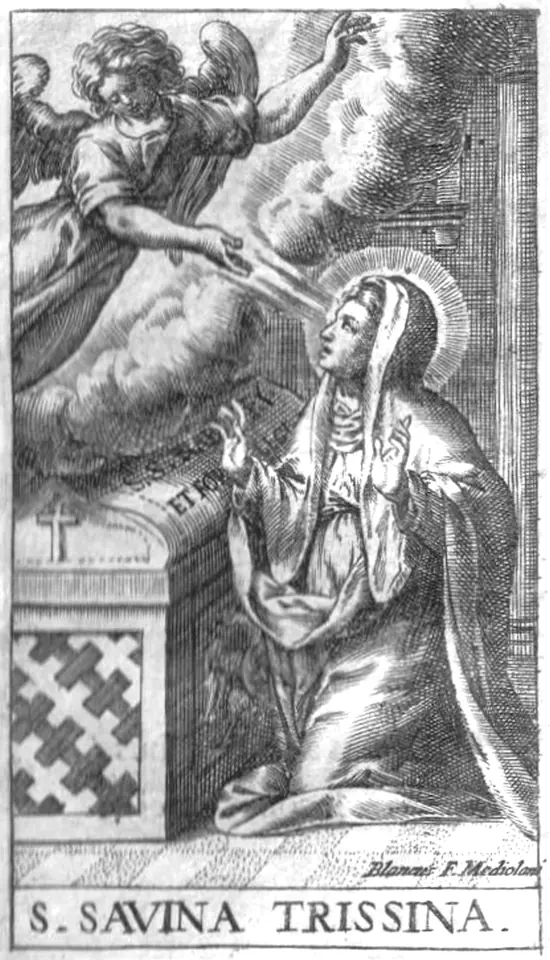
Her story is short and comes to us mostly through tradition. The oldest witness is the Roman Martyrology, which remembers her on January 30 in one sentence: at Milan, "St. Savina, a most religious woman, who went to rest in the Lord whilst praying at the tomb of the holy martyrs Nabor and Felix." Later lives, one of them published in Milan in 1627 with the engraving shown below, fill in more detail, and they don't always agree. We give the tradition as tradition.
A widow in a time of persecution
Tradition makes Savina a noblewoman, born in Milan in the later third century. The New Liturgical Movement's account, following the Milanese tradition, says she belonged to the Valerii family and married a patrician of Laus Pompeia, the town we now call Lodi. Other accounts link her to the Trissino family, which honored her as one of its own; the 1627 engraving calls her "Savina Trissina." All agree that she was widowed young and gave herself to prayer and charity.
When Diocletian's persecution reached northern Italy, she cared for Christians in prison. Among the martyrs of those years were Nabor and Felix, two soldiers, of the Theban Legion by one tradition, who refused to give up the faith. They were beheaded at Lodi, and Savina buried them secretly in her own house.
The martyrs' bodies come to Milan
When the persecution ended, Savina resolved to give the martyrs a worthy grave in Milan. The tradition tells a well-loved story about the journey. Afraid that guards on the road would stop her, she hid the relics in a barrel. When soldiers demanded to see what she carried, she told them it was honey, and when they opened it they found nothing but honey, and let her pass. The town where this happened, about ten miles southeast of Milan, is Melegnano, a name local tradition connects with mel, Latin for honey. We should call this what it is: a traditional miracle, loved in Lombardy, with no record from the time.

The relics of Nabor and Felix were laid in Milan, in the chapel of the Valerii according to one tradition, and later honored in a basilica of their own. Two generations later St. Ambrose, bishop of Milan, sang of them in one of his hymns.
Her death at the tomb
Savina did not go home. She stayed near the martyrs, keeping vigils and fasting, and there she died, praying, as the Martyrology says. She was buried beside them.
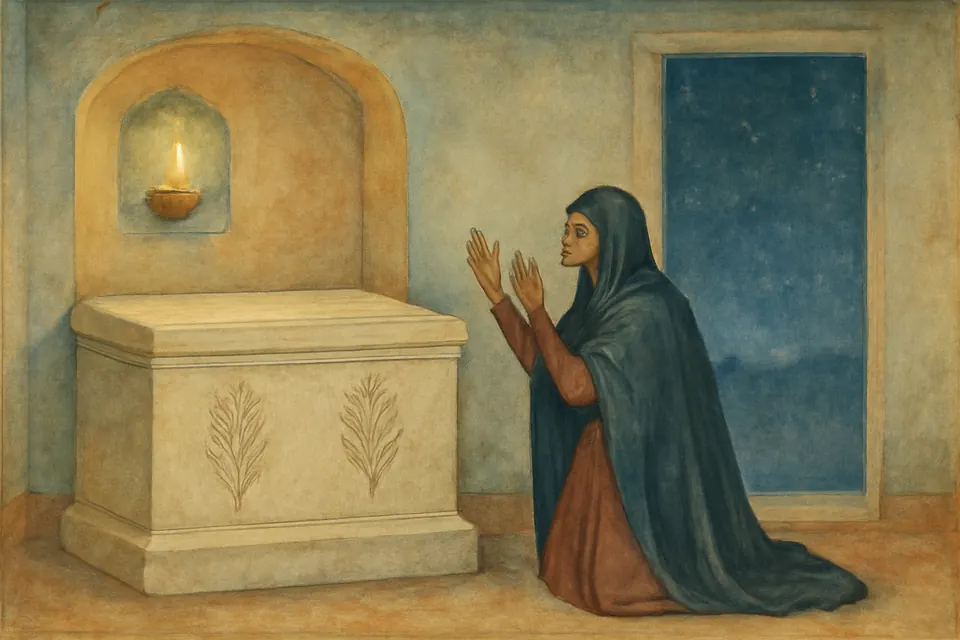
Her relics shared the martyrs' later journeys. When their old basilica in Milan, San Francesco Grande, was pulled down around the year 1800, the relics of all three were moved to the Basilica of Sant'Ambrogio. Since 1868 they have rested on the altar of a chapel there dedicated to Nabor, Felix and Savina.

Burying the dead
The Church counts burying the dead among the corporal works of mercy, and Savina's life is that work carried out at real risk. In a persecution, to claim the body of an executed Christian was to declare yourself one of them. She did it quietly, without any office in the Church, simply because the martyrs deserved a Christian grave. Her charity also kept their memory alive: without the woman who carried them home, Milan might never have honored Nabor and Felix at all.
Symbols of St. Savina in art
She is not often painted, and most of her pictures come from Lombardy and the Veneto. Look for:
- A widow's veil and plain dark dress: the dress of a Christian widow who gave her life to prayer.
- A barrel or cask: from the honey legend.
- The martyrs' tomb or relics: often she kneels beside a tomb, or carries the martyrs' remains.
- An angel: in the 1627 engraving an angel reaches down from the clouds to comfort her.
Feast day and prayer
We keep the feast of St. Savina on January 30, and Milan's Ambrosian calendar honors her on the same day. See the feast day calendar.
No traditional prayer to St. Savina appears in the standard prayer books. Let us ask her, in our own words, to pray for all who care for the persecuted and the imprisoned, for those who tend the graves of the faithful, and for widows who give their lives to prayer, that we may be as faithful to Christ's witnesses as she was.
Frequently asked questions
Who was St. Savina of Milan?
A noble Christian widow of the time of Diocletian's persecution who cared for persecuted Christians, buried the martyrs Nabor and Felix, brought their relics to Milan, and spent the rest of her life in prayer at their tomb.
Was St. Savina a martyr?
No. Some modern lists call her a martyr, but the Roman Martyrology describes her as "a most religious woman, who went to rest in the Lord whilst praying at the tomb of the holy martyrs Nabor and Felix." She is honored for her charity to the martyrs, not for martyrdom of her own.
When is the feast of St. Savina of Milan?
January 30, the traditional date of her death about the year 311.
Where are St. Savina's relics?
In a side chapel of the Basilica of Sant'Ambrogio in Milan, together with the relics of Sts. Nabor and Felix.
Keep exploring
Sources
- The Roman Martyrology (English translation, 1916), January 30, archive.org. Her death while praying at the tomb of Nabor and Felix
- New Liturgical Movement: Two Ambrosian Saints (January 30, 2020). Her family, widowhood, the burial and translation of Nabor and Felix, the honey legend and Melegnano, and the move of the relics to Sant'Ambrogio