St. Arnold Janssen, Founder of the Divine Word Missionaries

St. Arnold Janssen (1837–1909) was a German priest who in 1875 founded the Society of the Divine Word at Steyl, in the Netherlands, to send German-speaking missionaries around the world, and later founded two congregations of sisters. Pope John Paul II canonized him in 2003. His feast is January 15, and the Divine Word family asks his prayers for the missions.
Who was St. Arnold Janssen?
St. Arnold Janssen was a German priest and schoolteacher who, at the age of 37 and with almost no money, opened a mission house in a small Dutch village and sent men and women to preach the Gospel across the world. The Society of the Divine Word he founded in 1875 is now one of the largest missionary orders in the Church. He also founded two congregations of sisters, one active and one devoted to perpetual adoration. Pope John Paul II canonized him on October 5, 2003.

Many Americans know his work without knowing his name. Divine Word Missionaries have taught, preached and run parishes in the United States for more than a century, and the Catholic Encyclopedia of 1913 records that their first American house, St. Mary's Mission House at Techny, Illinois, opened on February 2, 1909, two weeks after his death.
The life of St. Arnold Janssen
A teacher from the Lower Rhine
Arnold was born on November 5, 1837, in Goch, a small town on the Lower Rhine, the second of ten children of parents who, the Vatican biography says, gave him a deep devotion to the faith. He was ordained a priest for the Diocese of Münster on August 15, 1861, and spent twelve years teaching natural science and mathematics at a secondary school in Bocholt. His students found him strict but fair, the Vatican biography says.
His devotion to the Sacred Heart led to his appointment as diocesan director of the Apostleship of Prayer. That work opened his eyes to the needs of the Church far beyond his own diocese.
Steyl, 1875
In 1873 he gave up teaching, became chaplain to the Ursuline sisters at Kempen, and started a monthly magazine, The Little Messenger of the Sacred Heart, with news from the missions. Germany was in the middle of Bismarck's Kulturkampf: bishops were in prison and religious orders were being expelled. Arnold proposed that German priests who could not work at home should prepare for the foreign missions. People told him he was the wrong man and it was the wrong time. His answer, as the Vatican biography quotes it, was that "The Lord challenges our faith to do something new, precisely when so many things are collapsing in the Church."
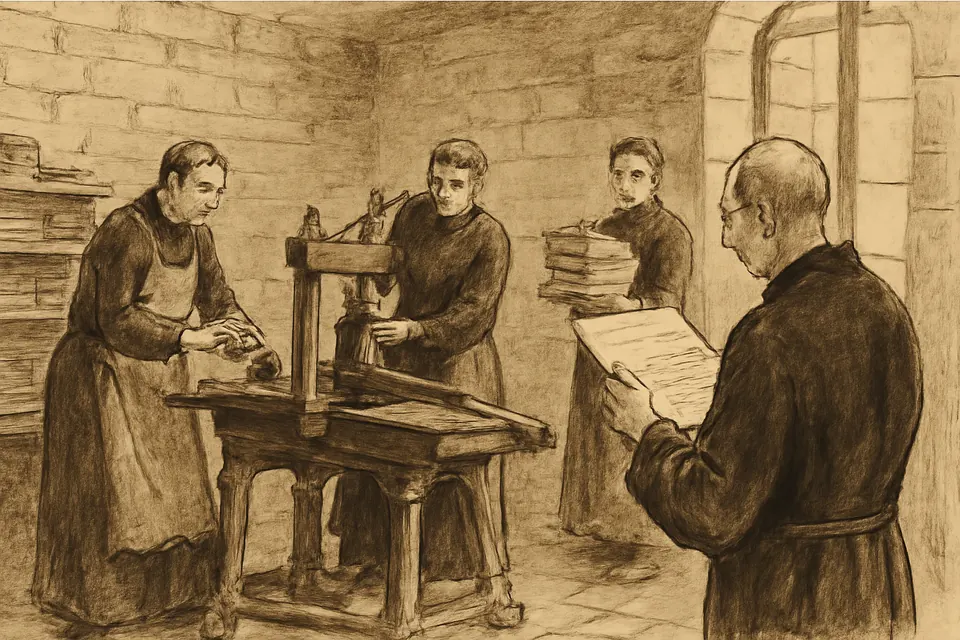
Because no mission house could open in Germany, he opened one just over the border, at Steyl in the Netherlands, on September 8, 1875. Four months later it had its own printing press, and its magazines soon reached thousands of German-speaking homes.

Missionaries for China and the world
On March 2, 1879, the first two missionaries left Steyl for China. One of them was Joseph Freinademetz, who would be canonized alongside his founder in 2003.
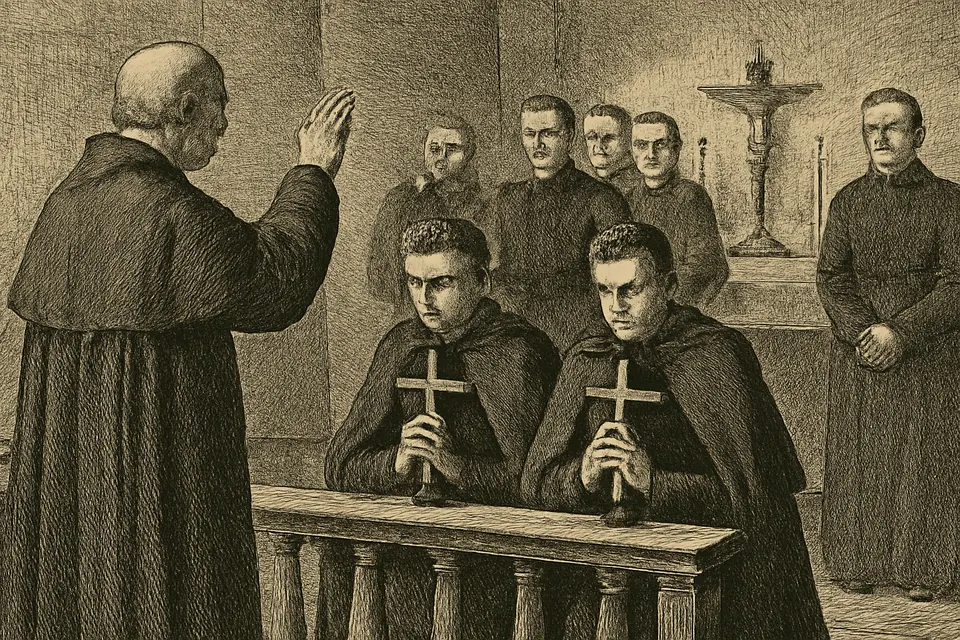
Women had served the mission house from the start, among them Blessed Maria Helena Stollenwerk. On December 8, 1889, Arnold founded the Missionary Sisters Servants of the Holy Spirit, and in 1896 he formed a cloistered branch, the Sister Servants of the Holy Spirit of Perpetual Adoration, to pray day and night before the Blessed Sacrament for the missions. The first sisters sailed for Argentina in 1895. The Society of the Divine Word received the Church's approval in 1901.
Arnold died at Steyl on January 15, 1909. When he was canonized in 2003, the Holy See counted more than 6,000 Divine Word Missionaries in 63 countries and more than 4,000 sisters in his two congregations.
Beatification, canonization and the miracle
Pope Paul VI beatified Arnold Janssen and Joseph Freinademetz on October 19, 1975, World Mission Sunday. Pope John Paul II canonized them both, with Bishop Daniel Comboni, on October 5, 2003. In his homily the Pope recalled a saying Arnold liked to repeat: "Proclamation of the Good News is the first and most significant expression of love for one's neighbour."
- The cure of Pamela Avellanosa (approved). The miracle that completed his canonization cause was the cure of a 14-year-old girl in the Philippines who had suffered a severe head injury, with bleeding over the brain. The Society of the Divine Word reports that the Church's medical and theological examiners accepted her cure as a miracle through his intercession.
Symbols of St. Arnold Janssen in art
Arnold lived in the age of photography, and his images follow his photographs closely:
- A black cassock and white collar, the dress of a diocesan priest of his day.
- Gray hair, a lined face and small spectacles, as in the portrait photographs.
- A Bible, for the Divine Word his society is named for.
- A globe or a map, for the missions to every continent.
- A printing press or a magazine, for his use of the press to spread the faith.

Feast day, tomb and prayer
His feast is January 15. See our feast days calendar and our patron saints list for other saints.
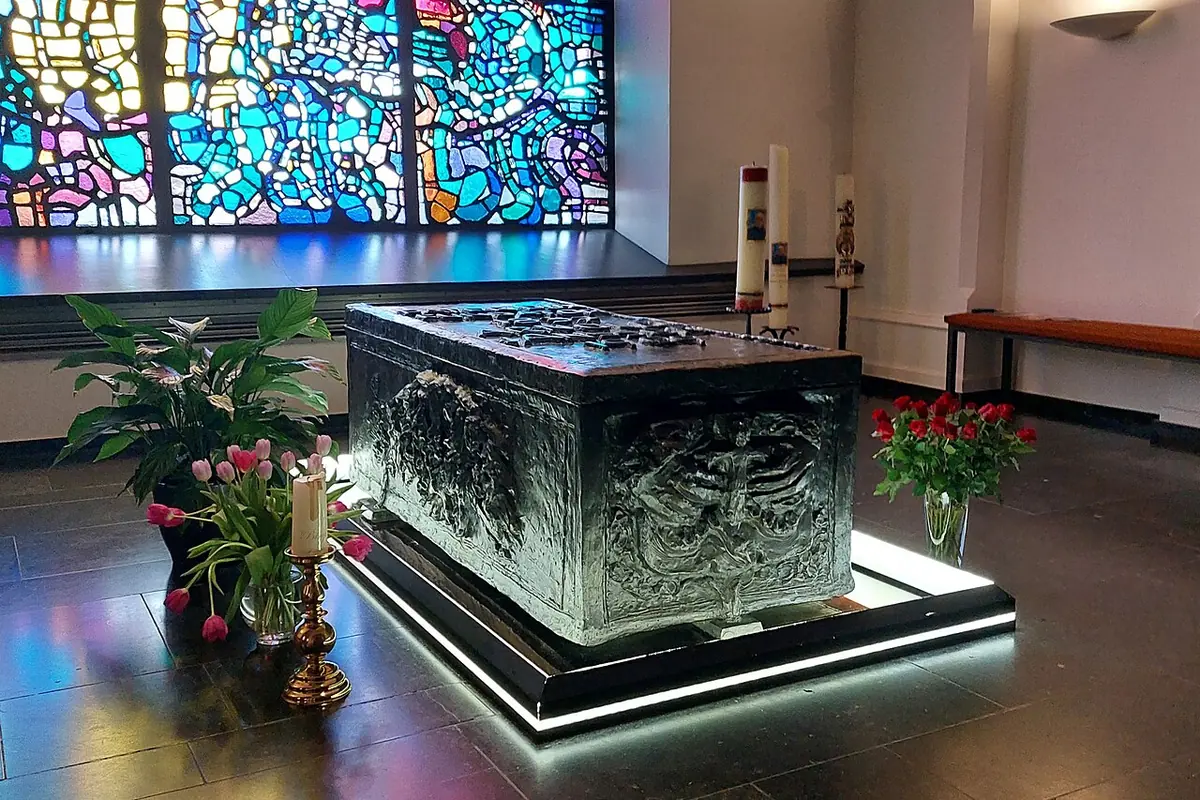
He is buried at Steyl, in the lower chapel of the church of the Mission House of St. Michael, and pilgrims also visit his birthplace in Goch.
The Divine Word family prays these lines, which it credits to St. Arnold Janssen and repeats in its houses around the world:
May the darkness of sin and the night of unbelief / vanish before the light of the Word and the Spirit of grace! / And may the Heart of Jesus live in the hearts of all people.
Let us ask St. Arnold to pray for missionaries and for all who carry the Word of God to people who have not yet heard it: St. Arnold Janssen, pray for us.
Frequently asked questions
What is St. Arnold Janssen known for?
He founded three religious congregations: the Society of the Divine Word (SVD, 1875), the Missionary Sisters Servants of the Holy Spirit (1889) and the cloistered Sister Servants of the Holy Spirit of Perpetual Adoration (1896). He also used the printing press to spread the faith and support the missions.
When is St. Arnold Janssen's feast day?
January 15, the day he died at Steyl in 1909. It is kept above all by the Divine Word Missionaries and the Holy Spirit Sisters and the parishes and schools they serve.
What miracle led to St. Arnold Janssen's canonization?
The cure of Pamela Avellanosa, a 14-year-old girl in the Philippines who had suffered a severe head injury with bleeding over the brain. The Society of the Divine Word reports that the Church accepted her cure as the miracle that completed his canonization cause.
Where is St. Arnold Janssen buried?
In the lower chapel of the church of the Mission House of St. Michael in Steyl, near Venlo in the Netherlands, the house where his work began in 1875.
Keep exploring
Sources
- Holy See: Arnold Janssen (1837–1909), biography. His early life, the Kulturkampf, the founding dates, and the numbers in his congregations in 2003
- John Paul II, homily for the canonization of Daniel Comboni, Arnold Janssen and Joseph Freinademetz, October 5, 2003. The canonization and the quotation he liked to repeat
- Paul VI, homily for the beatification of four servants of God, October 19, 1975 (Italian and German)
- Catholic Encyclopedia (1913): Arnold Janssen. The Kempen chaplaincy and St. Mary's Mission House at Techny, Illinois, opened February 2, 1909
- Society of the Divine Word: Missionary priest played central role in saint's canonization. The cure of Pamela Avellanosa
- Divine Word Alumni: SVD Prayers. The prayer credited to St. Arnold Janssen