St. Mutien-Marie Wiaux, the Brother Who Always Prayed

St. Mutien-Marie Wiaux (1841–1917) was a Belgian Brother of the Christian Schools who spent fifty-eight years at the boarding school of Saint-Berthuin in Malonne, helping with music and drawing classes, supervising the boys and teaching catechism. His pupils called him "the Brother who always prayed." He was canonized in 1989, and his feast is January 30.
Who was St. Mutien-Marie Wiaux?
St. Mutien-Marie Wiaux was a Belgian religious brother who never did anything the world would call remarkable. For fifty-eight years he lived at the boarding school of Saint-Berthuin in Malonne, near Namur. He helped the music and drawing teachers, watched over the boys in the yard and taught catechism in the parish. His pupils and his fellow Brothers gave him a name that says everything: "the Brother who always prayed."
When Pope John Paul II canonized him in 1989, he called Brother Mutien "a very simple religious" and held him up as a model of holiness in ordinary daily life. Those who watched him pray, the Pope said, found in him nothing that was not simply sincere. He was "a friend of God who remains a brother to humanity," and the Church honors in him the greatness of the humble.

The life of St. Mutien-Marie
A blacksmith's son from Mellet
He was born Louis Wiaux on March 20, 1841, in Mellet, a farming village of French-speaking Belgium, the third of six children. His father was a blacksmith. His mother ran a small café in part of the family home, where, the Brothers' own biography says, no rough language was allowed, and the evenings of beer and cards always ended with the rosary.
Louis was not strong enough for the forge. He met the Brothers of the Christian Schools at a nearby school and wanted to join them, and on April 7, 1856, at fifteen, he entered their novitiate at Namur. He took the name Brother Mutien-Marie.

Struggles at Malonne
After two years teaching young children, he was sent to the boarding school at Malonne, and there he stayed for the rest of his life. At first he did badly. He could not cope with teaching and supervising the boys at the same time, and his superiors wondered what to do with him.
The Brother who ran the music and art courses, then an important part of the school's program, took him on as his assistant. It was the turning point. Brother Mutien learned to teach music and drawing, kept order in the school yard and taught catechism in the parish nearby. The Lasallian biography says he became "a tremendous influence on the students by his patience and evident piety."
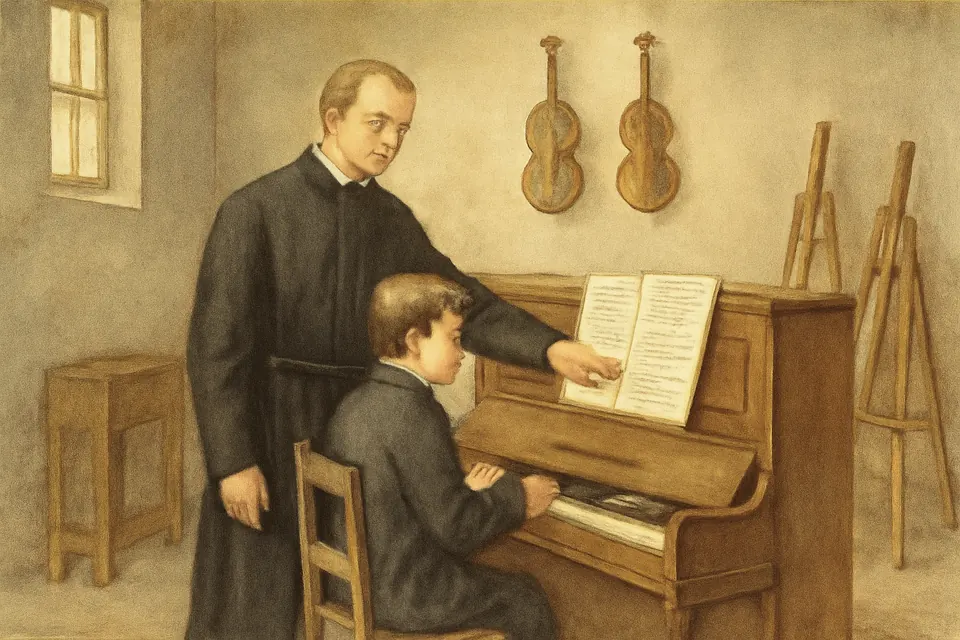
The Brother who always prayed
What people remembered was his prayer. He spent every spare moment before the tabernacle or at the school's grotto of Our Lady. The canonization homily says he received Communion joyfully every day, never began his work without calling on the Lord and honoring the Cross, and always carried his rosary. His fellow Brothers said they had never seen him break even the smallest point of their Rule.
He wrote to a correspondent in 1914 about the Mother of God, in words the Pope quoted at his canonization: "To reach intimate union with our Lord, take the way of Mary."
He died at Malonne on January 30, 1917, in the middle of the First World War, at the age of seventy-five.

The miracles of St. Mutien-Marie
After his death his fame spread quickly through Belgium, and many favors were attributed to him. Three healings were approved by the Church after formal investigation, as recorded in the Acta Apostolicae Sedis:
- Domenico Scaccia, a forty-four-year-old Italian stonemason working in Lambersart, near Lille, was cured of a phlegmon (a spreading infection) in his right leg in early September 1932.
- Georges Thibaut, a sixty-two-year-old retired Belgian railway worker, was healed of a varicose ulcer on his right foot on January 20, 1953, at Brother Mutien's tomb.
- Brother Madir (Frans Verstraelen), a seventy-seven-year-old De La Salle Brother crippled by severe osteoporosis and repeated fractures, was healed on February 22, 1977, during the recognition of Mutien-Marie's remains at Malonne.
The first two led to his beatification by Pope Paul VI on October 30, 1977. The third led to his canonization by Pope John Paul II on December 10, 1989.
Symbols of St. Mutien-Marie in art
Since Brother Mutien lived into the twentieth century, his images follow his photographs rather than an old iconographic tradition.
- Black habit and white rabat: the two-tabbed white collar of the Brothers of the Christian Schools, the clearest sign of a Lasallian Brother.
- Rosary: he was never seen without one.
- Crucifix or the Blessed Sacrament: his long hours of adoration.
- Music book or drawing board: sometimes added for his work at Malonne.
His home parish church at Mellet now bears his name alongside St. Martin's.

Feast day and where he is honored
We keep the memory of St. Mutien-Marie on January 30. His relics are venerated at Malonne in the shrine built in his honor after his canonization, beside the Institut Saint-Berthuin. Pilgrims come to pray there, as Georges Thibaut did in 1953. Find other saints of the season on our feast days page and the patrons of teachers on our patron saints page.
Praying with St. Mutien-Marie
We know of no traditional prayer to St. Mutien-Marie from a source we can cite, so we do not print one here. We can pray with him in the way he lived: a few minutes before the tabernacle, a decade of the rosary, and his own counsel to "take the way of Mary." Let us ask St. Mutien-Marie to pray for teachers and school staff, for religious brothers, for children learning their faith, and for everyone whose work is hidden and ordinary.
Frequently asked questions
Who was St. Mutien-Marie Wiaux?
Born Louis Wiaux, a blacksmith's son from Mellet in Belgium, he joined the Brothers of the Christian Schools at fifteen and spent almost his whole religious life at the school in Malonne near Namur. He was an ordinary assistant teacher, prefect and catechist, and his constant prayer before the tabernacle and the grotto of Our Lady made him famous for holiness.
When is the feast of St. Mutien-Marie?
January 30, the day he died at Malonne in 1917.
What miracles are attributed to St. Mutien-Marie?
Two healings were approved for his beatification in 1977: an Italian stonemason in Lambersart, near Lille, cured of a spreading phlegmon in 1932, and a retired Belgian railway worker cured of a leg ulcer at his tomb in 1953. The miracle for his canonization was the cure of Brother Madir, a De La Salle Brother crippled by osteoporosis, in 1977.
Where is St. Mutien-Marie buried?
At Malonne, near Namur in Belgium, where his relics are venerated in the shrine built in his honor after his canonization, beside the school where he spent his life.
Keep exploring
Sources
- Saint Mutien-Marie Wiaux, La Salle Worldwide (Brothers of the Christian Schools, Rome). His family, his entry into the novitiate on April 7, 1856, his fifty-eight years at Malonne, his shrine and his key dates
- John Paul II, Homily for the canonization of Brother Mutien-Marie Wiaux, December 10, 1989 (in Italian). The canonization, his work as assistant to the music and drawing teachers, his name 'the Brother who always prayed,' and his 1914 letter on the way of Mary
- Hagiography Circle: Newly canonized saints and blessed, 1917. The stages of his cause and the three approved healings, with their dates (AAS 69 [1977] and AAS 82 [1990])