Blessed Benedict XI, the Dominican Pope

Blessed Benedict XI (1240–1304) was Nicholas Boccasini, the son of a poor family of Treviso who became a Dominican at fourteen, master general of the Order of Preachers, and in 1303 pope. He stood by Boniface VIII when the pope was seized at Anagni, then spent his short reign of eight months making peace. He died at Perugia, perhaps by poison, and his tomb there became known for miracles. His feast is July 7.
Who was Blessed Benedict XI?
Blessed Benedict XI was a Dominican friar who became pope in one of the darkest hours the papacy had known. Born Nicholas Boccasini at Treviso in 1240, he rose from a poor home to lead the whole Order of Preachers, stood loyally beside Pope Boniface VIII when French agents seized him at Anagni, and was then chosen to succeed him. He reigned for only eight months. In that short time he worked to heal the quarrel between Rome and the king of France, and he lived as a pope exactly as he had lived as a friar.
We keep his feast on July 7, the day he died at Perugia in 1304.

From Treviso to master general
The Short Lives of the Dominican Saints (1901) says his parents were poor and that an uncle, a parish priest, gave him his first schooling. He entered the Dominicans at Venice at the age of fourteen, according to the Catholic Encyclopedia and the Dominican lives (Butler's Lives says seventeen). Fourteen years of prayer and study followed, then years of teaching theology to his brethren and preaching at Venice and Bologna. He wrote commentaries on St. Matthew's Gospel, the Psalms, Job and the Apocalypse, and a volume of sermons.
He served as prior and as provincial of Lombardy, and in 1296 the friars elected him master general of the Order. He visited the convents on foot, and the old life records how he urged on his tired companions: "Come, dearest Brethren, this is the glory of our Order." Writers of his own time called him "the lover of the Community."
The cardinal at Anagni
Boniface VIII made him a cardinal. The Dominican life says Nicholas threw himself at the pope's feet and asked why such a heavy burden had been laid on him. "God has a yet heavier one in store for you," Boniface answered.
The heavier burden came soon. King Philip IV of France had long been at war with the pope over taxes on the clergy and the freedom of the Church. On September 7, 1303, the king's minister William of Nogaret and Sciarra Colonna broke into the papal residence at Anagni with hired soldiers and laid hands on the old pope. Butler notes that only two cardinals stayed at his side, and one of them was Nicholas Boccasini. The people of Anagni freed Boniface three days later, but he died in Rome on October 11.
Pope for eight months
On October 22, 1303, the cardinals unanimously elected Nicholas. He took the name Benedict, out of reverence for Boniface, whose own baptismal name was Benedict, and he chose as his motto the words of the psalm, "Make Thy face to shine upon Thy servant."
His policy was peace without betraying his predecessor. He lifted the censures on King Philip and his subjects and absolved the Colonna cardinals, though he did not give them back their rank. But the men who had laid hands on the pope at Anagni he did not excuse: he declared Nogaret, Sciarra Colonna and their accomplices excommunicated and summoned them to answer for it. All three cardinals he created were Dominicans, and two of them were Englishmen, William of Macclesfield and Walter Winterbourne.
He kept the poverty and penance of a friar. The Short Lives tells a story that the people of Perugia never forgot. When his mother came to visit him, the magistrates dressed her in silks and brought her to him in state. The pope would not recognize her. "My mother was only a poor washerwoman, and not a princess like this," he said. She went away, changed back into her peasant's dress and returned, and he came down from his throne to embrace her.
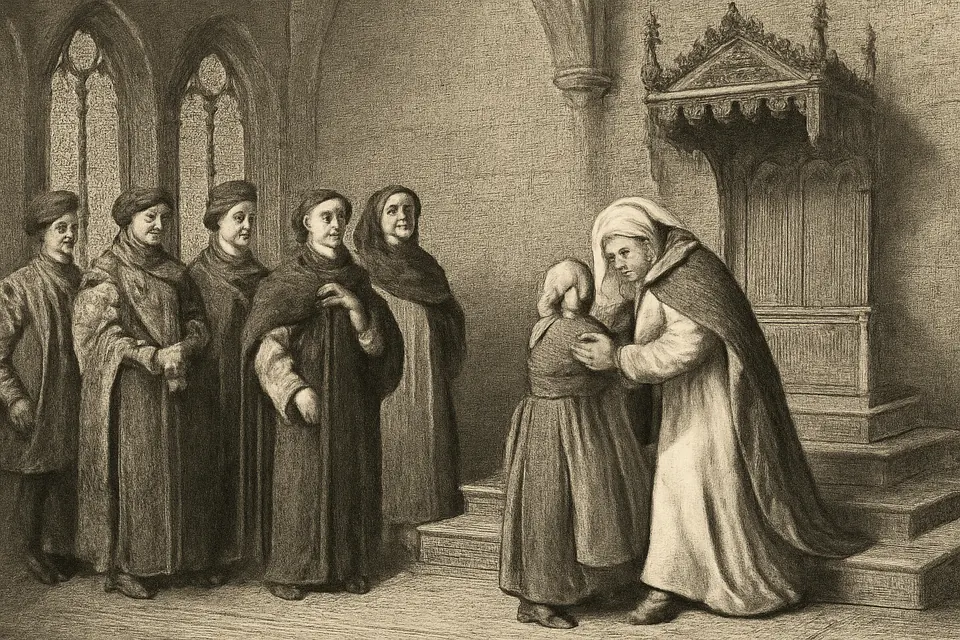
His death at Perugia
Benedict died suddenly at Perugia on July 7, 1304. The Dominican tradition says he ate poisoned figs brought to him by a stranger, and the Catholic Encyclopedia judged the suspicion of poison "not altogether without reason." Nothing was ever proved. The Roman Martyrology, as Butler quotes it, says that in his few months he "wonderfully promoted the peace of the Church, the restoration of discipline, and the increase of religion."
Miracles and beatification
- Reported: many miracles at his tomb in the Dominican church at Perugia, recorded in the old Dominican lives. No single cure from that time was examined in the modern way.
His cult grew from the tomb outward, and Pope Clement XII confirmed it in 1736. That act is his beatification. (The Catholic Encyclopedia gives the year 1773; Butler and the Dominican sources give Clement XII.)

Symbols of Blessed Benedict XI in art
Benedict has no single fixed emblem, but he is easy to recognize once you know the signs:
- The Dominican habit, white tunic and black cloak, sometimes worn under papal vestments, to show the friar who became pope;
- The papal tiara, or the tiara set down at his feet as a sign of humility;
- Books and a writing desk, for his commentaries on Scripture and his years as a teacher, as in Tommaso da Modena's fresco in Treviso.
In Treviso he is a hometown hero. Francesco Zugno's large canvas of about 1747 shows him kneeling below a vision of angels honoring the Holy Name of Mary, his tiara laid aside.
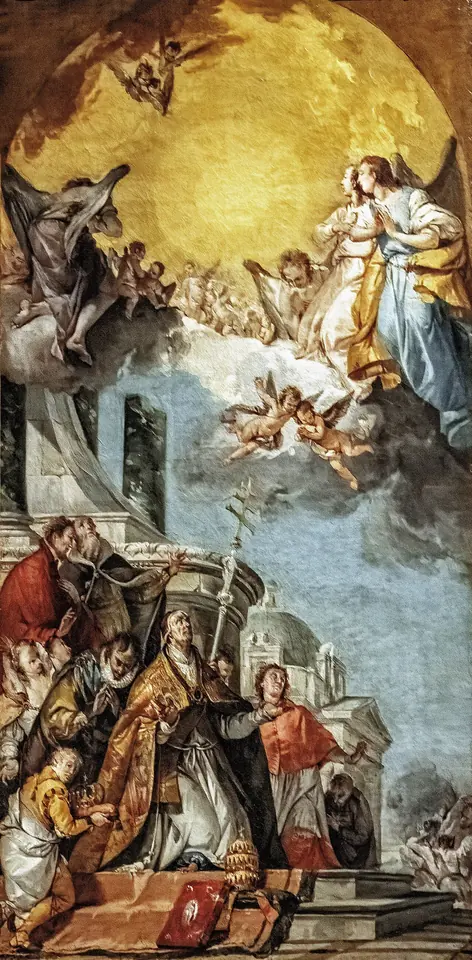
Feast day and prayer
We keep the feast of Blessed Benedict XI on July 7. See the feast day calendar for the saints around him. His tomb is still in the church of San Domenico at Perugia.
The collect for his feast, as printed in the Short Lives of the Dominican Saints, plays on his name, which means "blessed":
O God, who by the grace of Thy benediction didst raise the Blessed Benedict, Thy chief Bishop, to heaven, sanctify Thy people, we beseech Thee, with a new benediction of Thy grace, and, through his prayers and merits, defend us by Thy power from all the evils that threaten us. Through Christ our Lord. Amen.
Let us ask Blessed Benedict to pray for the pope and for peace between the Church and the powers of the world, and for all who are given a burden heavier than they wanted.
Frequently asked questions
Who was Blessed Benedict XI?
Nicholas Boccasini of Treviso, a Dominican friar, teacher and master general of his Order (1296), who was made a cardinal by Boniface VIII and elected pope on October 22, 1303. He reigned only eight months and died at Perugia on July 7, 1304.
Why was Benedict XI beatified?
He was honored for his holiness from the time of his death, and miracles were reported at his tomb in Perugia. Pope Clement XII confirmed his cult in 1736, which made his title of "Blessed" official.
Was Pope Benedict XI poisoned?
Possibly. He died suddenly at Perugia, and the old Dominican lives say he ate poisoned figs brought by an unknown person. The Catholic Encyclopedia says the suspicion of poison was "not altogether without reason," but it has never been proved.
When is the feast of Blessed Benedict XI?
July 7, the day of his death. It is kept in the Dominican Order and at Rome.
Keep exploring
Sources
- Catholic Encyclopedia (1907): Pope Benedict XI. Entry into the Order at fourteen, the Anagni background, his acts toward Philip IV, the Colonnas and Nogaret, his writings, and the suspicion of poison. It gives 1773 for his beatification; Butler and the Dominican lives give Clement XII (1736).
- Butler's Lives of the Saints, ed. Thurston and Attwater, July 7: Bd Benedict XI, Pope. His stand at Anagni, his three Dominican cardinals, the Roman Martyrology's words on his reign, and confirmation of his cult in 1736
- Short Lives of the Dominican Saints (London, 1901), July 7: Blessed Benedict XI. His poor family, his words as master general and on being made cardinal, his motto, his mother's visit, the poisoned figs, burial at Perugia, miracles at the tomb, and the collect quoted here