Blessed Catherine Jarrige, "Catinon Menette" of Mauriac
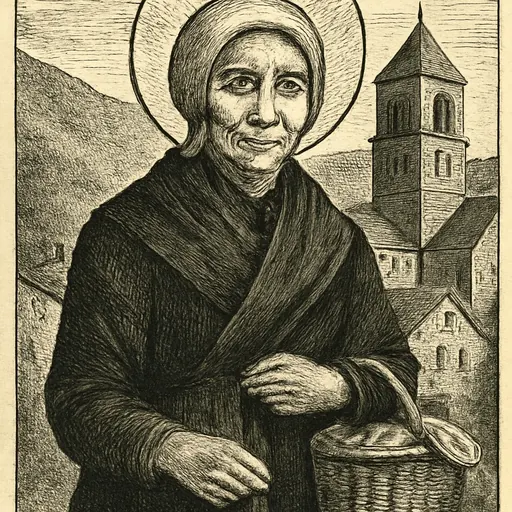
Blessed Catherine Jarrige (1754–1836), called Catinon Menette, was a poor lacemaker and Dominican tertiary in Mauriac, in Auvergne. During the French Revolution she hid hunted priests, guided them by night to the faithful and walked with the condemned to the scaffold. Pope John Paul II beatified her on November 24, 1996. Her feast is July 4.
Who was Blessed Catherine Jarrige?
Blessed Catherine Jarrige was a poor lacemaker from the mountains of Auvergne who, during the French Revolution, became the guardian angel of the hunted priests of her district. The people of Mauriac called her Catinon Menette. She lived to eighty-one, spent every year of it on the poor, and is remembered by the Dominican Order as one of its own: a tertiary who, like St. Catherine of Siena, served Christ in the street rather than the cloister.
The life of Blessed Catherine
A shepherd girl from Doumis
Catherine was born on October 4, 1754, in the hamlet of Doumis, in the parish of Chalvignac in the Cantal, the youngest of seven children of poor peasants, Pierre Jarrige and Marie Célarier. Before she was ten she was already working, first minding animals and then as a servant in a neighbor's house. She had almost no schooling and could not read or write.
By 1774 she had moved with her sister Toinette to the small town of Mauriac, where she earned her bread as a lacemaker. As a young woman she was lively and loved to dance; the Italian Santi e Beati calls this her worldly period, though she never lost her faith. In 1778, moved by thoughts of death and a call she linked to Our Lady, she gave herself to God and joined the Third Order of St. Dominic, taking her patron, St. Catherine of Siena, as her model.
Mother of the poor
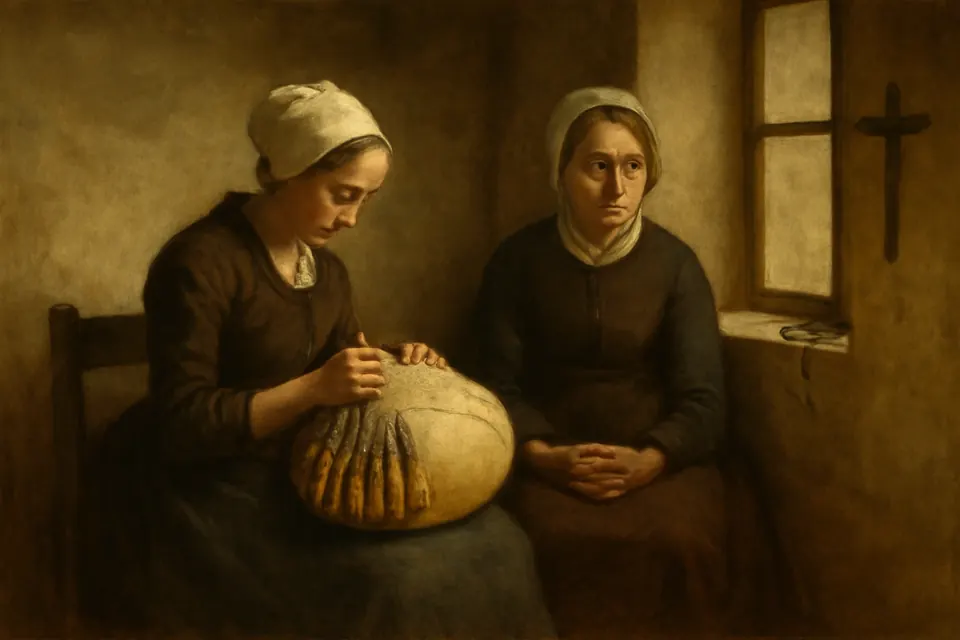
From then on she lived with Toinette in a poor room and gave her days to others. She begged from door to door for the hungry, nursed the sick in their homes, sat with the dying and prepared the dead for burial. The townspeople gave her the name Catinon Menette: Catinon is a dialect form of Catherine, and a menette was a devout woman living under vows in the world.
The Revolution: hiding the priests
When the Revolution closed the convents and hunted the priests who would not take the oath to the new state church, Catherine became their lifeline. In the words the Roman Martyrology uses for her, she found them shelter and food, above all bread and wine for Mass, and led them through the forests of the Auze valley by night to families who needed the sacraments. She carried messages, warned of patrols and hid sacred vessels and books under her skirts. For about eighteen months she sheltered two priests in Mauriac itself.
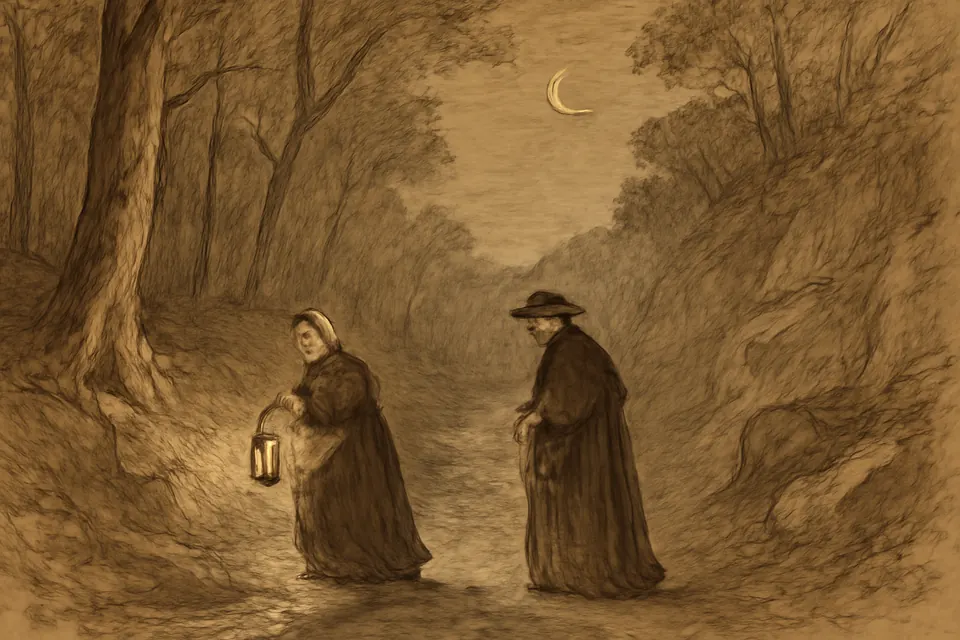
She could not save them all. When the young Abbé François Filiol was condemned, she walked with him to the scaffold. A story long told in Mauriac says that afterward she touched a blind child's eyes with a cloth stained with his blood and the child saw; that account is traditional, not examined by the Church.
She was arrested more than once. On July 30, 1794, she was taken after warning priests of a search. Each time she was released, in part because the crowds in Mauriac would not stand for her imprisonment, and the fall of Robespierre that summer may also have saved her. She is said to have told her judges she was not afraid of the guillotine and would dance up its steps as she had danced in her youth.
Old age in Mauriac
When peace returned to the Church, Catherine went back to her poor. She visited the prisons and kept begging for the sick. In 1833 she was even proposed for a prize for virtue by the French Academy, though it was never awarded. She died in Mauriac on July 4, 1836, at eighty-one, in great poverty. At her funeral, people pressed forward to take scraps of her clothing as relics.

A 1915 tribute
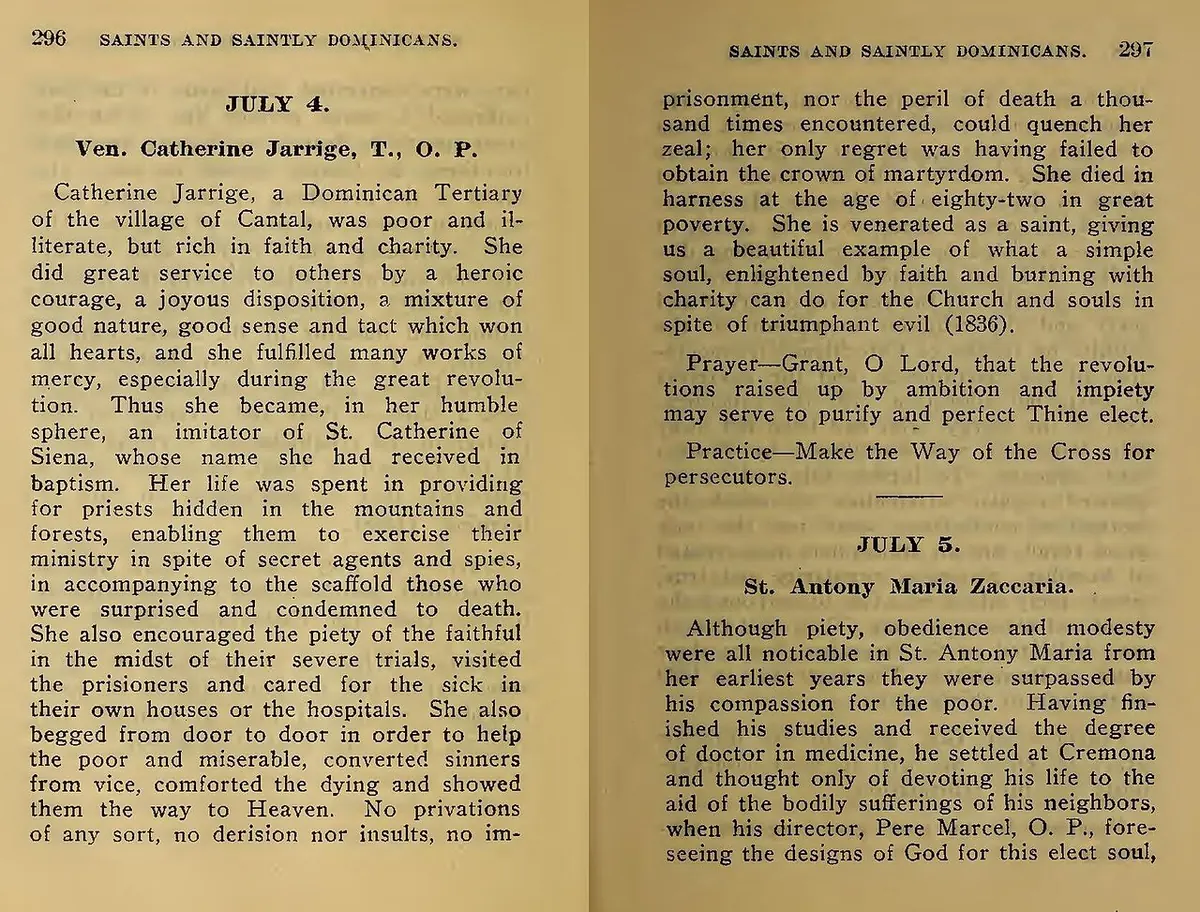
Her fame spread through the Dominican family long before Rome spoke. A 1915 American book of Dominican lives for each day gave her July 4 and summed her up as "poor and illiterate, but rich in faith and charity." It ended her entry with this prayer, which we print as it appears there:
Grant, O Lord, that the revolutions raised up by ambition and impiety may serve to purify and perfect Thine elect.
Beatification and miracles
Her cause was opened in the twentieth century. Like every blessed who was not a martyr, she could be beatified only after a healing attributed to her intercession was examined and approved by the Holy See; John Paul II beatified her in St. Peter's Square on November 24, 1996. The graces still reported by those who pray to her in the Cantal are reported, not formally investigated.
Symbols of Blessed Catherine in art
Images of Catinon Menette are simple, like her life:
- The black dress and white bonnet of a countrywoman of the Auvergne: she was a laywoman, and the people knew her this way.
- A basket of bread: her begging for the poor.
- A rosary: her steady prayer as a Dominican tertiary.
- A lantern or a priest at her side: her night journeys with the hunted clergy.
A statue of her stands in the Church of Notre-Dame-aux-Neiges in Aurillac.
Feast day and where she is honored
We keep her memory on July 4, the day she died. She is honored above all in Mauriac and across the Diocese of Saint-Flour, and by Dominicans everywhere. See more of July's saints on our feast days page.
Prayer with Blessed Catherine Jarrige
We have not found a traditional prayer addressed to Blessed Catherine in a source we can cite. The 1915 Dominican prayer above is one we can pray with her. Let us ask her to pray for priests in danger and for Christians who are persecuted, for lacemakers and all who work with their hands, for the poor and the sick who are alone, and for courage when faithfulness is costly.
Frequently asked questions
Who was Blessed Catherine Jarrige?
A French laywoman (1754–1836) from the Cantal, a lacemaker and member of the Third Order of St. Dominic, who served the poor of Mauriac for half a century and risked her life to hide and help priests during the French Revolution.
What does "Catinon Menette" mean?
It was her nickname in Mauriac. Catinon is a dialect pet form of Catherine, and menette was the local word for a devout woman living under vows in the world, such as a tertiary.
When is the feast of Blessed Catherine Jarrige?
July 4, the day she died in Mauriac in 1836.
When was Catherine Jarrige beatified?
On November 24, 1996, by Pope John Paul II in St. Peter's Square.
Keep exploring
Sources
- Beata Caterina Jarrige, Domenicana, Santi e Beati. Her return to fervor in 1778, the night journeys through the Auze valley described in the Roman Martyrology, her arrests and release, and the cause
- Saintly lacemakers: Catherine Jarrige of Mauriac, Lace in Context (University of Oxford project). Her lacemaking, the meaning of Catinon-Menette, the arrest of July 30, 1794, and Abbé Serres's 1864 biography
- Bienheureuse Catherine Jarrige, Nominis (Église catholique en France). The Roman Martyrology entry for July 4
- Thomas à Kempis Reilly, Saints and Saintly Dominicans (1915), Internet Archive. The July 4 entry and its prayer, quoted on this page