Blessed Ralph Milner, Farmer and Martyr of Winchester

Blessed Ralph Milner was an unlettered Hampshire farm laborer, a husband and father of a large family, who became a Catholic as a grown man and spent years bringing priests to poor Catholics and prisoners around Winchester. He was hanged at Winchester on July 7, 1591, with the priest Roger Dickenson, for helping him. Pope Pius XI beatified him in 1929.
Who was Blessed Ralph Milner?
Blessed Ralph Milner was a Hampshire farm laborer who could neither read nor write, who came to the Catholic faith late in life, and who gave the rest of that life to bringing priests to poor and imprisoned Catholics. He was hanged at Winchester on July 7, 1591, for helping the priest Roger Dickenson, and he went to his death after blessing his own children at the foot of the gallows. We keep his feast on July 7.
His story comes down to us from a Jesuit who knew him well, Father Thomas Stanney, whose short life of Ralph was printed by Bishop Richard Challoner in his Memoirs of Missionary Priests. Father Stanney called him simply "this good old man."
The life of Blessed Ralph Milner
A laborer near Winchester
Ralph was born at Slackstead in Hampshire and spent most of his life in a village near Winchester, "maintaining his wife and a large family of children by the labour of his hands," as Stanney put it. He was "entirely illiterate," but he lived an upright life and went to the parish church like his neighbors.

What changed him was watching people. He compared the Catholics he knew with the Protestants around him, and even with their ministers. The Catholics fasted and prayed and kept their appetites in check, and they suffered heavy fines and prison for conscience' sake without complaint. The others, he thought, had taken a broad and easy road. He decided to return to "the old religion." A priest instructed him and received him into the Church.
Arrested on the day of his first Communion
On the very day he made his general confession and received the Blessed Sacrament for the first time, he was arrested and sent to jail for his religion. He stayed a prisoner for many years.
Yet his gentleness won over the keeper. Ralph was often let out on his word of honor, sometimes sent out on the keeper's own errands, and trusted with the keys of the prison. He used that freedom for others. He begged alms for the poor Catholic prisoners and brought priests in to give them the sacraments. Outside the walls he became known to the scattered Catholics of the countryside, and once a month he came to fetch Father Stanney and lead him from village to village to preach, hear confessions and say Mass for the poor.

Stanney wrote that this unlettered man had, "by the bright light of his virtues and by his fervent prayers," brought many people into the Church.
"Hungry souls that want bread"
One day the worn-out Jesuit told Ralph he could not make another journey so soon; he had been watching whole nights and saying Mass twice a day. Ralph answered: "Well, but master, we have still a great many hungry souls that want bread, and there is no one to give it them." He offered to find a home for a second priest if Stanney could send one. Their superior proposed Roger Dickenson, a priest of Lincoln trained at the English College at Reims. Ralph said he would be glad above all others "to live and die with that good man." Stanney added: "which afterwards happened."
Dickenson came to Winchester and worked for some years among the poor and the prisoners. Once he was captured and held under a guard of six soldiers, but they drank themselves asleep and he slipped away in the night. The second time he was taken in Ralph's company, and both went to Winchester jail.
The trial and martyrdom of Ralph Milner
Dickenson was sent to London, put to torture, and returned to Winchester for trial. He was condemned for being a priest. Ralph was condemned for relieving him. Challoner says Ralph had "a wife and eight children living" at the time. The judge, as if in pity, advised him to go to church just once, so that he could live and provide for his family. Ralph answered:
Would your lordship then advise me, for the perishable trifles of this world, or for a wife and children, to lose my God? No, my lord, I cannot approve or embrace a counsel so disagreeable to the maxims of the gospel.
At the same assizes seven unmarried gentlewomen were condemned for receiving Dickenson to say Mass in their homes. The judge reprieved them. Challoner records that they burst into tears and begged to die with their priest.
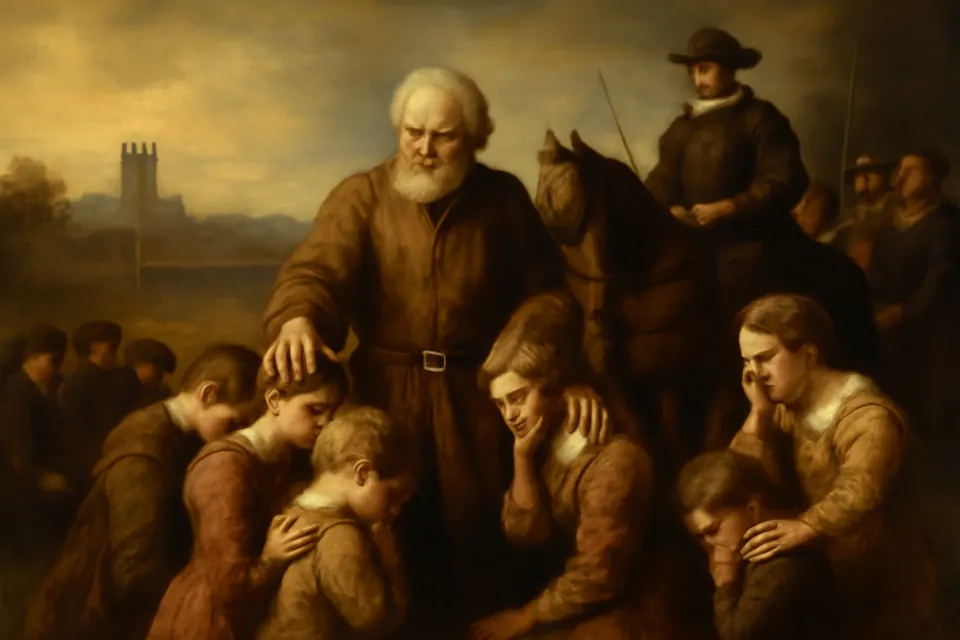
Friends and ministers kept at Ralph to the end. At the gallows itself they brought his children to him, hoping the sight would make him give way. He gave them his last blessing and said aloud that he could wish them no greater happiness than to die for the same cause. He and Roger Dickenson were executed at Winchester on July 7, 1591. No grave or relic of either is known.
Beatification
Ralph Milner was declared Venerable in the first English cause. On December 15, 1929, Pope Pius XI beatified 136 martyrs of England. The papal letter names him as number 49, "Radulphus Milner, laicus Slaksteadii natus," and notes that he died at Winchester with Roger Dickenson on July 7, 1591. Dickenson was beatified with him.
- Approved: as a martyr he was beatified without a miracle. No miracle has yet been approved for his canonization.
Symbols of Blessed Ralph Milner in art
No portrait of Ralph Milner from his lifetime exists, and old images of him are very rare. When he is pictured, the fitting attributes are the martyr's palm and the rope of the gallows, the plain dress of a Hampshire laborer, and a ring of prison keys, since his jailer trusted him with the keys and he used them to bring priests to the prisoners. A scene that tells his whole story is the old man blessing his children before his death. See the what is a martyr page for the palm and other martyr symbols.
Feast day and prayer
We keep his feast on July 7. In England and Wales he is also honored with all the martyrs of the Reformation on May 4. See the feast day calendar.
We know of no traditional prayer to Blessed Ralph Milner. Let us ask him to pray for fathers and mothers torn between their families and their faith, for prisoners and those who visit them, and for every layman who works quietly so that priests can reach the people who are hungry for the sacraments. Blessed Ralph Milner, pray for us.
Frequently asked questions
Who was Blessed Ralph Milner?
A laboring man from Slackstead in Hampshire who could not read, converted to the Catholic faith, was imprisoned for it for years at Winchester, and used the freedom his jailer gave him to bring priests and alms to Catholics. He was executed at Winchester on July 7, 1591, for assisting the priest Roger Dickenson.
What did Ralph Milner say to the judge?
When the judge urged him to go to church just once and save his life for his family's sake, he answered, as Bishop Challoner records it: "Would your lordship then advise me, for the perishable trifles of this world, or for a wife and children, to lose my God?"
When was Ralph Milner beatified?
On December 15, 1929, when Pope Pius XI declared 136 martyrs of England blessed. The papal letter lists him as number 49, "Radulphus Milner, laicus Slaksteadii natus," a layman born at Slackstead.
When is the feast of Blessed Ralph Milner?
July 7, the day he died. He is also honored with all the martyrs of England and Wales on May 4.
Keep exploring
Sources
- Richard Challoner, Memoirs of Missionary Priests, ed. John Hungerford Pollen (1924 edition), pp. 168–169 and Appendix II, pp. 594–596. Birthplace, family, his answer to the judge, the seven condemned gentlewomen, and Father Thomas Stanney's account of his conversion, arrest on the day of his first Communion, years in prison with the keeper's trust, the request for a priest, Dickenson's escape and second arrest, and his last blessing to his children
- Pius XI, apostolic letter beatifying 136 English martyrs (December 15, 1929), Acta Apostolicae Sedis 22 (1930). No. XLIX: Radulphus Milner, laicus Slaksteadii natus, put to death at Winchester with Roger Dickenson on July 7, 1591
- Catholic Encyclopedia (1909): English Confessors and Martyrs (1534–1729). 1591: Roger Dicconson p., with Ralph Milner l., 7 July, Winchester