Blessed Boniface of Savoy

Blessed Boniface of Savoy (about 1207–1270) was a son of the Count of Savoy who became a Carthusian as a boy, bishop of Belley, and then Archbishop of Canterbury from 1241 to 1270, an uncle of Queen Eleanor, wife of King Henry III. He paid off the crushing debts of his see and governed through the troubled years of the barons' wars. He is buried at Hautecombe Abbey in Savoy, and Pope Gregory XVI confirmed his cult in 1839. The Roman Martyrology remembers him on July 4.
Who was Blessed Boniface of Savoy?
Blessed Boniface of Savoy was a prince of the House of Savoy who became Archbishop of Canterbury and held the see of St. Augustine for nearly thirty years, from 1241 to 1270. He was born about 1207, the eleventh child of Thomas I, Count of Savoy. As a boy he entered the Carthusian order, the silent monks founded by St. Bruno, and he was later made bishop of Belley. The Roman Martyrology sums up his life in a single line: of royal stock, first hidden among the Carthusians, then raised to the see of Belley and at last to Canterbury, he "always devoted himself to the care of his flock." We remember him on July 4.
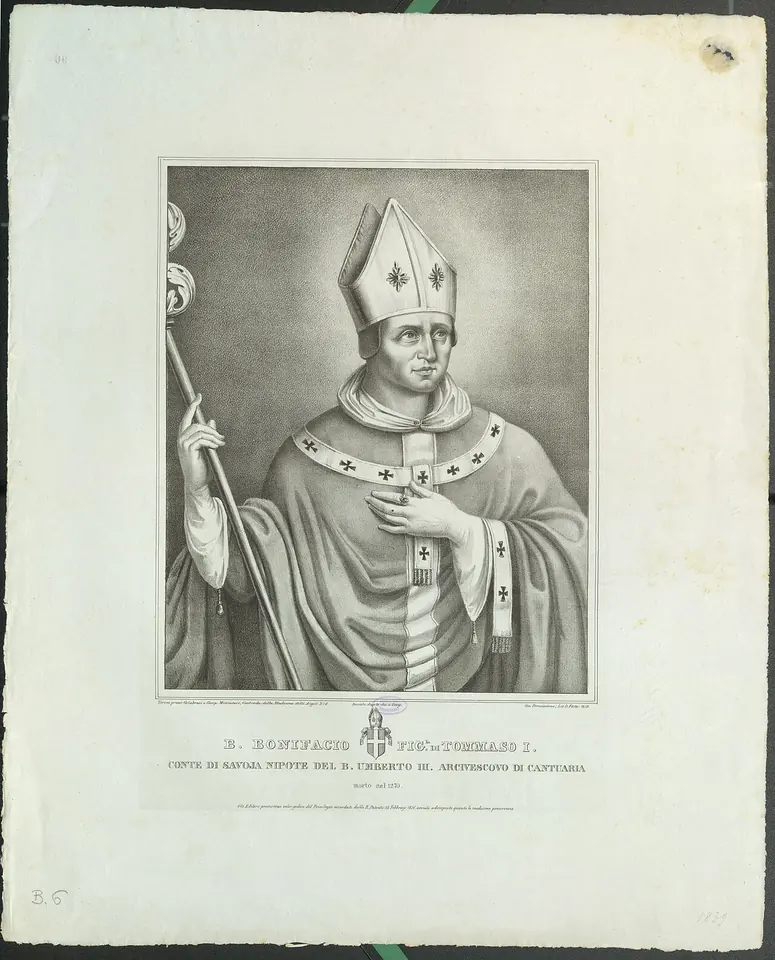
He was not a quiet saint, and his biographers have not always been kind to him. He was a great lord, a man of action and sometimes of temper, set over the English Church because the king wanted him there. He is honored all the same, and his long service to a ruined see is part of the reason.
From Savoy to Canterbury
The Savoy family placed many sons in the Church. Boniface's niece Eleanor of Provence married King Henry III of England in 1236, and her Savoyard uncles followed her to the English court. When St. Edmund of Abingdon, Archbishop of Canterbury, died in exile in 1240, Henry pressed the monks of Canterbury to elect Boniface. He was nominated in 1241, and Pope Innocent IV confirmed the election at the end of 1243.
In 1244, before he had even been consecrated, he refused to accept the king's candidate for the see of Chichester as unfit, and he backed the bishop the canons had chosen, St. Richard of Chichester. The pope upheld Richard. Innocent IV himself consecrated Boniface at Lyons on January 15, 1245, in the season of the First Council of Lyons. Boniface stayed in France for several years and worked there for the canonization of his predecessor Edmund, who was declared a saint in 1246.
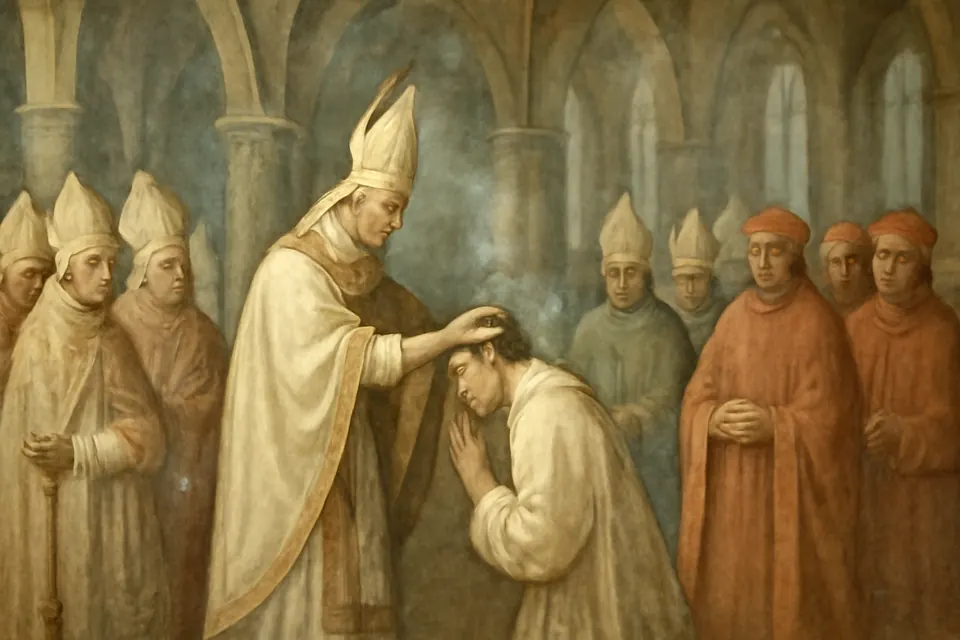
Archbishop in hard times
He was enthroned in Canterbury Cathedral on November 1, 1249. The see was buried in debt, and Boniface set out to clear it. He made the archbishopric solvent again, finished the great hall at Lambeth that Hubert Walter had begun, and built an almshouse at Maidstone for the poor. Mandell Creighton, who wrote his life for the Dictionary of National Biography in 1886 and was no admirer, gave him credit for all three.
His visitations of his province caused uproar. At the priory of St. Bartholomew in London in 1250, the canons refused to receive him, a brawl broke out in the church, and the archbishop struck the subprior; the chroniclers of the time, who disliked the foreign archbishop, said he wore armor under his vestments. The case went to the pope, who upheld his right to visit but limited what he could charge.
He governed through the long quarrel between Henry III and his barons, sat on the baronial Council of Fifteen in 1258, helped make peace between the king and Prince Edward in 1260, and held councils of the English Church at London, Merton and Lambeth. The council of Lambeth in 1261, which defended the rights of the Church against royal officials, issued its decrees without the king's consent. He left England for the last time in 1268 and died in Savoy, at the castle of Sainte-Hélène, on July 18, 1270.

His tomb and his cult
He was buried in the sanctuary of Hautecombe Abbey, the Cistercian monastery on Lake Bourget where the counts of Savoy were laid to rest. When his tomb was opened in 1580, his body was found well preserved (reported). The abbey was sacked and sold during the French Revolution and turned into a china factory, and his tomb was destroyed with the rest. King Charles Felix of Sardinia bought the ruins in 1824 and rebuilt the church, and the Savoy tombs were remade. In 1839 Pope Gregory XVI confirmed the ancient cult of Boniface, and he has been called Blessed ever since.

No miracles of Boniface have been approved by the Church in modern times; his cult rests on the long veneration at his grave, which the pope confirmed.
Symbols of Blessed Boniface of Savoy in art
He is shown as an archbishop, and almost every image of him comes from Savoy and Piedmont. Look for:
- Mitre, crozier and pallium: the pallium, the white woolen band with black crosses, marks the metropolitan Archbishop of Canterbury.
- The arms of Savoy: a white cross on red, his family's shield.
- A recumbent effigy: on his tomb at Hautecombe he lies in full vestments, as Guichenon drew it in 1658.
Feast day and prayer
The Roman Martyrology remembers him on July 4. Some calendars list him on July 14. Hautecombe Abbey still stands on the western shore of Lake Bourget, near Aix-les-Bains, and visitors can see his tomb among the princes of Savoy. See also the feast day calendar.

We know of no traditional prayer to Blessed Boniface. Let us ask him to pray for bishops who inherit hard and broken situations, for the Church in England, and for all who must lead through times of division. Blessed Boniface of Savoy, pray for us.
Frequently asked questions
Who was Blessed Boniface of Savoy?
The eleventh child of Thomas I, Count of Savoy, a Carthusian as a boy and later bishop of Belley. In 1241 King Henry III, who had married Boniface's niece Eleanor of Provence, had him named Archbishop of Canterbury. He held the see until his death in 1270.
When is the feast of Blessed Boniface of Savoy?
The Roman Martyrology (2004) remembers him on July 4. Some calendars give July 14. He died on July 18, 1270.
Where is Boniface of Savoy buried?
At Hautecombe Abbey, the Cistercian burial church of the House of Savoy on Lake Bourget in France. His tomb was destroyed in the French Revolution and rebuilt in the nineteenth century.
Is Boniface of Savoy the same as St. Boniface?
No. St. Boniface, the Apostle of Germany, died a martyr in 754. Boniface of Savoy lived five centuries later and was Archbishop of Canterbury.
Keep exploring
Sources
- Martyrologium Romanum (2004), July 4. The July 4 entry for "beatus Bonifatius," Carthusian, bishop of Belley and Canterbury, buried at Hautecombe
- Dictionary of National Biography (1886): Boniface of Savoy, by Mandell Creighton. His parents, Belley, his consecration at Lyons on January 15, 1245, enthronement on November 1, 1249, the St. Bartholomew's visitation, the hall at Lambeth, the Maidstone almshouse, his death at Sainte-Hélène on July 18, 1270
- Catholic Encyclopedia (1910): Hautecombe. His burial in the sanctuary of the abbey church and the later history of the abbey
- Wikipedia: Boniface of Savoy (bishop). Beatification by Gregory XVI in 1839 and the opening of the tomb in 1580; only source found