St. Alexander Schmorell, White Rose Martyr of Munich
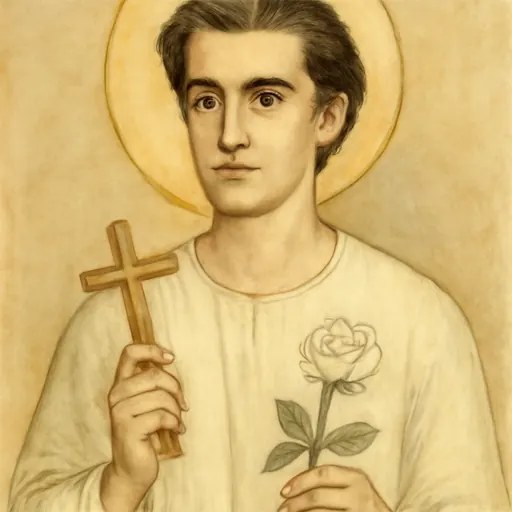
St. Alexander Schmorell (1917–1943), called St. Alexander of Munich, was a Russian-born German medical student and Orthodox Christian who co-founded the White Rose, the student resistance group that wrote and spread leaflets against Hitler. He was beheaded at Stadelheim Prison in Munich on July 13, 1943, his feast day. The Russian Orthodox Church Outside Russia glorified him as a saint and passion-bearer in 2012.
Who was St. Alexander Schmorell?
St. Alexander Schmorell, honored in the Orthodox Church as St. Alexander of Munich, was a medical student who, with Hans Scholl, founded the White Rose, the Munich student circle that wrote and secretly spread leaflets against Hitler in 1942 and 1943. He was born in Russia, raised Orthodox in Munich, arrested by the Gestapo, and beheaded at Stadelheim Prison on July 13, 1943, at the age of twenty-five. In February 2012 the Russian Orthodox Church Outside Russia glorified him as a saint and passion-bearer, and his grave in Munich has become a place of prayer.

The life of St. Alexander
A Russian childhood in Munich
Alexander was born in Orenburg, in the southern Urals, on September 16, 1917. His father, Hugo Schmorell, was a German doctor whose family had lived in Russia since 1856; his mother, Natalia Vvedenskaya, was the daughter of an Orthodox priest, and he was baptized in the Orthodox church of Sts. Peter and Paul in Orenburg. His mother died of typhus when he was little more than a year old. In 1921 the family fled the Bolsheviks for Munich, bringing with them his Russian nanny, Feodosia Lapshina, who never learned German and raised him speaking Russian and praying in the Orthodox way.
At school in Bavaria he had to attend Catholic religion classes. When the teacher told him that as a guest he could cross himself as they did, he answered, in the words the Munich cathedral's life preserves: "Ich bin orthodox, wir machen es eben anders" ("I am Orthodox; we just do it differently").
Soldier and medical student
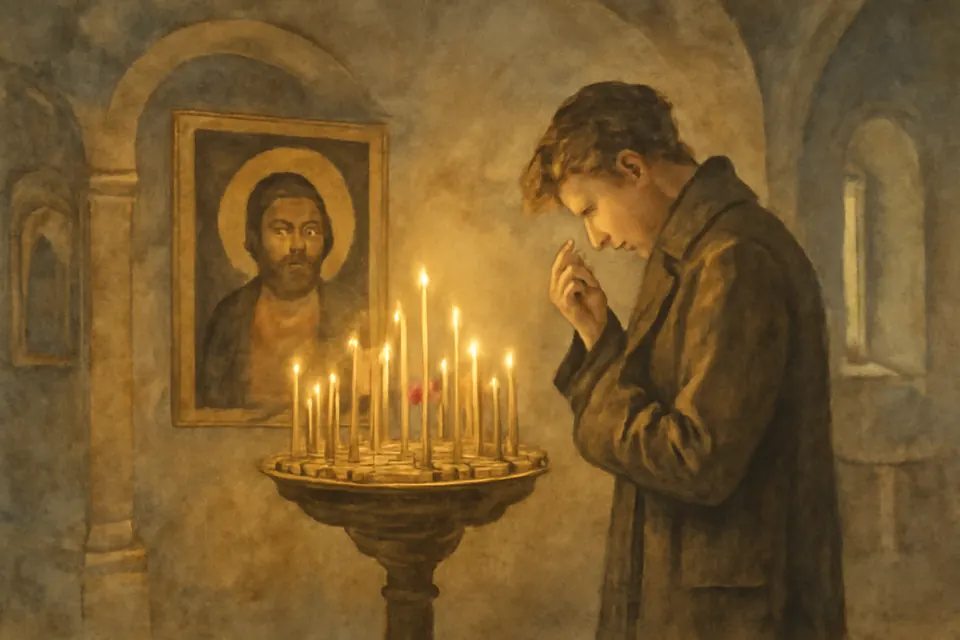
After school he did labor service and then joined the army, where he struggled with the oath of loyalty to Hitler. To serve by saving lives rather than taking them, he and his friend Christoph Probst enrolled in medicine at Munich's university. He loved horses, painting, sculpture and Dostoevsky, and sometimes signed his letters "Alyosha," after the gentle hero of The Brothers Karamazov. Through these years he kept going to the Russian Orthodox church in Munich and always carried a small Orthodox prayer book.
The White Rose
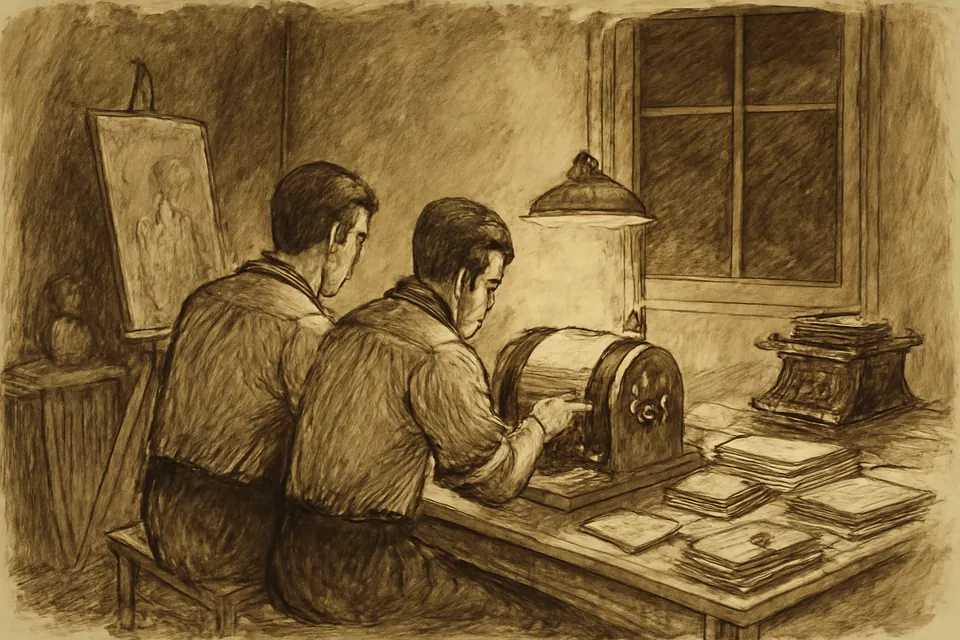
In the summer of 1942 Alexander and Hans Scholl decided to resist openly. Between June 27 and July 12, 1942, they wrote and duplicated the first four leaflets of the White Rose and mailed them across Munich. The second spoke plainly of the murder of the Jews: "since the conquest of Poland, 300,000 Jews have been murdered in that country in a bestial manner." The fourth said of Hitler, "Sein Mund ist der stinkende Rachen der Hölle" ("His mouth is the stinking maw of hell"), and asked its Christian readers whether they could still hesitate. According to the Munich cathedral's dean, Fr. Nikolai Artemoff, it was Alexander who proposed the name White Rose.
That summer the medical students were sent to the Russian front as medics. Alexander met Russian villagers and an Orthodox priest there and felt he had come home. Back in Munich he wrote to a Russian friend, "Aber noch muss ich in Deutschland bleiben" ("But I must still stay in Germany"), because of his duty to his friends. The circle grew, thousands of leaflets went out, Alexander carried them to cities in Austria, and at night he and Hans painted "Down with Hitler" and "Mass murderer Hitler" on Munich walls.
Arrest and martyrdom
On February 18, 1943, Hans and Sophie Scholl were caught scattering leaflets at the university. Alexander tried to flee to Switzerland with a friend's passport but could not cross the Alps in the snow. Back in Munich, during an air raid on the night of February 24, he was recognized in a shelter and handed over. At a second trial on April 19 he was sentenced to death. In prison his faith deepened. He wrote to his half-sister Natascha on July 2: "Denn was wusste ich bisher vom Glauben, vom warmen tiefen Glauben, von der Wahrheit, der letzten und einzigen, von Gott? Sehr wenig!" ("For what did I know until now of faith, of warm, deep faith, of the truth, the last and only truth, of God? Very little!").
Fr. Alexander Lovchy, the Orthodox priest of Munich, heard his confession and gave him Holy Communion. On the day of his death, July 13, 1943, he wrote to his father and stepmother:
In just a few hours I will be in a better life, by my mother, and I will not forget you; I will ask God to grant you solace and peace. And I will wait for you! One thing, above all, let me leave this on your hearts: Never forget God!
He was beheaded that evening at Stadelheim, on the same day as Professor Kurt Huber of the White Rose.
Why he is honored as a passion-bearer
The Orthodox Church calls a Christian who goes to an unjust death meekly and without hatred, in the spirit of Christ, a passion-bearer. ROCOR glorified him under that title in Munich on February 4–5, 2012, in services led by six bishops, among them Metropolitan Valentin of Orenburg, his birthplace. Jim Forest, who was there, noted that Bishop Engelbert Siebler attended for the Catholic Archdiocese of Munich. He is the patron of his city in the words of his troparion, which speaks of "our glorious city, having within it your holy relics." See more on our patron saints page.
Symbols of St. Alexander Schmorell in icons
The icon presented at his glorification in 2012, as Jim Forest describes it, shows him as a tall, brown-haired young man in the white robe of a physician with a Red Cross armband, for the medical student and army medic he was. His left hand is raised in greeting, and in the other he holds a red martyr's cross and a white rose, the sign of the resistance group he named, against a gold background. Copies hang at his grave and in the Cathedral of the New Martyrs nearby; some smaller icons show him with a lit candle.
Feast day and where he is honored
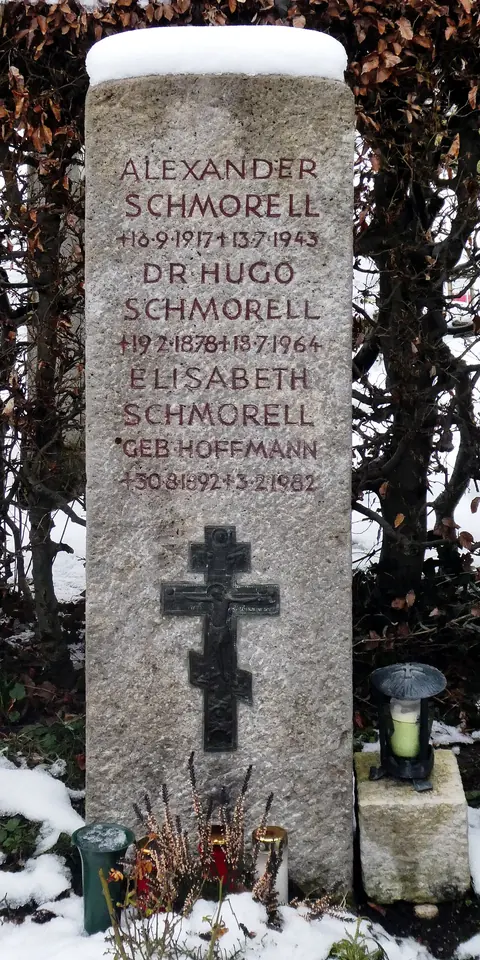
We keep his memory on July 13. He is buried with his father and stepmother in the Friedhof am Perlacher Forst, beside Stadelheim Prison, near the graves of Hans and Sophie Scholl and Christoph Probst. After the war, American forces built a base next to the cemetery, and its chapel later became the Russian Orthodox Cathedral of the Holy New Martyrs and Confessors of Russia, so his relics rest across the street from the church that glorified him. In Orenburg, his birthplace, a monument with his icon now stands. Find other July saints on our feast days page.
Prayer to St. Alexander of Munich
His troparion, sung by the Orthodox faithful, speaks of the light his holy relics bring to Munich and praises his courage in standing against the godless powers. His kontakion looks back to the love of Christ he received from his mother and his nurse, and it asks him to pray with the angels for everyone who honors his memory. The American Carpatho-Russian Orthodox Diocese publishes both texts.
Let us ask him to give us courage to speak the truth and to never forget God. Holy Passion-bearer Alexander of Munich, pray to God for us!
Frequently asked questions
Why is Alexander Schmorell a saint?
The Russian Orthodox Church Outside Russia glorified him on February 4–5, 2012, in Munich, as a passion-bearer: a Christian who accepted an unjust death in the spirit of Christ. He was a faithful Orthodox believer all his life, resisted the Nazi regime in the name of God and human freedom, and went to his death after confession and Holy Communion, writing to his parents, "Never forget God!"
What did Alexander Schmorell do in the White Rose?
With Hans Scholl he wrote and duplicated the first four White Rose leaflets in June and July 1942, mailing them across Munich. After service on the Russian front he helped spread thousands more, carried leaflets to Austrian cities, and painted slogans against Hitler on Munich walls at night.
Is Alexander Schmorell a Catholic saint?
He was Orthodox, baptized in Orenburg and faithful to the Russian Orthodox Church all his life, and it is the Orthodox Church that glorified him. Catholics honor him with the other members of the White Rose, several of whom were Catholic, as witnesses for Christ against Nazism.
When is the feast of St. Alexander Schmorell?
July 13, the day he was executed in 1943. Churches on the Julian calendar list it as June 30.
Keep exploring
Sources
- Cathedral of the Holy New Martyrs and Confessors of Russia, Munich (ROCOR): Über das Leben und das Werk des Märtyrers Alexander von München (2011). His Orthodox upbringing, the leaflets of June 27 to July 12, 1942, his arrest on February 24, 1943, his letters from prison, and confession and Communion from Fr. Alexander Lovchy
- American Carpatho-Russian Orthodox Diocese: New Martyr Alexander (Schmorell), by Fr. Edward Pehanich (archived). His glorification on February 4–5, 2012, his last letters and the troparion and kontakion
- Jim Forest, Canonization in Munich: Saint Alexander Schmorell (2012)