St. Pius I, Pope
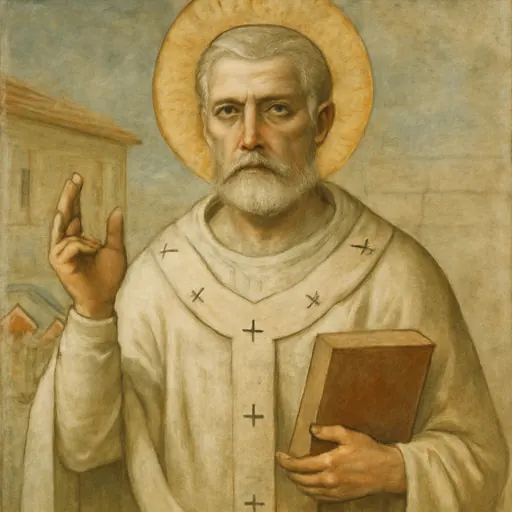
St. Pius I was the bishop of Rome from about 140 to about 155, the ninth successor of St. Peter. In his years the Gnostic Valentinus and the heretic Marcion taught in Rome, St. Justin defended the faith there, and his brother Hermas wrote The Shepherd. He was buried near St. Peter. His feast day is July 11.
Who was St. Pius I?
St. Pius I was the bishop of Rome from about 140 to about 155, the ninth successor of St. Peter and the first of the long line of popes named Pius. He shepherded the Church of Rome in the years when it was becoming, in the Catholic Encyclopedia's words, "clearly conspicuous as the centre of the Church," a place where both great teachers and dangerous ones came to be heard.
We know only a little about him, and the sources are worth reading closely. Some are close to his time. Others were written centuries later and mix facts with guesses.
What the oldest sources say
The list of St. Irenaeus
St. Irenaeus, writing about 180, lists the bishops of Rome to show how the apostles' teaching was handed on: after Telesphorus "then Hyginus; after him, Pius; then after him, Anicetus." Irenaeus had been in Rome himself and knew Christians who remembered these men.
Dating his reign
The only firm date we have comes from St. Polycarp of Smyrna. Polycarp visited Rome the year before his martyrdom, usually dated 155 or 156, and found Anicetus already bishop there. So Pius must have died about 154. The later Liberian list of popes gives 146 to 161, but the Catholic Encyclopedia shows that those numbers rest on a miscalculation.
The Book of the Popes
The Liber Pontificalis, compiled centuries later, says Pius was "by nationality an Italian, son of Rufinus, brother of the shepherd, from the city of Aquilegia," that is, Aquileia. The encyclopedia thinks the Aquileia detail is probably a guess by an author who knew the later writer Rufinus of Aquileia. The same book says he ruled that Easter be kept on a Sunday and that he "was buried near the body of the blessed Peter in the Vatican, July 11." The burial is the most trustworthy line.
The book also says he ruled that a convert "coming out from the heresy of the Jews" should be received and baptized. The Catholic Encyclopedia admits, "What this means we do not know," and suspects the author was crediting Pius with a rule of his own day, as he often did.
His brother Hermas and The Shepherd
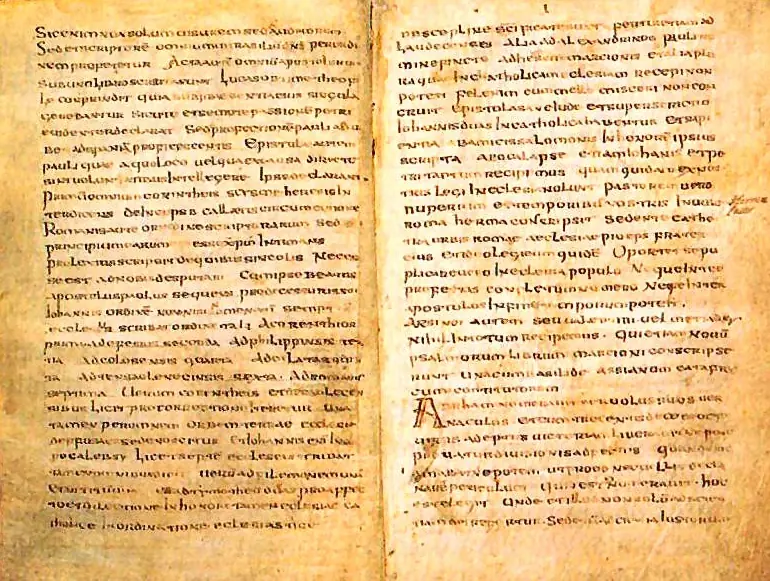
The most striking fact about Pius is his brother. The Shepherd of Hermas, a book of visions in which an angel appears to Hermas dressed as a shepherd and gives him commandments of repentance and holy living, was read with deep respect in the early Church. A Roman list of sacred books from the late second century, the Muratorian Fragment, explains when it was written:
And very recently, in our own times, in the city of Rome, Herma wrote the Pastor, when his brother Pius, the bishop, sat upon the chair of the Church of the city of Rome.
The same text says the book may be read privately but not publicly in church as Scripture. So the pope's brother wrote one of the most popular Christian books of the second century, and the Roman Church drew a careful line around it.
A Church of teachers and heretics
Rome drew everyone. The Gnostic Valentinus, who had come under St. Hyginus, went on teaching with some success. The Gnostic Cerdo was there, and Marcion arrived from Pontus with his own version of the Christian Scriptures, cutting out the Old Testament and much of the New. The Catholic Encyclopedia says Marcion was "excluded from communion by Pius" and then founded his own church.

Faithful teachers came too. St. Justin Martyr opened his school in Rome and explained the faith during the reigns of Pius and his successor. A small, often persecuted Church held to the apostles' teaching while brilliant men offered it something else. That was Pius's task, and the line of bishops Irenaeus wrote down is the proof that he kept it.
Legends: St. Pudentiana and St. Praxedes
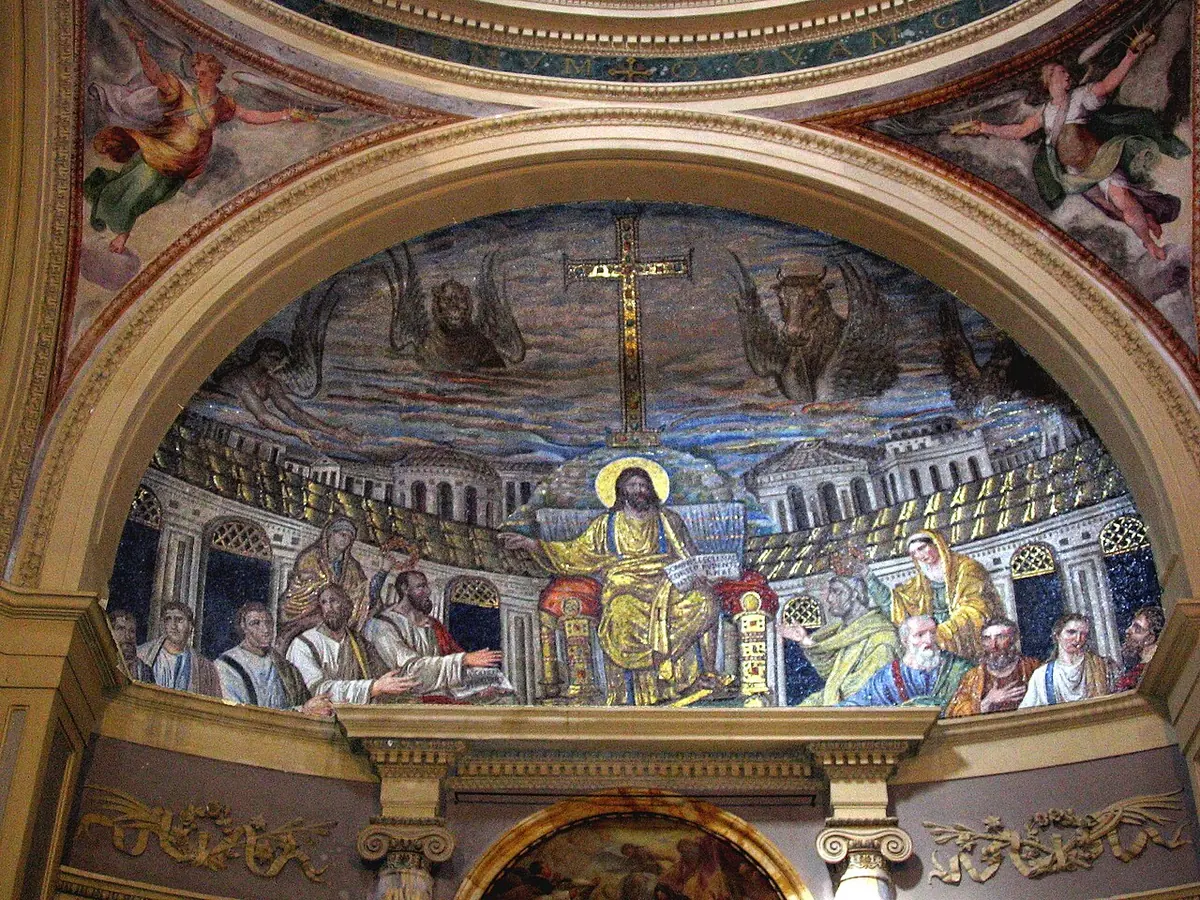
A later legend says Pius consecrated the two Roman churches of St. Pudentiana and St. Praxedes and baptized converts in a baptistery beside the first. The Catholic Encyclopedia says plainly that "the story, however, can lay no claim to historical credibility." The two churches date from the fourth century. The legend is traditional, and two letters to a bishop of Vienne once credited to Pius are not authentic.
Symbols of St. Pius I in art
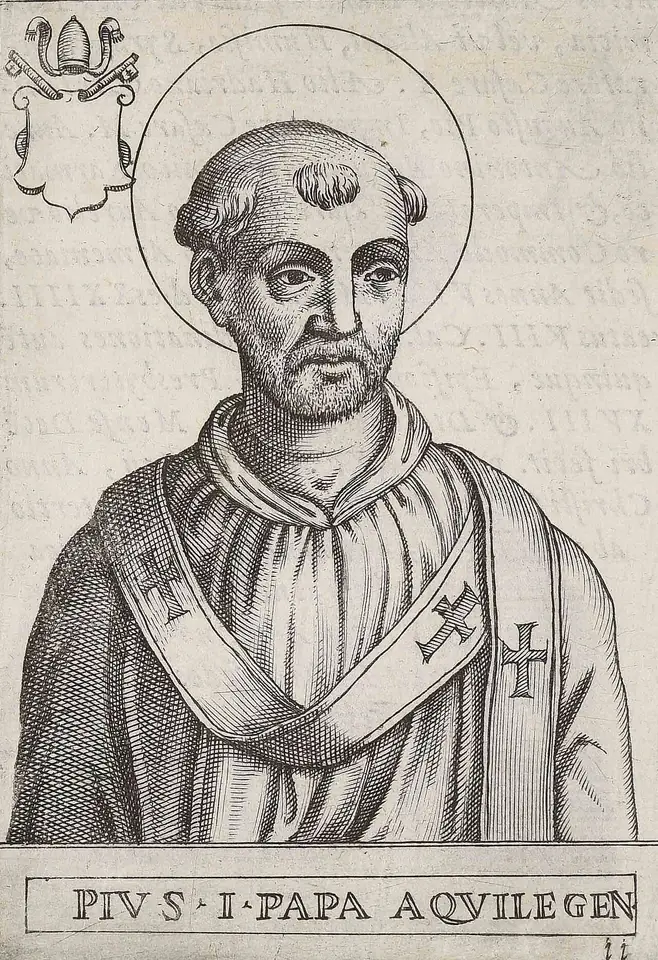
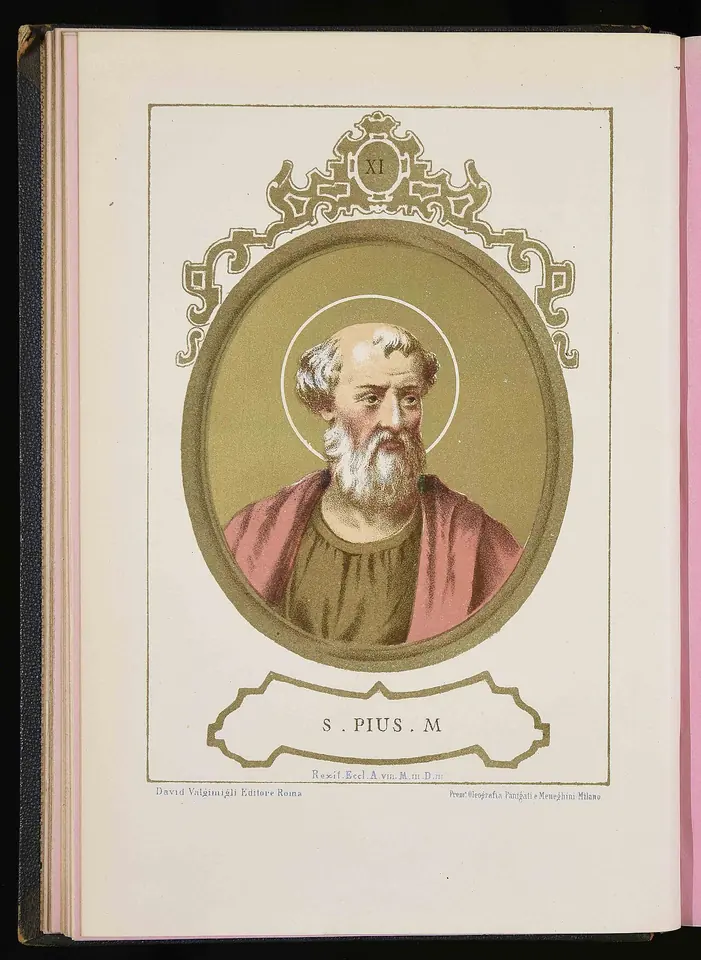
No early image of Pius survives. Artists give him the signs of his office: the papal tiara or miter, the pallium marked with crosses, a book of the Gospels and sometimes a double-barred papal cross. To tell him from the later popes named Pius, look for an inscription. Cavalieri's engraving labels him "Pius I Papa Aquilegen," and the 1879 lithograph on this page names him "S. Pius M.," the M for the martyr's title older calendars gave him.
Feast day and prayer
We keep the memory of St. Pius I on July 11, the burial date in the Book of the Popes and his day in the Roman Martyrology, which remembers him as the "brother of the famous Hermas" who "guarded the Church as a good shepherd for fifteen years." Older martyrologies called him a martyr, but no early source tells of his death, so the title is traditional. Alban Butler, writing in the 18th century, followed the older books, and noted that one Italian scholar of his day, Giusto Fontanini, held that Pius died by the sword. Butler gives no ancient source for it. See his neighbors on our feast days page.
There is no traditional prayer to St. Pius I alone. Let us ask him: St. Pius, pray for the pope and the bishops, for teachers of the faith, and for all who are tempted by teachings that lead away from Christ.
Frequently asked questions
Who was Pope St. Pius I?
The bishop of Rome after St. Hyginus and before St. Anicetus, around 140 to 155. St. Irenaeus lists him in the succession of Roman bishops, and early sources say he was the brother of Hermas, author of The Shepherd. He is the first of the many popes named Pius.
When is the feast of St. Pius I?
July 11, his burial date in the Book of the Popes and his day in the Roman Martyrology. He is not on the General Roman Calendar, where July 11 is the feast of St. Benedict.
Was St. Pius I a martyr?
Older martyrologies called him "pope and martyr," and Butler's Lives followed them. The current Roman Martyrology simply commemorates him as a pope "who guarded the Church as a good shepherd for fifteen years," and no early source tells of his death. The martyr title is traditional.
Who was Hermas, the brother of Pius I?
The author of The Shepherd, a book of visions and moral teaching that many early Christians read with great respect. The Muratorian Fragment, a Roman list of Scripture from the late second century, says Hermas wrote it "when his brother Pius, the bishop, sat upon the chair of the Church of the city of Rome."
Keep exploring
Sources
- J.P. Kirsch, Pope St. Pius I (Catholic Encyclopedia, 1911). Dating by Polycarp's visit to Anicetus, Hermas, Marcion excluded from communion, Justin in Rome, the legend of Santa Pudenziana
- Hermas (Catholic Encyclopedia, 1910). Text and translation of the Muratorian Fragment on Hermas and Pius
- Alban Butler, Lives of the Saints, vol. VII (1866): St. Pius I, Pope and Martyr
- Roman Martyrology 2004, July 11 (GCatholic)
- Louise Ropes Loomis, The Book of the Popes (Liber Pontificalis), New York: Columbia University Press, 1916. Son of Rufinus, of Aquileia, brother of the Shepherd; burial near St. Peter on July 11