Blessed Justo Takayama Ukon, the Samurai of Christ
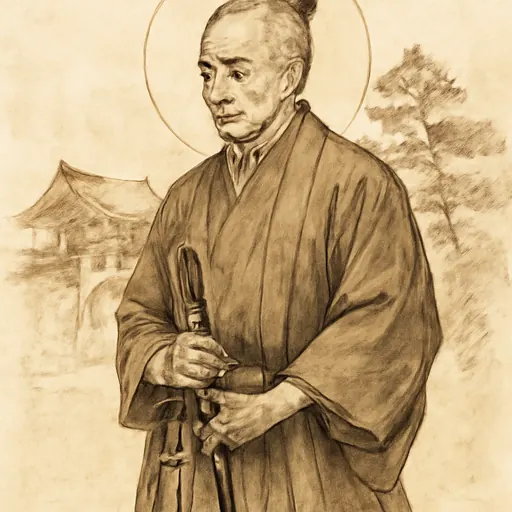
Blessed Justo Takayama Ukon (about 1552–1615) was a Japanese samurai lord who spread the faith in his domains. Ordered by Toyotomi Hideyoshi in 1587 to give up Christ, he gave up his lands and rank instead, and in 1614 was exiled to Manila, where he died weeks later. Beatified as a martyr in 2017, he is remembered on February 3.
Who was Blessed Justo Takayama?
Blessed Justo Takayama Ukon was a samurai and a feudal lord of Japan in the age of civil wars, and a Catholic from boyhood. When the most powerful man in Japan ordered him to choose between his faith and his lands, he gave up the lands. He spent his last years under suspicion and his last weeks in exile in Manila, where he died in 1615. The Church beatified him as a martyr in 2017. In Japan and the Philippines he is often called the "samurai of Christ."
"Ukon" was a court title, so his name is often given simply as Takayama Ukon; the Spanish and Portuguese called him Dom Justo, or "Ucondono."
The life of Blessed Justo Takayama
A samurai family baptized
His father, Takayama Tomoteru, was a samurai commander. In 1563, Santi e Beati relates, he was one of three judges appointed to examine the Jesuit Fr. Gaspar Vilela, who had founded the first Catholic mission in Kyoto. The priest answered so well that the judge asked for baptism himself and took the name Dario. Back at his castle he had the family taught, and his wife, their six children and many soldiers were baptized. The eldest son, born about 1552, became Justo.
A duel and a conversion of heart
As a young warrior he fought in the wars of his day. In a feud he was forced into a duel with the son of his father's dead ally, killed his opponent, and was badly wounded himself. Lying between life and death, he admitted to himself how little he had cared for the faith he had been taught. He recovered a changed man. In 1574 he married a Christian woman, Justa, and the Takayamas received the castle and lands of Takatsuki, near Osaka.
The Christian lord of Takatsuki
Under Justo, Takatsuki became a center of the mission, with places for catechumens to gather and priests to teach them. In 1578 a rebel lord took his sister and son hostage and threatened the Christians of Takatsuki. Justo prayed at length, then handed his rights back to his father and gave himself up, unarmed, to the warlord Oda Nobunaga. Nobunaga admired the act and confirmed him as lord. Justo became one of his generals, helped build churches in Kyoto and at Azuchi, and many people of rank were baptized through his influence. In 1585 Toyotomi Hideyoshi gave him the domain of Akashi, where the people too turned to the faith.

"For nothing in the world"
In 1587 Hideyoshi turned against the Christians. He ordered the missionaries out and pressed the Christian lords to return to the religion of their ancestors. On the night of July 24 he summoned Justo, complained that he had converted many lords, and ordered him to renounce his faith on pain of exile and the loss of his estates. Justo refused, declaring that for nothing in the world would he reject the God the missionaries had taught him to believe in. He lost everything, and for a time he and his family lived as wanderers until a Christian friend, Konishi Yukinaga, hid them on the island of Shodoshima.

Kanazawa, Nagasaki and the sea
Hideyoshi later made peace with him, though he never restored him as a lord. Justo lived for many years in Kanazawa under the protection of the Maeda lords, helping the Jesuits where he could. In 1614 the new ruler, Tokugawa Ieyasu, banned Christianity outright. Friends urged Justo to make a show of renouncing his faith, perhaps by stepping on a holy image. He answered that he knew what a treasure the Christian faith was, and that they should not suggest such a thing even in jest. He was taken under guard to Nagasaki and waited seven months, expecting to die. Then, on November 8, 1614, he was put aboard a crowded junk with about 300 other Christians, bound for Manila.

Death in Manila
The Spanish city received him as a hero of the faith. When the Spanish proposed that he help them overthrow the shogun, he refused. About forty days after landing he fell into a high fever. He sent for his spiritual director, the Jesuit Fr. Morejón, received the last sacraments, urged those around him to persevere, and died repeating the name of Jesus, around midnight on February 3, 1615. He was about sixty-two. The Spanish buried him with full military honors.
The beatification of Justo Takayama
The priests of Manila tried to open his cause within a few years of his death, but Japan's closed borders made it impossible to gather testimony. A second attempt in 1965 stalled on technical errors. In 2012 Archbishop Leo Jun Ikenaga of Osaka asked Pope Benedict XVI to take it up again. The Church judged that his death came from the hardships and mistreatment he suffered for Christ, and in January 2016 Pope Francis approved the decree of his martyrdom. Cardinal Angelo Amato beatified him at the Osaka-jo Hall on February 7, 2017. No miracle was required, since he was beatified as a martyr, and none has yet been approved for his canonization.
- His martyrdom (approved). The decree of 2016 recognizes his death in exile as martyrdom for the faith.
- Favors toward his canonization (reported). Devotees in Japan and the Philippines pray for the miracle his canonization needs. None has been approved so far.
Why Blessed Justo is a model for exiles and public servants
Takayama had everything a man of his world could want: rank, lands, armies and the trust of the great. He let all of it go rather than betray Christ, and he died a refugee. Japanese and Filipino Catholics ask his prayers for exiles and migrants, and he is held up as a model for Catholics in public life, like St. Thomas More. More patronages are on our patron saints page.
Symbols of Blessed Justo Takayama in art
- Samurai dress and a topknot: his rank in life.
- A sword held point down, with a crucifix over it: his best-known image, from the statue at Plaza Dilao in Manila. The sword is sheathed and lowered, its power laid under the cross.
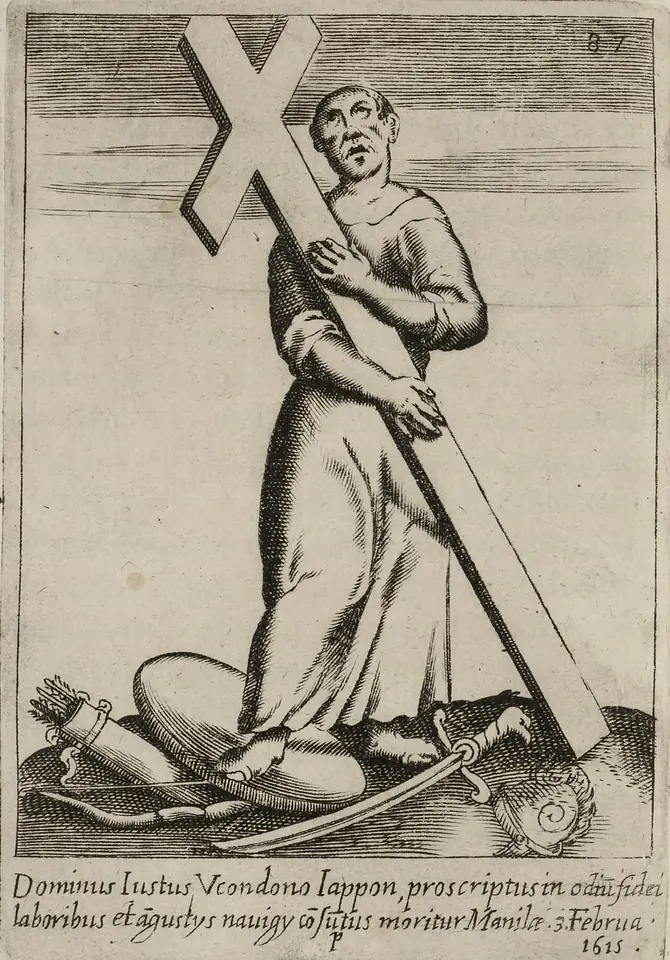
- Discarded armor at his feet and a cross on his shoulder: the old Jesuit engraving of 1646.
- Armor and weapons: in Japanese popular prints, which remember him first as a warrior.
Blessed Justo's feast day and memorials
We keep his memorial on February 3, the date given by the Catholic Church in Japan. In Manila, a statue of him stands at Plaza Dilao in Paco, and a copy stands at the University of Santo Tomas. His remains were lost among others when San Ignacio Church in Intramuros was destroyed in 1945; all the bones from its niches were moved together to the Jesuit cemetery at Novaliches. See other February saints and blesseds on our feast days page.
Prayer to Blessed Justo Takayama
We know of no traditional English prayer to Blessed Justo; the Church in Japan has its own Mass and Office texts for his memorial. We can pray simply: Blessed Justo Takayama, pray for us.
Let us ask him to pray for Christians who are forced from their homes, for those who must choose between their faith and their livelihood, and for the Church in Japan.
Frequently asked questions
Who was Blessed Justo Takayama?
A Christian daimyo (feudal lord) and samurai of 16th-century Japan, known as Takayama Ukon. He was baptized Justo as a boy of about twelve, ruled Takatsuki and later Akashi, and when the warlord Toyotomi Hideyoshi ordered Christian lords to renounce their faith in 1587, he lost everything rather than obey. Expelled from Japan in 1614 with some 300 Christians, he died in Manila on February 3, 1615.
Why is Justo Takayama called a martyr if he was not killed?
The Church recognized that his death in exile was the result of the hardships and mistreatment he suffered for the faith. Pope Francis approved the decree of his martyrdom in January 2016, and he was beatified in Osaka on February 7, 2017, the first Japanese martyr beatified on his own rather than in a group.
When is Blessed Justo Takayama's feast day?
February 3, as kept by the Catholic Church in Japan.
Where is Blessed Justo Takayama buried?
He was buried with military honors by the Spanish in the Jesuit church in Intramuros, Manila. After San Ignacio Church was destroyed in 1945, all the bones from its niches, his among them, were moved together to the Jesuit novitiate at Novaliches in Quezon City.
Keep exploring
Sources
- Emilia Flocchini, Beato Giusto Takayama Ukon (Santi e Beati). His father's conversion through Fr. Gaspar Vilela; the duel and his recovery; his surrender at Takatsuki in 1578; the 1587 refusal; the voyage of November 8, 1614; his death calling on Jesus; the decree of martyrdom and the Osaka beatification
- Justo Takayama Ukon (Catholic Bishops' Conference of Japan, in Japanese). His memorial on February 3; beatified as a martyr in Osaka in February 2017
- Ernie de Pedro, The Search for the Bones of Takayama Ukon (Prayer Warriors of Blessed Takayama). The burial in Manila and the 1945 removal of the bones to Novaliches