St. Claudine Thévenet
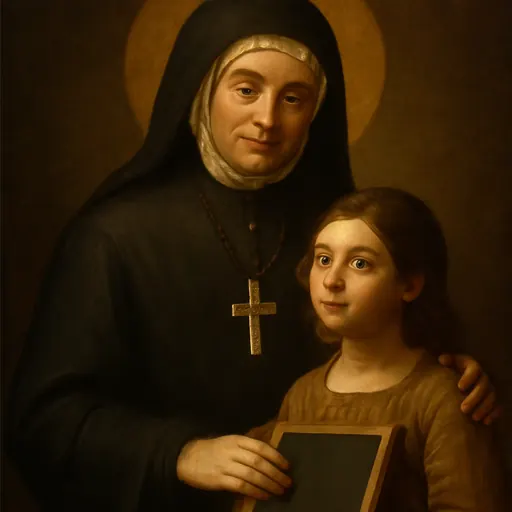
St. Claudine Thévenet (1774–1837) was a woman of Lyon who saw two of her brothers executed during the French Revolution and heard their last plea to forgive. She gave her life to poor and abandoned girls and in 1818 founded the Congregation of Jesus and Mary to educate them. Pope John Paul II canonized her in 1993. Her feast is February 3.
Who was St. Claudine Thévenet?
St. Claudine Thévenet was a Frenchwoman of Lyon whose two brothers were executed in the Revolution, and who answered that wound by giving her life to poor and abandoned girls. In 1818 she founded the Congregation of Jesus and Mary, which still educates children around the world. St. John Paul II canonized her in 1993. We keep her feast on February 3.
She was born in Lyon on March 30, 1774, the second of seven children. Her family called her "Glady." The Dicastery for the Causes of Saints says that even as a girl she was known for goodness, gentleness and forgetting herself to please others.
The life of St. Claudine Thévenet
"Glady, forgive, as we forgive"
She was fifteen when the French Revolution broke out. In 1793 Lyon rose against the Convention and was besieged by government troops. After the city fell, two of her brothers were killed in reprisal in January 1794, and Claudine witnessed it, helpless and horrified. Their last words to her were, "Glady, forgive, as we forgive."
She took those words into her heart and made them her own. In his canonization homily, St. John Paul II said her vocation "has its origin in this wound," and that the heroic forgiveness her brothers asked of her moved her to turn with faith and love toward everyone she saw wounded by life.

The Providence of St. Bruno
She came to believe that ignorance of God was the deepest cause of the people's suffering, and she longed to make Jesus and Mary known, above all to girls and young women. A holy priest, Father André Coindre, helped her discern God's will. One day he found two little girls abandoned and shivering on the floor of the Church of St. Nizier in Lyon, and he brought them to Claudine, who took them in without hesitation. That act of compassion was the beginning of the "Providence" of St. Bruno in Lyon, in 1815.
Other women joined her in an association of the Sacred Heart and elected her president.

The Congregation of Jesus and Mary
On July 31, 1818, Father Coindre told her plainly that the time had come to form a community. "God has chosen you," he said. On October 6, 1818, at Pierres-Plantées on the hill of the Croix-Rousse, the Congregation of the Religious of Jesus and Mary was founded. Claudine took the name Mother Mary of St. Ignatius. In 1820 the community settled at Fourvière, facing the famous shrine of Our Lady, on land bought from the Jaricot family. The diocese of Le Puy approved the congregation in 1823 and Lyon in 1825.
At first the sisters took in poor girls and cared for them until they were twenty, teaching them school subjects, a trade and the faith. Then they opened a boarding school for girls from well-off families too. Their mission became the Christian education of every class of society, with a preference for girls, and among them the poorest.
Trials and death
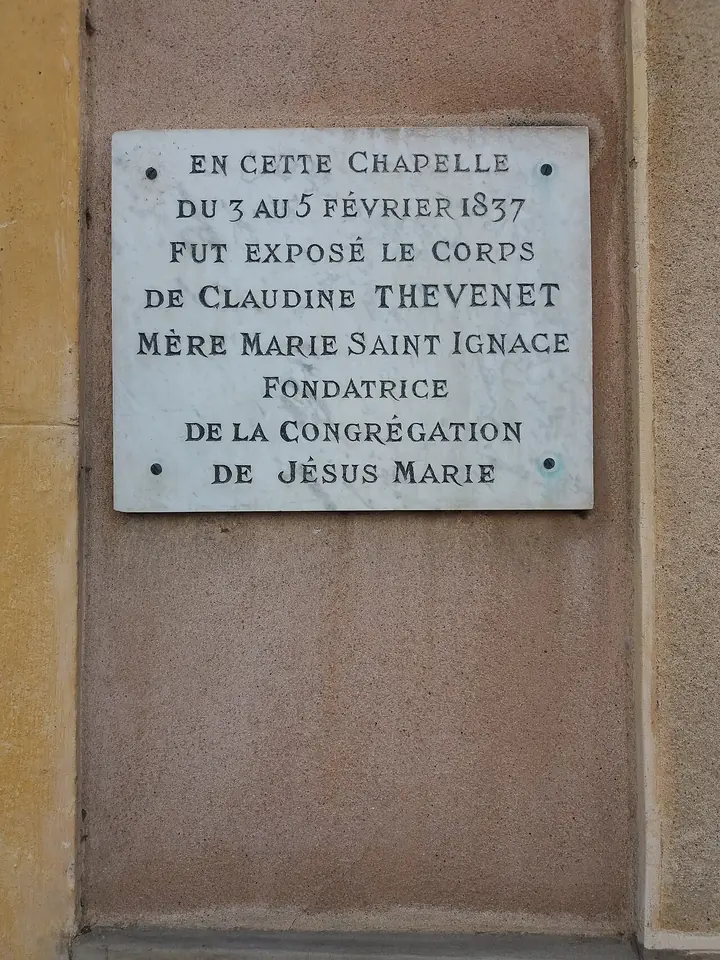
Her last twelve years were hard. Father Coindre died in 1826, and some of the first sisters in 1828. She had to fight to keep her congregation from being merged into another. The uprisings in Lyon in 1831 and 1834 put Fourvière, on its strategic hill, between the two sides. She did not lose heart. She built new buildings, including the chapel of the mother house, and worked carefully on the constitutions of the congregation. She was writing their final version when she died on February 3, 1837, in her sixty-third year.
Canonization and miracles
St. John Paul II beatified her on October 4, 1981, and canonized her in St. Peter's Basilica on March 21, 1993, together with St. Teresa of the Andes. Both steps required a miracle attributed to her intercession, so the healings accepted in her cause are approved miracles; we have not found the details of those cases in a source we could check, so we don't describe them here.
Symbols of St. Claudine Thévenet in art
She lived into the 1830s, and her images are portraits in the habit of her congregation:
- White fluted cap and black veil: the habit of the Religious of Jesus and Mary.
- Cross: the cross she wore on her breast.
- Children: the poor and abandoned girls she took in.
- Hearts of Jesus and Mary: the names and devotion of her congregation.

Feast day and prayer
We keep her feast on February 3. The Religious of Jesus and Mary honor her in their schools and communities around the world.
She often told her sisters, "Let charity be like the apple of your eye," and at her beatification St. John Paul II recalled another of her sayings: be ready to suffer everything for others and never make anyone suffer. There is no traditional prayer to her in standard prayer books. Let us ask her to pray for teachers, for children without a home, and for all who carry a wound they are trying to forgive. St. Claudine Thévenet, pray for us.
Frequently asked questions
Who was St. Claudine Thévenet?
She was born in Lyon in 1774, lived through the siege of the city in 1793, and in January 1794 saw two of her brothers executed. Their last words, "Glady, forgive, as we forgive," shaped her life. She cared for orphaned and poor girls and founded the Religious of Jesus and Mary in 1818, taking the name Mother Mary of St. Ignatius.
When is the feast of St. Claudine Thévenet?
February 3, the day she died at Fourvière in 1837.
When was Claudine Thévenet canonized?
Pope John Paul II beatified her on October 4, 1981, and canonized her in St. Peter's Basilica on March 21, 1993, together with St. Teresa of the Andes.
What is Claudine Thévenet known for saying?
She often told her sisters, "Let charity be like the apple of your eye," as St. John Paul II recalled at her canonization.
Keep exploring
Sources
- Dicastery for the Causes of Saints: Claudine Thévenet (1774–1837). Her birth, her brothers' execution and last words, Father Coindre, the Providence of St. Bruno, the founding on October 6, 1818, Fourvière, her death, and the beatification and canonization dates
- St. John Paul II, homily at the canonization of Claudine Thévenet and Teresa of the Andes, March 21, 1993. Her heroic forgiveness and the saying about charity as the apple of the eye