St. Catherine of Ricci, Dominican Mystic of Prato

St. Catherine of Ricci (1522–1590), more properly St. Catherine de' Ricci, was a Florentine Dominican nun at Prato. For twelve years from 1542 she was rapt every week from Thursday noon to Friday afternoon in an ecstasy of the Passion of Christ. She was canonized in 1746. The Dominicans keep her feast on February 4.
Who was St. Catherine of Ricci?
St. Catherine of Ricci, whose family name is properly de' Ricci, was a Dominican nun of Prato in Tuscany and one of the great mystics of the sixteenth century. Born in Florence in 1522 and baptized Alessandra Lucrezia Romola, she entered the convent of San Vincenzo at Prato as a girl. From 1542, every week for twelve years, she was caught up in an ecstasy of Christ's Passion from Thursday noon until Friday afternoon. People of every rank came to Prato to see it. Yet she was also a practical prioress, a loving sister to her brothers, and a counselor by letter to many. She died on February 2, 1590, and was canonized in 1746.

The life of St. Catherine de' Ricci
A Florentine girl who wanted a strict convent
Her father, Pier Francesco de' Ricci, came from an old family of Florentine bankers and merchants. Her mother, of the Ricasoli family, died when Alessandra was small, and her stepmother, Fiammetta da Diacceto, saw the child's love of solitary prayer and did all she could to help it grow. As a girl Alessandra resolved to enter a convent that kept its rule strictly. The Catholic Encyclopedia notes that relaxed discipline was so common at the time that it took her a long while to find one.
She found it at Prato, in the Dominican convent of San Vincenzo, founded in 1503 by nine women who had followed the Dominican preacher Girolamo Savonarola. Her father was reluctant, but she was clothed in 1535, taking the name Catherine, and made her profession in 1536.
Misunderstood, then trusted
Her first years in the convent were hard. During her novitiate and for four or five years after her profession, her sisters misunderstood the extraordinary graces she received and treated her with suspicion. Her humility won them over. She was given one office after another and served as prioress or subprioress for the rest of her life. The Dominican nuns of North Guilford, Connecticut, write that she was prioress for thirty-six years and was especially gentle with the sick.

The ecstasy of the Passion
In February 1542, when Catherine was about twenty, the great "Ecstasy of the Passion" began. Every week, from Thursday at noon until four o'clock on Friday afternoon, she passed in ecstasy through each stage of Christ's suffering, and showed to those who watched what His Mother endured beside Him. The Catholic Encyclopedia, usually cautious, calls it "a marvellous, but fully and most carefully authenticated ecstasy." This is a reported grace, witnessed by many people in her lifetime.
It went on for twelve years. People of every rank flocked to Prato, and the peace of the convent suffered, so Catherine and her community prayed that it would stop. It did.

Other graces and wonders
Several more graces are told of her, and the art of her basilica shows them:
- The stigmata: the Dominican nuns record that she bore the wounds of Christ. This is reported from her lifetime.
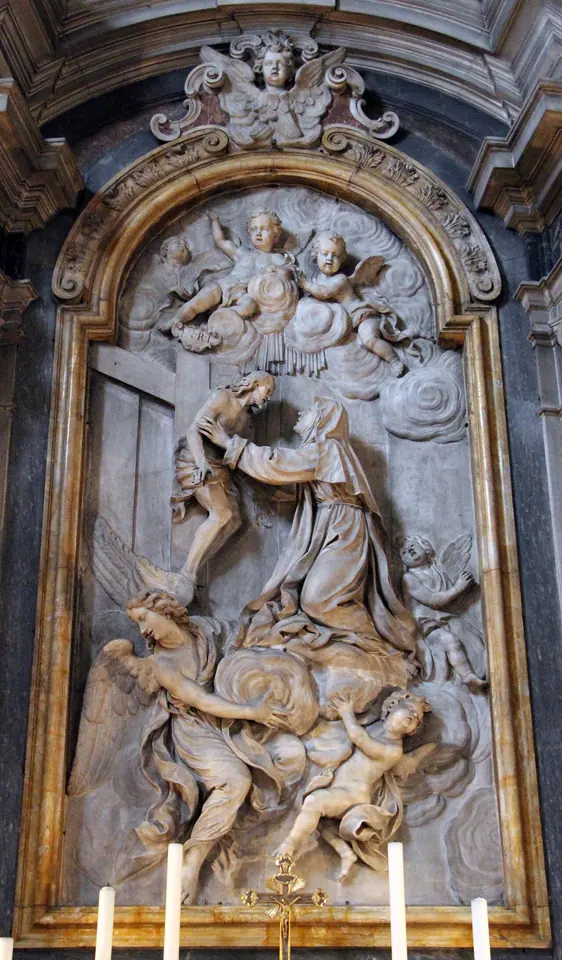
- The embrace of the crucifix: tradition holds that Christ leaned down from the crucifix to embrace her. This is a traditional account, carved in marble by Girolamo Ticciati for her altar.
- The mystical espousal: Christ is said to have given her a ring as His bride. Traditional.
- Friends she never met: the Catholic Encyclopedia says she is said to have had "miraculous intercourse" with St. Philip Neri in Rome and St. Mary Magdalene de' Pazzi in Florence, though she never met either in the ordinary way. Traditional.
She lived in an age of saints. Besides Philip Neri and Mary Magdalene de' Pazzi, her contemporaries included St. Charles Borromeo. Her many letters to her brothers, her friends and her "spiritual children" were published in Florence in 1890.
Symbols of St. Catherine de' Ricci in art
Images of St. Catherine come mostly from Prato and from the Dominican Order:
- The Dominican habit: white tunic and wimple, black veil and cloak.
- A crucifix: held to her heart, or Christ reaching down from the cross to embrace her, for her ecstasy of the Passion.
- A ring: for her mystical espousal to Christ.
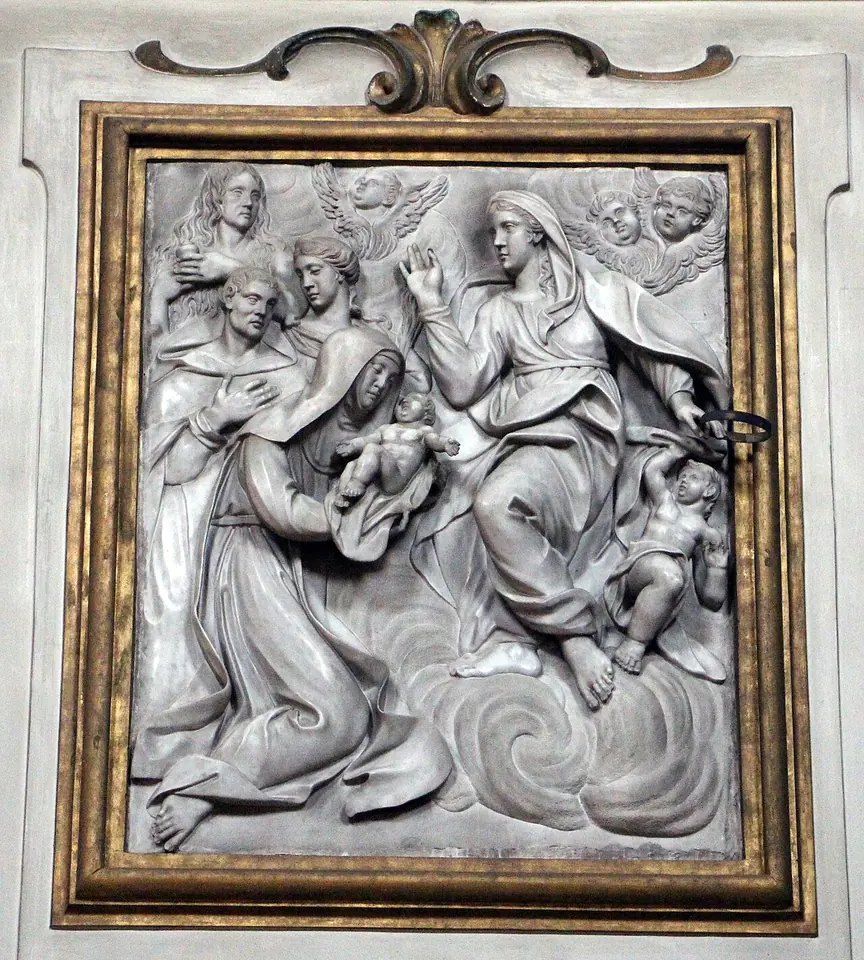
- The Christ Child: Vincenzo Foggini's relief shows Our Lady placing the infant Jesus in her arms.
- A lily: for purity, shared with many Dominican women saints.
- A crown of thorns: sometimes on her head or in her hand, for the Passion she shared.
Be careful not to confuse her with St. Catherine of Siena, also a Dominican in the same habit with a crucifix and lily. Catherine of Siena is usually shown with the stigmata and a book or a church; Catherine de' Ricci more often appears in scenes of the Passion, or with Philip Neri.
Feast day and where she rests
The Dominican Order keeps her feast on February 4. The Roman Martyrology remembers her on February 2, the day of her death; before 1969 the universal calendar kept her feast on February 13. She was beatified by Pope Clement XII in 1732 and canonized by Pope Benedict XIV in 1746, both times amid great rejoicing in Prato. Her body still rests in her own convent church, the Basilica of Sts. Vincent and Catherine de' Ricci. See the feast day calendar for other saints of February.

Prayer to St. Catherine de' Ricci
We have not found a traditional prayer to her in common use in English, so we ask her intercession in our own words. Let us ask St. Catherine de' Ricci to pray for all who suffer, that they may unite their pain to the Passion of Christ; for religious superiors and all who must care for a community; and for us, that we may stay close to Our Lord and His Mother at the foot of the cross.
Frequently asked questions
Who was St. Catherine of Ricci?
Alessandra de' Ricci, born in Florence in 1522 to a family of bankers and merchants, who entered the Dominican convent of San Vincenzo at Prato as a girl and took the name Catherine. She became famous for a weekly ecstasy of the Passion, served her community as prioress or subprioress for decades, and died on February 2, 1590.
What was St. Catherine de' Ricci's ecstasy of the Passion?
Beginning in February 1542, every week from Thursday noon until 4 p.m. on Friday, she lived through the stages of Christ's Passion in ecstasy, showing those who watched what His Mother suffered. The Catholic Encyclopedia calls it "fully and most carefully authenticated." It continued for twelve years, until her prayers and those of her sisters asked God to end it because the crowds were disturbing the convent.
When is the feast of St. Catherine of Ricci?
February 4 for the Dominican Order. The Roman Martyrology lists her on February 2, the day of her death; the older calendar kept her feast on February 13.
Where is St. Catherine de' Ricci buried?
In Prato, in the church of her Dominican convent of San Vincenzo, today the Basilica of Sts. Vincent and Catherine de' Ricci.
Keep exploring
Sources
- St. Catherine de' Ricci, Catholic Encyclopedia (1908), New Advent. Her family, the convent of San Vincenzo and its Savonarolan founders, the trials of her novitiate, the weekly Ecstasy of the Passion and its end, her contemporaries, beatification and canonization, the old February 13 feast and her tomb
- St. Catherine de' Ricci, Dominican Nuns of the Monastery of Our Lady of Grace. Her February 4 Dominican feast, the stigmata, and her thirty-six years as prioress
- Saint of the Day, February 2, Vatican News. Lists her on February 2