St. Vardan Mamikonian, Commander and Martyr of Avarayr

St. Vardan Mamikonian (about 387–451) was the commander of the Armenian army who led his people's stand against the Persian king's attempt to force Zoroastrianism on Christian Armenia. He fell with 1,036 companions at the Battle of Avarayr in 451. The Armenian Church honors him and his comrades as martyrs, the Sts. Vartanants, on the Thursday before Great Lent (February 4 in 2027).
Who was St. Vardan Mamikonian?
St. Vardan Mamikonian was the commander of the Armenian army in the middle of the 5th century, and the Armenian Church honors him as its great martyr of the battlefield. In 451 he led a small Christian nation against the Persian Empire, which had ordered Armenia to give up Christ for the worship of fire and the sun. He died at the Battle of Avarayr with more than a thousand of his men. The battle was lost, but the faith was kept, and for fifteen centuries Armenians have said that Avarayr was a victory.
We know him chiefly from the History of Vardan and the Armenian War by Yeghishe (Elisaeus), a churchman of the same century, and from the history of Ghazar Parpetsi, written a generation later. Both writers loved him, and both wrote as believers, so their books are histories and sermons at once.
His life
A grandson of St. Sahak
Vardan was born around 387 in Taron, the son of Hamazasp Mamikonian. His mother, Sahakanoysh, was a daughter of the Catholicos Sahak, honored by the Church as St. Isaac of Armenia. The boy grew up in the circle that gave Armenia its alphabet and its Bible: Sahak and St. Mesrop Mashtots ran the school where he was taught. The Mamikonians held by inheritance the office of sparapet, supreme commander of the Armenian forces, and in time it passed to Vardan.
The king's order
From 428 the eastern part of Armenia was ruled directly by Persia. King Yazdegerd II, who came to the throne in 439, wanted his whole empire to share one religion, the Zoroastrian faith of the Magi. Around 449 he ordered the Armenians to give up Christianity. The bishops, priests and nobles met at the old capital, Artashat, and sent him an answer that Yeghishe preserved. In the 1830 English translation of Neumann it reads in part:
From this belief no one can move us, neither angels nor men—neither fire nor sword, nor water, nor any other horrid tortures, however they be called.
...our bodies are in thy hands—do with them according to thy pleasure; tortures are thine, and patience ours; thou hast the sword, we the neck...
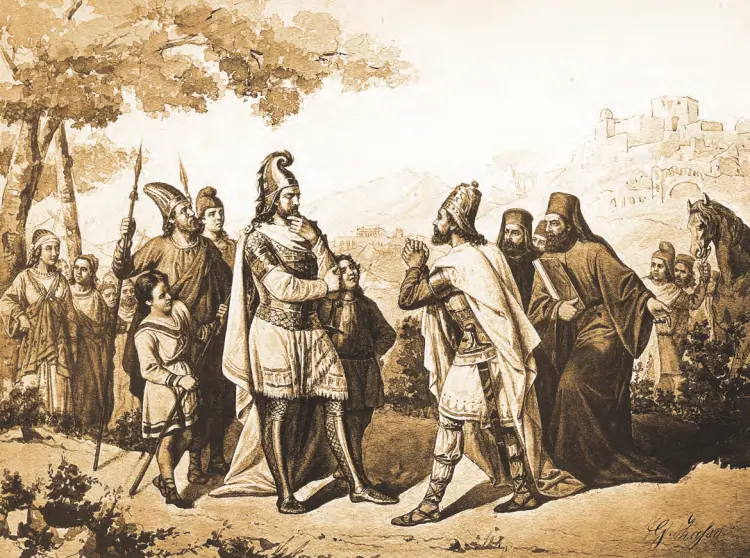
The king summoned the leading nobles to his court and forced them to submit. Vardan and the others went through the outward motions of apostasy to win their release. When they came home, they repented of it publicly and turned openly back to Christ. Yeghishe and Ghazar tell this part differently, and it is honest to say so: Vardan was not a man without a fall. He was a man who rose again.
The rising
Through 450 the Armenians took back fortresses and drove out the Magi who had come to close the churches. Vardan won a victory over a Persian force in the Caucasus and sent to Constantinople for help, which never came. At home the nobles were divided. The governor, Vasak Siwni, went over to the Persian side and drew part of the country with him.
Avarayr
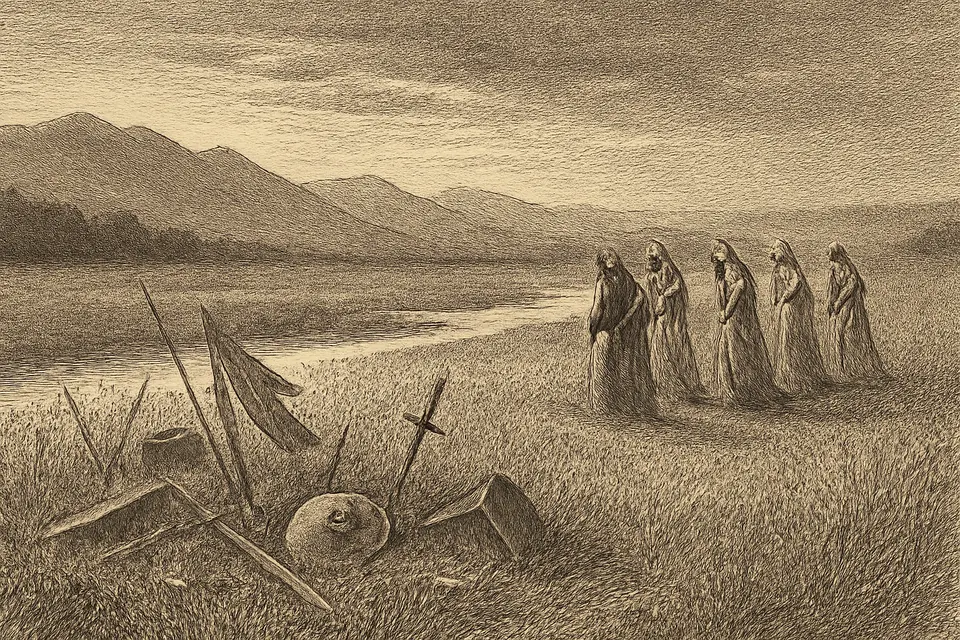
In the spring of 451 a great Persian army, with war elephants and the elite cavalry called the Immortals, marched into Armenia. The Armenians met it on the plain of Avarayr, beside a small river, in what is now northwestern Iran. Vardan spoke to his army before the battle, and Yeghishe gives his words:
Should the object of our lives be completed by a holy death in battle, let us meet it with a joyful heart.
That night the priest Leont (Ghevond), with the Catholicos Joseph, preached to the soldiers. Yeghishe writes that "all the Catechumens in the army were baptized during the night, and on the following morning they received the holy Eucharist." After the battle Joseph and Leont were carried off to Persia, where Joseph, as Neumann's notes say, suffered martyrdom; Armenian tradition honors Leont and his fellow priests as martyrs as well.
The battle lasted the whole day. Yeghishe says that Vardan "was found worthy of martyrdom on the spot," and he lists the noble houses that fell with him, beginning: "Of the house of the Mamigonians, the brave Vartan, with one hundred and thirty-three." He counts 1,036 Armenians who, in his words, "have inscribed their names in the book of life by the great battle on this day."

What Avarayr won
Armenia lost the battle, but Persia did not win the war. The Persians were shaken by their own losses and pulled back. Over the next thirty years the Armenians kept their churches open. In 484 Vardan's nephew, Vahan Mamikonian, won by the Treaty of Nvarsak what his uncle had died for: the right of the Armenian people to live as Christians. That is why the Armenian Church does not remember Avarayr as a defeat.
Is St. Vardan a saint of the Catholic Church?
St. Vardan is a saint of the Armenian Church, which keeps him among its martyrs, and he is honored by Armenian Christians of every communion. He is honored for his death for the faith, not for wonders; we know of no approved miracle attributed to him. He does not appear in the Roman Martyrology, and the Latin Church has no feast for him. His story stands beside those of the soldier saints the whole Church knows, like St. George and St. Sebastian: Christians who served in arms but would not give their faith to an earthly king.
Symbols of St. Vardan Mamikonian in art
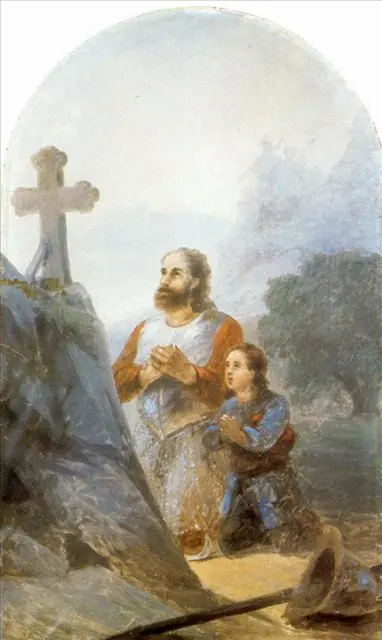
Armenian painters show Vardan as a mature, bearded commander in armor with a red cloak, carrying a sword. Often he holds or kneels before a cross, because his war was fought for the cross, or he rides at the head of his army on a horse. The best-known painting of him, Aivazovsky's Oath before the Battle of Avarayr, shows him not fighting but praying. Old Armenian manuscripts of Yeghishe show the battle itself, as in the miniature above, with the Persian war elephants that made Avarayr famous. Icons of the Vartanants show Vardan with his companions, a crowd of armed men under a single banner with a cross.
Feast day: Vartanants
The Armenian Church keeps the feast of Sts. Vartanants, St. Vardan and his companions, on the Thursday before Great Lent. In 2027 that is February 4. Armenian churches named for St. Vartan, like St. Vartan Cathedral in New York, keep the day with special solemnity, and many parishes hold a Divine Liturgy, a requiem for the fallen and a cultural program for young people. The feast comes just before Lent, and Armenian preachers often use it to call the faithful to the same steadfastness in their own Lenten struggle. See our feast day calendar for other saints of the season.
Prayer to St. Vardan
The Armenian Church has its own hymns (sharakans) for the feast of Vartanants, sung in the Divine Liturgy and the hours. We do not have a published English prayer to St. Vardan that we can cite, so we do not print one here. The reply of Artashat, quoted above, is itself a prayer and a confession that any Christian can make their own.
Let us ask St. Vardan and his companions to pray for Christians who are pressed to give up their faith, for soldiers, and for the Armenian people. Holy Vardan and all the martyrs of Avarayr, pray for us.

Frequently asked questions
Who was St. Vardan Mamikonian?
The head of the Mamikonian family and the sparapet, or supreme commander, of Armenia's forces in the 5th century. When the Persian king Yazdegerd II ordered the Armenians to abandon Christ, Vardan led the resistance and died in battle at Avarayr in 451.
What is Vartanants?
The feast of St. Vardan and the companions who died with him at Avarayr. The name means "those of Vardan." The Armenian Church keeps it on the Thursday before Great Lent.
Why is St. Vardan honored as a martyr if he died in battle?
Because the war was fought over the faith itself. The Persian king demanded that the Armenians worship the sun and fire; Vardan and his men took up arms to keep the Gospel, and the Armenian Church has honored those who died as witnesses for Christ since the time of the historian Yeghishe, who wrote of them as having "inscribed their names in the book of life."
When is the feast of St. Vardan in 2027?
Thursday, February 4, 2027, the Thursday before the start of Great Lent in the Armenian Church. In 2026 it fell on February 12.
Keep exploring
Sources
- Elisaeus (Yeghishe), The History of Vartan and of the Battle of the Armenians, translated by C. F. Neumann (London, 1830), archive.org. The reply of the Armenian assembly to the king, Vardan's words to his army, the night of baptisms and the Eucharist before the battle, the names of the fallen, and the count of 1,036 Armenian dead
- Armenian Church (Eastern Diocese): Celebrate Vartanantz at St. Vartan Cathedral. The feast kept every year on the Thursday preceding Great Lent