St. Isidore of Pelusium, Desert Monk and Letter Writer

St. Isidore of Pelusium (died about 449) was an Egyptian monk and priest who lived on a mountain near Pelusium. More than 2,000 of his letters survive, written to monks, bishops and even emperors. He defended the memory of St. John Chrysostom and urged St. Cyril of Alexandria toward peace. His feast is February 4.
Who was St. Isidore of Pelusium?
St. Isidore of Pelusium was an Egyptian monk of the late fourth and early fifth centuries who became, from a small monastery on a mountain, one of the great letter writers of the early Church. He was born in Alexandria. Leaving his family and his property, he went to live as a monk on a mountain near Pelusium, a port city at the eastern edge of the Nile Delta, and the name of that city has been joined to his ever since.
He never became a bishop. Yet monks, priests, bishops, officials and the emperor himself received letters from him, and more than two thousand of them survive. We keep his feast on February 4.
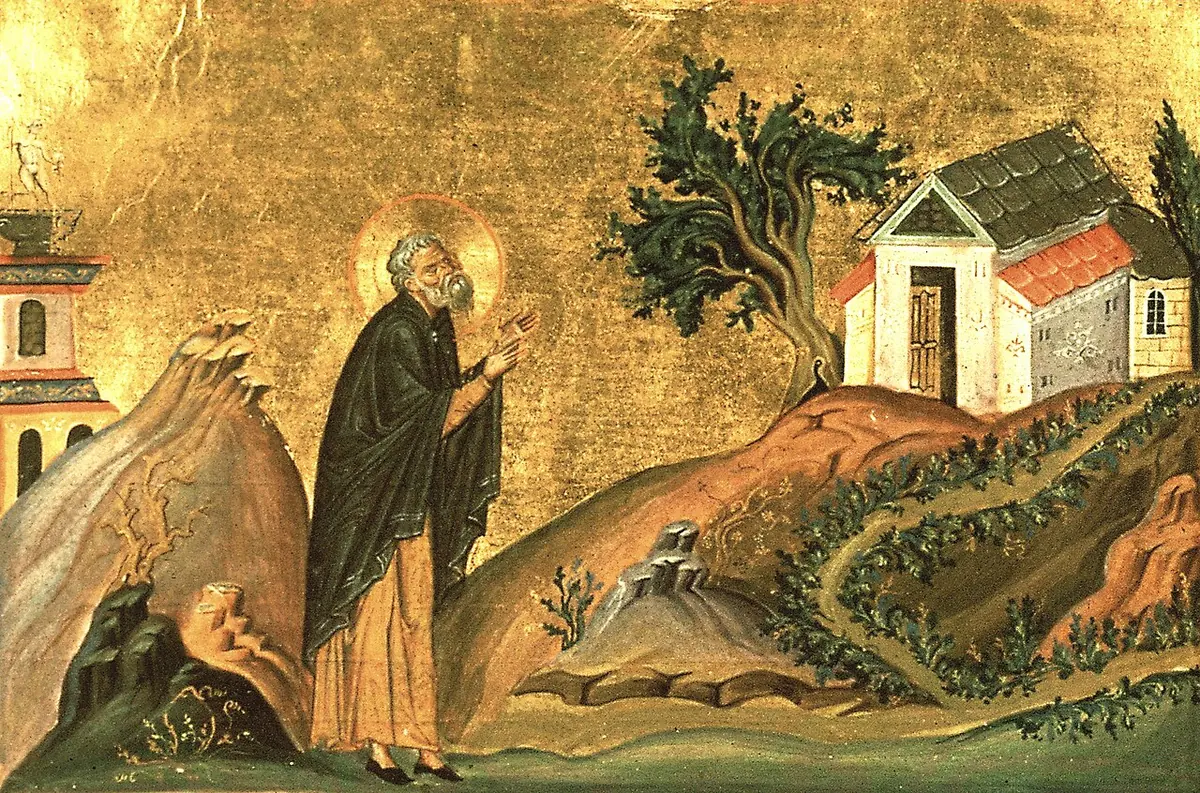
The life of St. Isidore of Pelusium
A monk of Lychnos
The 1910 Catholic Encyclopedia says Isidore entered the monastery of Lychnos on the mountain near Pelusium and "soon became remarkable for his exactitude in the observance of the rule and for his austerities." A passage in his letters suggests he served as abbot. Two later writers, Facundus and Suidas, call him a priest. The Orthodox Church in America says the monks had him ordained because of his wisdom, and that he was related to Theophilus, archbishop of Alexandria, and to Theophilus's nephew St. Cyril of Alexandria.

The man who wrote to everyone
Isidore's work was correspondence. The Byzantine church historian Nicephorus spoke of ten thousand letters. The Catholic Encyclopedia counts 2,182 that survive, in five books of 590, 380, 413, 230 and 569 letters. Many are only a few lines long. They fall into three groups: letters on doctrine and Scripture, letters on the discipline of the Church and of monasteries, and letters of practical advice for lay people "of all classes and conditions."
He wrote against unworthy clergy whose ordination scandalized the faithful, and he lamented that some lay people were staying away from the sacraments rather than receive them from such men. To a man named Hierax he defended the honoring of relics. He told a soldier named Tuba that it was unbecoming to carry a sword through the city in peacetime. He scolded the monk Thalelaeus for filling his mind with pagan poets and their fables.
Friend of Chrysostom, counselor to Cyril
Isidore revered St. John Chrysostom, the archbishop of Constantinople who had been driven into exile and died in 407. According to the Catholic Encyclopedia, he pressed Cyril "to render full justice to the memory of the great doctor," and Cyril in time restored Chrysostom's name to the diptychs of Alexandria, the lists of the faithful named at the liturgy.
When the Council of Ephesus (431) ended in a bitter quarrel between Cyril and John of Antioch, Isidore thought the fault lay partly with his own kinsman. He wrote to Cyril "in urgent terms," as both father and son, begging him to end the division and not to turn a private grievance into a lasting break. The two sides were reconciled in 433. Isidore also wrote against the Nestorians, and in a letter to Theologius he defended the virginal motherhood of Mary.
In his last years the teaching of Eutyches, that Christ has only one nature, was spreading in Egypt, and Isidore's letters oppose it. They never mention the Robber Council of 449 or the Council of Chalcedon in 451, so it is likely he died around 449.
His teaching
The Catholic Encyclopedia describes his letters as brief and natural, written with "an imperturbable equability of temperament." In Scripture he preferred the moral and spiritual sense, the one most useful to the people who wrote to him. On monastic life he taught that it rests on retirement and obedience. A new monk should be led step by step. And fasting alone is not enough: "Great abstinences serve no purpose unless they are accompanied by the mortification of the senses."
Above all he asked that a Christian's life match his words. He practiced what he taught, and that is why so many people listened to a monk on a mountain in Egypt.
No miracles are recorded for St. Isidore, and none are claimed here. His gift to the Church was counsel.
Symbols of St. Isidore of Pelusium in art
Isidore is shown as a monk, usually as an old man with a long white or gray beard. Look for:
- A monk's habit and dark mantle: the dress of the Egyptian desert monks.
- A scroll or book: his letters.
- A hand raised in blessing or in prayer.
- A rocky mountain and a small monastery: the mountain near Pelusium.
In the Menologion of Basil II he stands on a hillside raising his hands to heaven. Russian printed icons, like the one below from the Lives of the Saints published between 1903 and 1911, show him standing in a full monastic mantle. Don't confuse him with St. Isidore of Seville, who appears as a bishop with a book and a pen, or St. Isidore the Farmer, shown with a plow, a spade or angels plowing beside him.
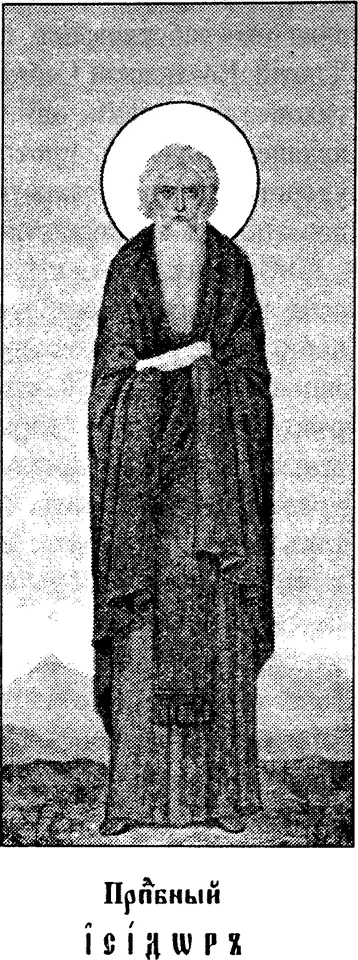
Feast day
The Roman Martyrology and the Orthodox calendar both remember St. Isidore of Pelusium on February 4. His tomb is not known today. You can see the saints of nearby days on our feast days page and other desert fathers such as St. Anthony the Great and St. Pachomius.
Prayer to St. Isidore of Pelusium
There is no traditional prayer to St. Isidore of Pelusium in the standard prayer books. We can ask his intercession simply: St. Isidore of Pelusium, pray for us. Let us ask him for priests and bishops who give wise counsel, for peace between Christians who quarrel, and for the grace to live what we say we believe.
Frequently asked questions
When is the feast day of St. Isidore of Pelusium?
February 4, in both the Roman Martyrology and the Eastern Orthodox calendar.
How many letters did St. Isidore of Pelusium write?
The Byzantine church historian Nicephorus spoke of 10,000. The Catholic Encyclopedia counts 2,182 surviving letters, gathered in five books of 590, 380, 413, 230 and 569 letters. The OCA's life gives a slightly lower count of about 2,090.
Is St. Isidore of Pelusium the same as St. Isidore of Seville?
No. Isidore of Pelusium was an Egyptian monk of the 5th century. St. Isidore of Seville was a Spanish bishop and Doctor of the Church who died in 636, and St. Isidore the Farmer was a Spanish laborer of the 12th century. Isidore of Pelusium is sometimes wrongly called Isidore of Damietta.
What did St. Isidore of Pelusium teach about monastic life?
That it consists mainly in retirement and obedience. Newcomers should be led step by step, neither crushed by every austerity at once nor left idle. In the words of the Catholic Encyclopedia's summary of his letters, 'Great abstinences serve no purpose unless they are accompanied by the mortification of the senses.'