Blessed Pope Eugene III, the Cistercian Pope
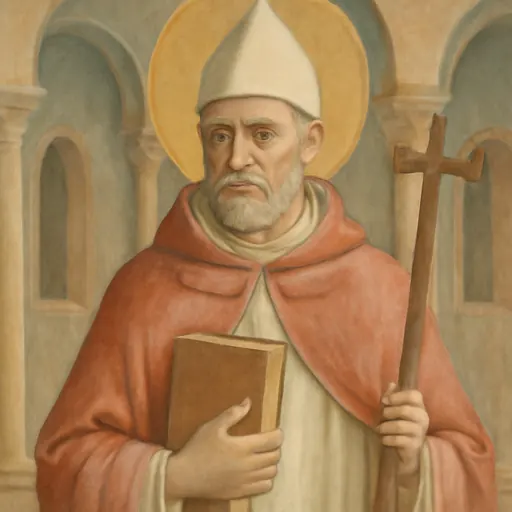
Blessed Eugene III (died 1153) was a Cistercian monk from Pisa, a disciple of St. Bernard of Clairvaux, who was abbot of Tre Fontane in Rome when the cardinals unexpectedly elected him pope in 1145. He called the Second Crusade, held reforming councils and stayed a monk at heart. Pius IX confirmed his cult in 1872; his feast is July 8.
Who was Blessed Eugene III?
Blessed Eugene III was pope from 1145 to 1153, the first Cistercian to sit on the chair of Peter. He had been a monk under St. Bernard of Clairvaux, and the Catholic Encyclopedia says his old brothers found that under the papal robes he "remained in his heart an observant monk." His reign was hard: he spent much of it in exile from a rebellious Rome, and the crusade he called failed. Pisa honored him from early times, and Pope Pius IX confirmed that cult in 1872. We keep his feast on July 8.
He should not be confused with St. Eugene I, a seventh-century pope.
A canon of Pisa becomes a monk
He was born near Pisa. The Catholic Encyclopedia gives his name as Bernardo and his family as the Pignatelli, though it notes that no one knows whether Bernardo was his baptismal name or the name he took in religion; other sources call the family Paganelli. He was educated in Pisa, became a canon of the cathedral and served as vice-dominus, the steward of the diocese's property.
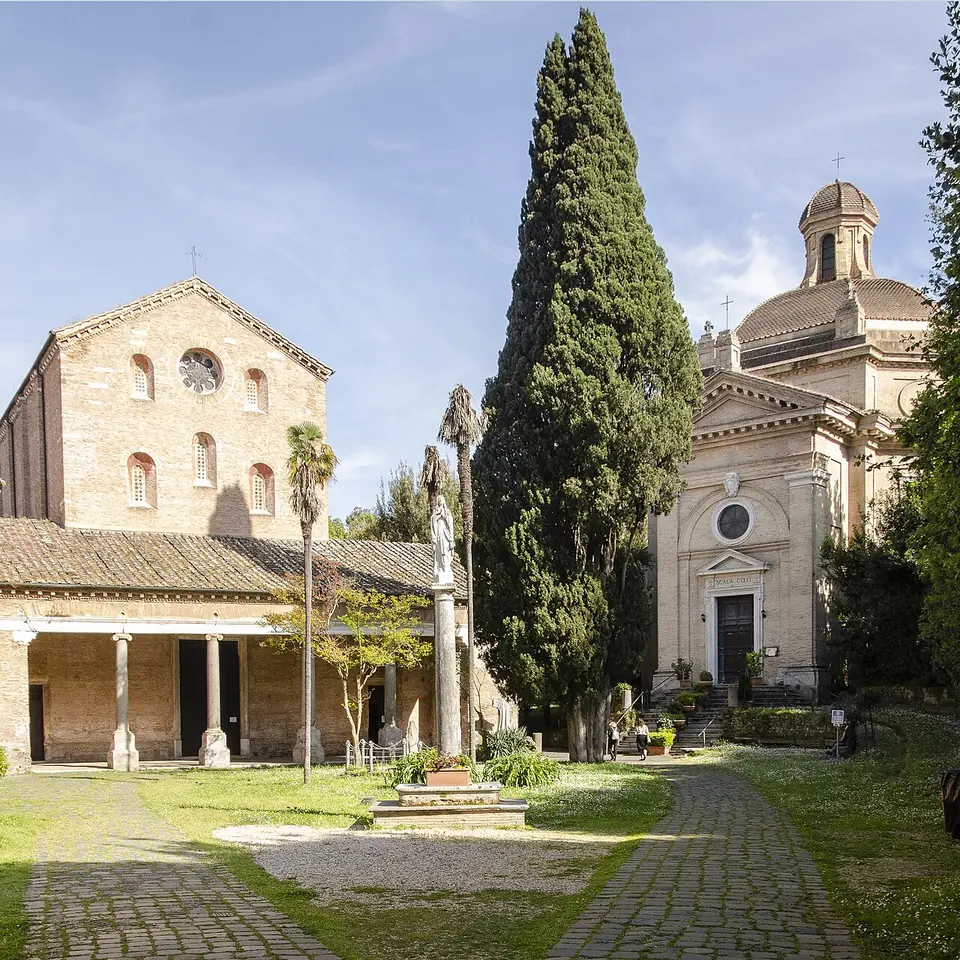
In 1130 he came under the influence of St. Bernard, and about 1135 he went to Clairvaux as a novice, giving up his post for the white habit of the Cistercians. Bernard later sent him back to Italy, and he became abbot of the Cistercian monastery of Sts. Vincent and Anastasius at Tre Fontane outside Rome, the place where tradition says St. Paul was beheaded.
The unexpected pope
On February 15, 1145, the cardinals met in the cloister of St. Caesarius and chose the abbot of Tre Fontane unanimously. He took the name Eugene III.

Rome was then in revolt, with a commune that rejected the pope's rule. Eugene and the cardinals had to flee the city. He was consecrated bishop at the abbey of Farfa and lived at Viterbo. Arnold of Brescia, a preacher who had been condemned and exiled in 1139, returned under Eugene, was absolved, and then led the movement against the papacy; Eugene excommunicated him at Cremona in 1148.
The Second Crusade
In 1144 the crusader city of Edessa fell. Eugene appealed to the princes of Europe to defend the Holy Places, and St. Bernard preached the crusade across France and Germany. The kings of France and Germany took the cross, but the Second Crusade ended in failure.
Councils across the Alps
Early in 1146 Eugene crossed the Alps and spent two years in France and Germany. He held synods at Paris in 1147 and at Trier in 1148, and a great council at Reims in 1148, which passed canons on the dress and conduct of the clergy. While he was at Trier in 1147, the visions of a German nun, St. Hildegard of Bingen, were brought to his notice.

On Consideration
Bernard never stopped being his teacher. In the years of Eugene's reign he wrote De consideratione (On Consideration), which the Catholic Encyclopedia calls an "admirable handbook for popes." Addressed to his former monk, it urges the pope to keep time for prayer and reflection amid the endless business of the Roman court, and to remember that he is a servant before he is a ruler.

Death and cult
Eugene finally returned to Rome but died at Tivoli, where he had gone to escape the summer heat, on July 8, 1153. He was buried in St. Peter's in front of the high altar. Bernard died six weeks later. At Pisa he was honored as a holy man from early times, and by a decree of December 28, 1872, Pius IX approved that cult and ordered him honored with a Mass and Office on the anniversary of his death. This confirmation of an ancient cult is an equivalent beatification, so there was no formal miracle process. We know of no approved miracles; any wonders told of him are traditional.

Why he is honored in Pisa
Eugene is a son of Pisa, and the city's devotion to him is what kept his memory as a holy man alive until Rome confirmed it. Pisans see him alongside the other patron saints of their city.
Symbols of Blessed Eugene III in art
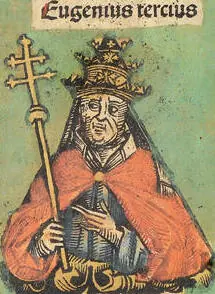
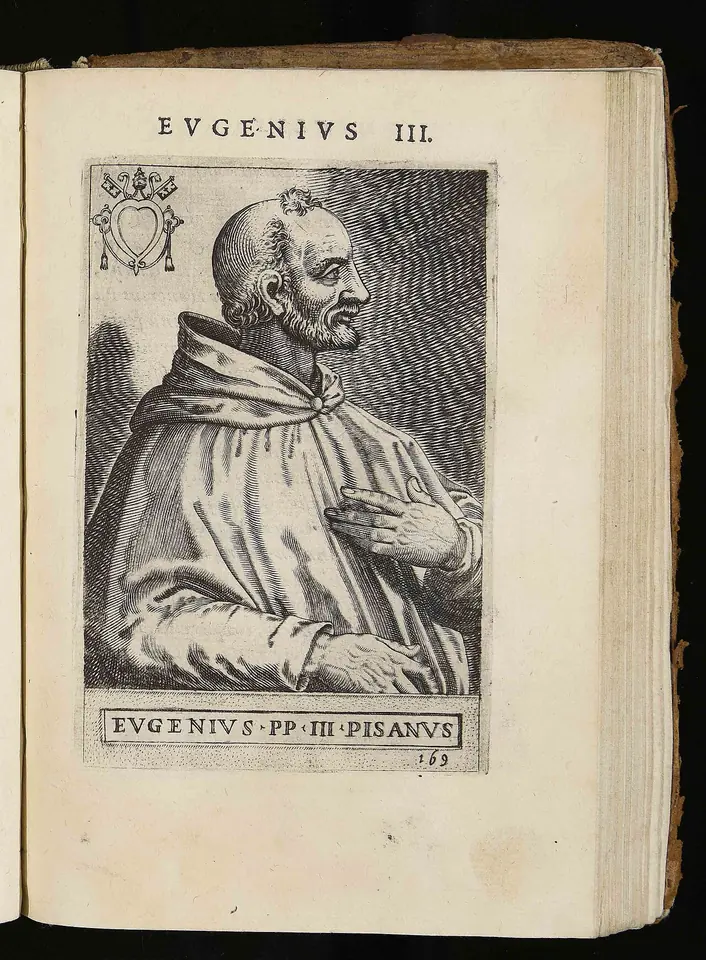
Old papal portraits, like the 1493 Nuremberg Chronicle woodcut, show him in the standard way of popes: a tiara, a cope, and a cross with three bars. Later images make him recognizable as a Cistercian, showing the white monk's habit under the papal mantle, often with a book for Bernard's On Consideration or for his own decrees. Cavalieri's 1580 engraving gives him the monk's cowl and labels him simply "Pisanus," the man from Pisa. On monuments to St. Bernard, such as the one in Dijon, Eugene stands at the foot of his abbot's pedestal.
Praying with Blessed Eugene III
We know of no traditional prayer to Blessed Eugene III in English. Let us ask him to pray for the Pope and for all who govern in the Church, that, as St. Bernard asked of him, they may never let the business of the day crowd out the time they owe to God.
Frequently asked questions
Is Pope Eugene III a saint?
He is honored as Blessed. Pope Pius IX confirmed his ancient local cult at Pisa by a decree of December 28, 1872, and allowed a Mass and Office in his honor on July 8, the anniversary of his death. This is called equivalent beatification.
What was Pope Eugene III's connection to St. Bernard?
Eugene had been Bernard's monk. He joined the Cistercians at Clairvaux under St. Bernard around 1135, and Bernard later wrote his treatise On Consideration for him, a handbook on how a pope should live and govern.
Did Eugene III call the Second Crusade?
Yes. After the fall of Edessa in 1144 he appealed to Europe to defend the Holy Places, and St. Bernard preached the crusade. The Second Crusade ended in failure.
Where is Pope Eugene III buried?
In St. Peter's in Rome. The Catholic Encyclopedia says he was buried before the high altar of the old basilica.
Keep exploring
Sources
- Catholic Encyclopedia (1909): Pope Blessed Eugene III. His family and early life, Clairvaux, election at St. Caesarius, exile, Arnold of Brescia, councils, death at Tivoli, burial and the 1872 decree
- Catholic Encyclopedia (1910): St. Hildegard. Her visions brought to Eugene's notice at Trier in 1147