St. Paul Tchen (Paul Chen Changpin), Seminarian and Martyr of China
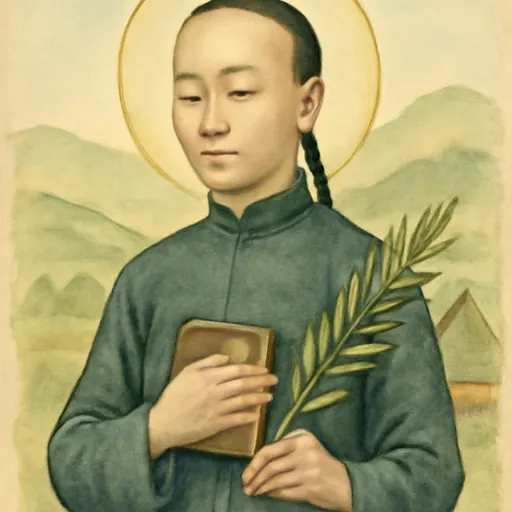
St. Paul Tchen (Chen Changpin, 1838–1861) was a Chinese seminarian from a poor, non-Christian family in Guizhou, baptized at fifteen and beheaded for the faith at Qingyan on July 29, 1861. His relics have rested in Notre-Dame de Paris since 1920. We honor him with the 120 martyrs of China on July 9.
Who was St. Paul Tchen?
St. Paul Tchen, whose Chinese name was Chen Changpin, was a young seminarian beheaded for the faith in Guizhou Province, in southwest China, on July 29, 1861. He was twenty-three. "Tchen" is the old French spelling of his family name, used by the missionaries who taught him, and it is still the name under which he is honored in France.
He is one of the 120 martyrs of China canonized by Pope John Paul II on October 1, 2000, the feast of St. Thérèse of Lisieux, patroness of the missions. We honor them together on July 9.
His story has an unusual ending: his relics rest in Paris, in the Cathedral of Notre-Dame.
A poor boy and the Holy Childhood
Fides, the news service of the Pontifical Mission Societies, gives the outline of his life. Paul was born on April 11, 1838, in Guizhou, into a very poor family that was not Christian. He received his schooling through the Holy Childhood Association, the work founded in France in 1843 so that Catholic children could help children in mission lands with their prayers and their pennies.
In 1853 he was admitted to the minor seminary. That Christmas he was baptized and confirmed, taking the name Paul, and he made his First Communion the next year. Fides describes him as gentle and quiet by nature. When his father later called him home, Paul refused. His vocation was settled.
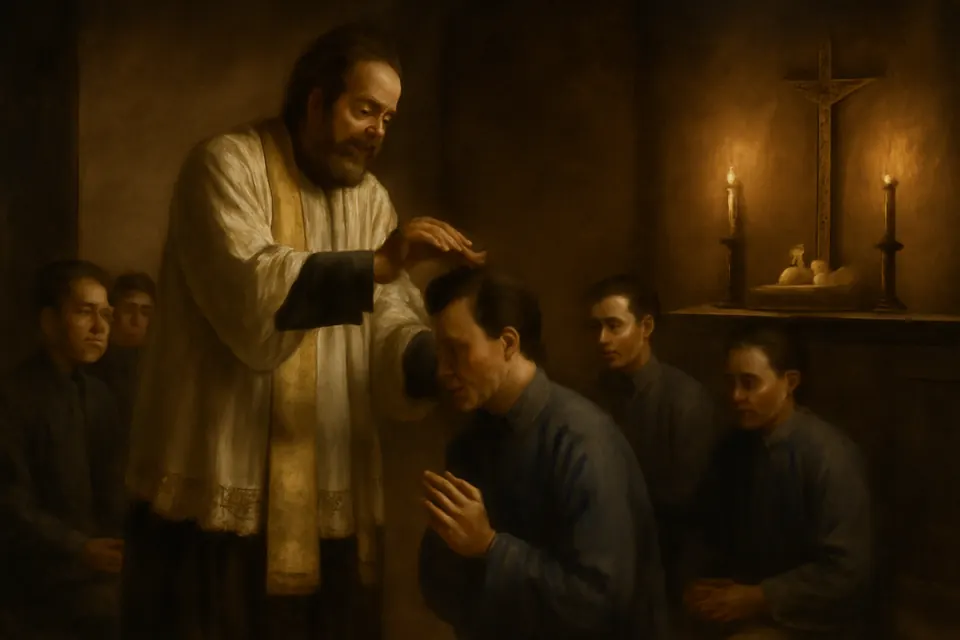
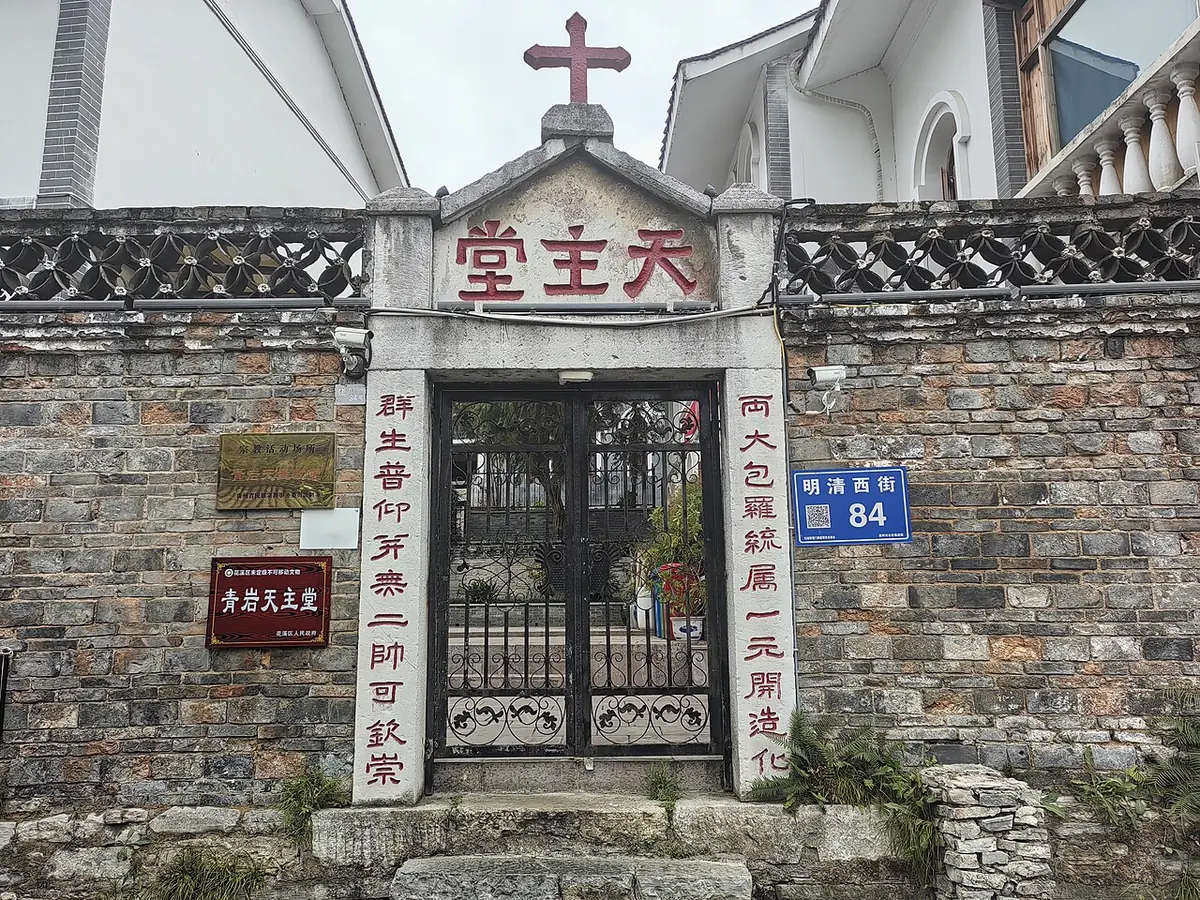
In 1860 he went on to the major seminary at Qingyan (the missionaries wrote it Tsin-gay), not far from the provincial capital, Guiyang.
Arrest and martyrdom
Guizhou was dangerous ground for Christians in those years. The Vatican's biography of the 120 martyrs lists three catechists killed at Maokou in the same province in 1858, and more deaths followed in 1862.
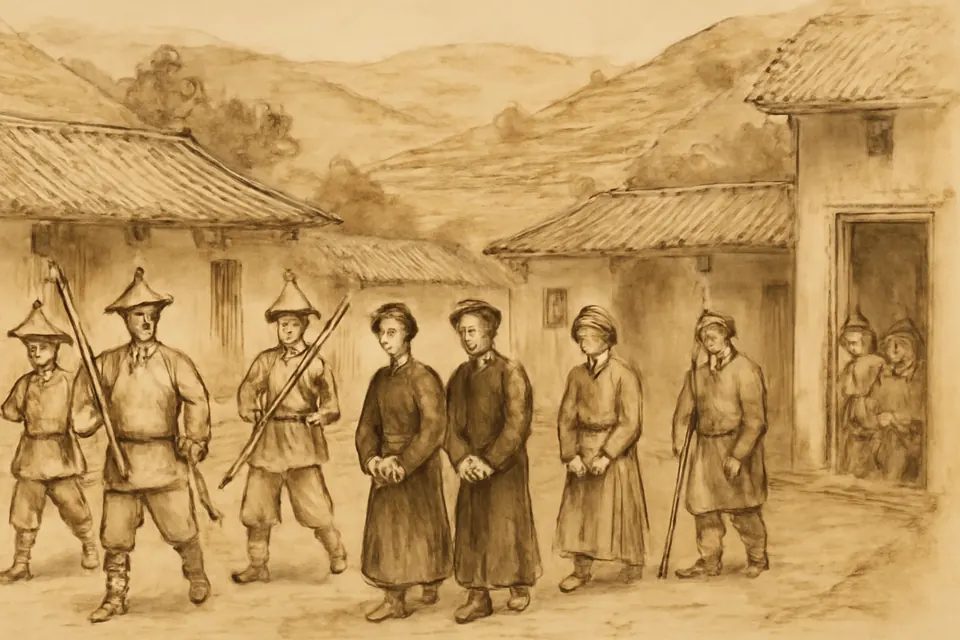
On June 12, 1861, soldiers burst into the seminary at Qingyan and arrested Paul and others, accusing them of being Christians. Seven weeks of threats and suffering followed. Fides says that none of them denied the faith. On July 29, 1861, four were killed together, the group the Church calls the Martyrs of Qingyanzhen:
- St. Joseph Zhang Wenlan, a seminarian;
- St. Paul Chen Changpin, a seminarian;
- St. John Baptist Luo Tingying, a farmer;
- St. Martha Wang Luo Mande, a widow who worked as the seminary's cook.
Joseph Zhang Wenlan, born in 1832, was some six years older than Paul, and John Baptist Luo had been born in 1825, according to the list of the 120 martyrs kept by the Swiss Bibliothèque monastique. The soldiers destroyed the seminary. Two students and two working people, a farmer and a cook, died side by side for the same Lord.
From Guizhou to Notre-Dame
Pope St. Pius X beatified the Qingyanzhen martyrs on May 2, 1909. Because Paul had been a child of the Holy Childhood, his remains were later brought to France. They arrived at Notre-Dame de Paris on June 10, 1920, and were placed in the chapel the cathedral had entrusted to the Holy Childhood, dedicated to the Child Jesus.
In 2010 the Holy Childhood celebrated the ninetieth anniversary with a Mass at Notre-Dame, and Bishop Jérôme Beau, an auxiliary bishop of Paris, spoke of the place of children in the Church's mission. The chapel now bears Paul Chen's name.

Canonized with the martyrs of China
On October 1, 2000, Pope John Paul II canonized Paul with St. Augustine Zhao Rong and 118 other martyrs who died in China between 1648 and 1930: Chinese priests, catechists, seminarians, laymen and women and children, and the foreign missionaries who died beside them. In his homily the Pope said that "the testimonies which have come down to us allow us to glimpse in them a state of mind marked by deep serenity and joy." He added that the celebration was not the moment to pass judgment on those periods of China's history, only to recognize the martyrs as "an example of courage and consistency to us all," who "honour the noble Chinese people."
As a martyr, Paul Tchen needed no miracle for beatification, and none, approved or reported, is attached to his name.
Symbols of St. Paul Tchen in art
There is no portrait of him from life. Modern images show him as:
- A young man in Chinese scholar's dress or a seminarian's cassock: his state in life when he died.
- A book: the studies of a seminarian preparing for the priesthood.
- The martyr's palm: victory through death for Christ.
He sometimes appears among the 120 martyrs of China in group paintings, and in France in images tied to the Holy Childhood.
Feast day and prayer
We keep his feast with all the martyrs of China on July 9. He died on July 29, 1861. In Paris, visitors to Notre-Dame can pray at the chapel that holds his relics. See the feast day calendar.
There is no traditional prayer to St. Paul Tchen alone. On July 9 the Church prays with St. Augustine Zhao Rong and his companions. Let us ask his help in our own words: St. Paul Tchen, you came to Christ through the prayers and gifts of children far away. Pray for children in mission lands, for young men preparing for the priesthood, and for the Church in China.
Frequently asked questions
Who was St. Paul Tchen?
A young Chinese seminarian, Paul Chen Changpin, born in Guizhou in 1838. Helped by the Holy Childhood Association, he entered the minor seminary in 1853 and was baptized that Christmas. Soldiers arrested him at the major seminary of Qingyan on June 12, 1861, and he was beheaded on July 29, 1861, at twenty-three.
Why are St. Paul Tchen's relics in Notre-Dame de Paris?
Because he was a child of the Holy Childhood Association, the French-founded work through which children help children in the missions. His remains came to Notre-Dame on June 10, 1920, and were placed in the chapel the cathedral had given to the Holy Childhood, according to Fides, the news agency of the Pontifical Mission Societies.
When is the feast of St. Paul Tchen?
July 9, the memorial of St. Augustine Zhao Rong and Companions, the martyrs of China. He died on July 29, 1861.
Who died with St. Paul Tchen?
The Martyrs of Qingyanzhen: St. Joseph Zhang Wenlan, a fellow seminarian; St. John Baptist Luo Tingying, a farmer; and St. Martha Wang Luo Mande, a widow who cooked for the seminary.
Keep exploring
Sources
- Agenzia Fides (June 17, 2010): L'Enfance missionnaire évoque les 90 ans de l'arrivée à Notre-Dame de Paris des reliques de Saint Paul Chen, martyr chinois (in French). His birth on April 11, 1838, his poor non-Christian family, the Holy Childhood, minor seminary in 1853, baptism and confirmation at Christmas 1853, his refusal to go home, the major seminary of Tsin-gay in 1860, arrest on June 12, 1861, death on July 29, 1861, and the arrival of his relics at Notre-Dame on June 10, 1920
- Vatican: Augustine Zhao Rong and 119 Companions, Martyrs in China (biography for the canonization of October 1, 2000). The four Martyrs of Qingyanzhen, two seminarians, a farmer and a widow who cooked for the seminary, killed together on July 29, 1861
- Bibliothèque monastique: 120 martyrs de Chine (1648–1930), list with beatification dates (in French). The Qingyanzhen martyrs beatified May 2, 1909
- Pope John Paul II, Homily for the canonization of Augustine Zhao Rong and 119 companions, October 1, 2000