St. Auguste Chapdelaine

St. Auguste Chapdelaine (1814–1856) was a Norman farmer's son who became a priest of the Paris Foreign Missions Society and carried the Gospel into Guangxi, in southern China. Arrested in February 1856, he refused to give up his faith and died after torture in a cage at Xilin. He was canonized in 2000 with the Martyr Saints of China, whom we honor on July 9.
Who was St. Auguste Chapdelaine?
St. Auguste Chapdelaine was a French missionary priest of the Paris Foreign Missions Society who died for the faith in Guangxi, in southern China, in February 1856. He was a farmer's son who did not reach the seminary until he was twenty, served seven years as a country curate in Normandy, and then gave the last four years of his life to China. Pope Leo XIII beatified him in 1900, and Pope John Paul II canonized him on October 1, 2000, with St. Augustine Zhao Rong and 119 companions, the Martyr Saints of China.

The life of St. Auguste Chapdelaine
A late vocation
The archives of the Paris Foreign Missions record that he was born on January 6, 1814, at the hamlet of La Métairie in the commune of La Rochelle, in the Manche, into a Christian family of Norman farmers. He spent his youth working the land. Only at twenty could he follow his call to the priesthood, studying at the Abbaye-Blanche in Mortain and at the major seminary of Coutances.

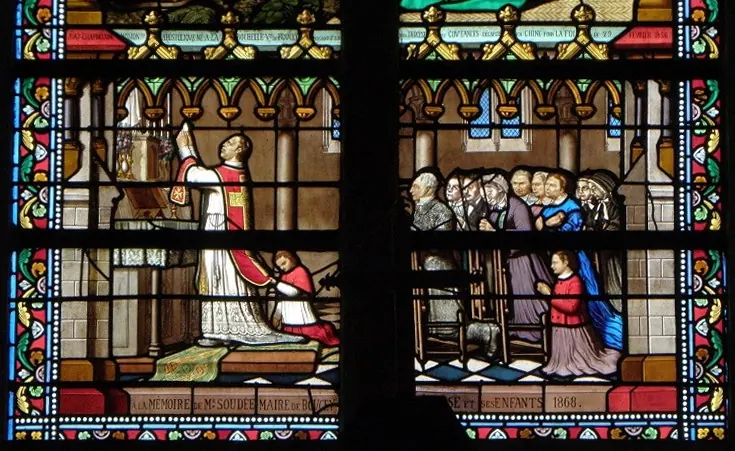
He was ordained on June 10, 1843, and already hoped to join the foreign missions. Instead he was named curate of Boucey, a village near Mont-Saint-Michel, where he stayed seven years. Boucey never forgot him. In 1868 a memorial window was placed in the parish church showing him at the altar there, and other scenes of the window show his trial and martyrdom.
To China
On March 16, 1851, he entered the seminary of the Paris Foreign Missions, and on April 29, 1852, he sailed for the mission of Guangdong and Guangxi. His first attempt to reach Guangxi ended when bandits attacked and robbed him, and he had to return to Canton. On the second try he reached Guizhou in the spring of 1854 and studied Chinese at Guiyang. The Chinese called him Ma Lai.
At the beginning of December 1854 he finally entered Guangxi. Foreign missionaries were then forbidden to preach in the interior, and he had barely begun to care for a few new Christians when he was denounced and taken to Xilin. The local official held him for sixteen days and let him go. Through 1855 he taught the Christians of Panpo and Yaoshan, went back to Guizhou, and soon returned.

Arrest and death
Early in 1856 he was denounced again. He hid with a scholar at Xilin, and was arrested there the next day, February 24 or 25, with several Christians. Among those taken were Laurence Bai Xiaoman, a humble laborer who had joined him in his hiding place, and soon after Agnes Cao Guiying, a widow who taught the women and girls he had brought to the faith. Both are saints today.
Brought before the mandarin, he was accused of stirring the people to revolt and ordered to renounce the Catholic religion. The missionaries' record gives his answer (here in our translation from the French):
My religion being the true one, I cannot leave it. I have no evil intention; I exhort men to do good and so to merit the happiness of Heaven.
He was cruelly beaten and made to spend a night and a day kneeling, bound so tightly he could not move. The next day he was condemned to die by the cage, a slow and cruel punishment. He died in the middle of the night, and his body was then beheaded. The Holy See's biography says that Laurence Bai Xiaoman was beheaded on February 25 and Agnes Cao Guiying died on March 1.
The exact date of his death was never settled. One missionary, Father Bazin, put it on February 26; Bishop Chouzy put it on February 27; an early French life gave February 29, since 1856 was a leap year.
After his death
The cause of his beatification was opened on September 24, 1857, under Pope Pius IX, only a year and a half after he died. His death also had political consequences he could never have wanted: France cited it as a grievance when it joined Britain in the Second Opium War. The Church canonized him for one reason, that he would not deny Christ.
Miracles
No miracles are recorded for St. Auguste Chapdelaine, and none was required: martyrs may be beatified without one.
Symbols of St. Auguste Chapdelaine in art
- Chinese dress and a long beard: his portraits show him in a Chinese robe and cap, as missionaries in the interior then dressed.
- A cage: the instrument of his death.
- A martyr's palm and a crucifix.
The 1868 window at Boucey is the best known image of him in France. The Paris Foreign Missions also kept paintings of his trial and martyrdom in their Salle des Martyrs, and a bust was carved for his beatification in 1900.
Feast day
We honor him with the Martyr Saints of China on July 9, and many in France remember him at the end of February, on the anniversary of his death. See our feast days page for other saints of July.
Prayer to St. Auguste Chapdelaine
No traditional prayer to St. Auguste Chapdelaine has come down to us. Let us take his own words before the mandarin as our prayer of faith, "My religion being the true one, I cannot leave it," and ask him to intercede for the Church in China, for missionaries far from home, and for late vocations like his own.
Frequently asked questions
When is the feast day of St. Auguste Chapdelaine?
He is honored with the Martyr Saints of China on July 9. His own death day is uncertain, late February 1856; some calendars keep February 27 or February 29.
How did St. Auguste Chapdelaine die?
Arrested at Xilin in Guangxi, he was beaten, ordered to renounce the Catholic faith, and condemned to die in the cage, a slow form of execution. He died during the night, and his body was then beheaded.
What did St. Auguste Chapdelaine say at his trial?
According to the Paris Foreign Missions record, he answered the mandarin, "My religion being the true one, I cannot leave it. I have no evil intention; I exhort men to do good and so to merit the happiness of Heaven."
Why is St. Auguste Chapdelaine remembered in history books?
France later cited his execution as a grievance when it joined Britain in the Second Opium War (1856–1860). The Church honors him for one thing only, his witness to Christ unto death.
Keep exploring
Sources
- Institut de recherche France-Asie (IRFA), Paris Foreign Missions archives: biographical notice of Auguste Chapdelaine (no. 620). Birth on January 6, 1814; Boucey; his arrests, his words before the mandarin, his death; the uncertain date; the relics in the Salle des Martyrs; beatification on May 27, 1900
- Holy See: Augustine Zhao Rong and 119 companions, martyrs in China, biography for the canonization of October 1, 2000. Chapdelaine, Laurence Bai Xiaoman and Agnes Cao Guiying
- Pope John Paul II, homily for the canonization of 123 new saints, October 1, 2000