St. Procopius of Ustyug, Fool for Christ

St. Procopius of Ustyug (died 1303) was a Western merchant trading in Novgorod who embraced the Orthodox faith, gave away his wealth and became the first fool for Christ in Russia, living barefoot and homeless in Ustyug. Tradition credits his prayer with saving the town from a "stone cloud" in 1290. The Orthodox Church keeps his feast on July 8.
Who was St. Procopius of Ustyug?
St. Procopius of Ustyug was a wealthy merchant from the West who came to trade in Novgorod in the thirteenth century, was won over by the beauty of Orthodox worship, and gave up everything to live as a fool for Christ in the northern town of Ustyug. The Russian Church honors him as its first holy fool, the forerunner of a long line of yurodivye who mocked worldly wisdom by their poverty and strange behavior. He died in 1303, and his relics rest in Veliky Ustyug in the cathedral that bears his name.
He is a saint of the Orthodox Church, which keeps his feast on July 8 on the Church calendar (July 21 on the civil calendar).
His life was written down long after his death, and later tradition added details, such as the name of his home city, that the oldest accounts leave out. What the Church has kept with care is the shape of his holiness: a rich man who became poor, a foreigner who became a son of the Russian land, and a man of prayer whom the town learned too late to listen to.

From merchant to monk
The Orthodox lives say he was "a foreign merchant" engaged in trade at Novgorod, the great trading city linked with the Hanseatic ports of the Baltic. Later Russian and German tradition says he came from Lübeck. One modern Orthodox telling calls him "a German Catholic." The Holy Trinity Orthodox calendar says he was captivated by Orthodox worship and "the divine teaching" of the faith, was received into the Orthodox Church, gave away his riches, and became a monk at the Monastery of the Venerable Varlaam of Khutyn outside Novgorod.
He did not stay. When people began to honor him, he left Novgorod and walked east to Ustyug, a trading town on the Sukhona River.
A fool for Christ in Ustyug
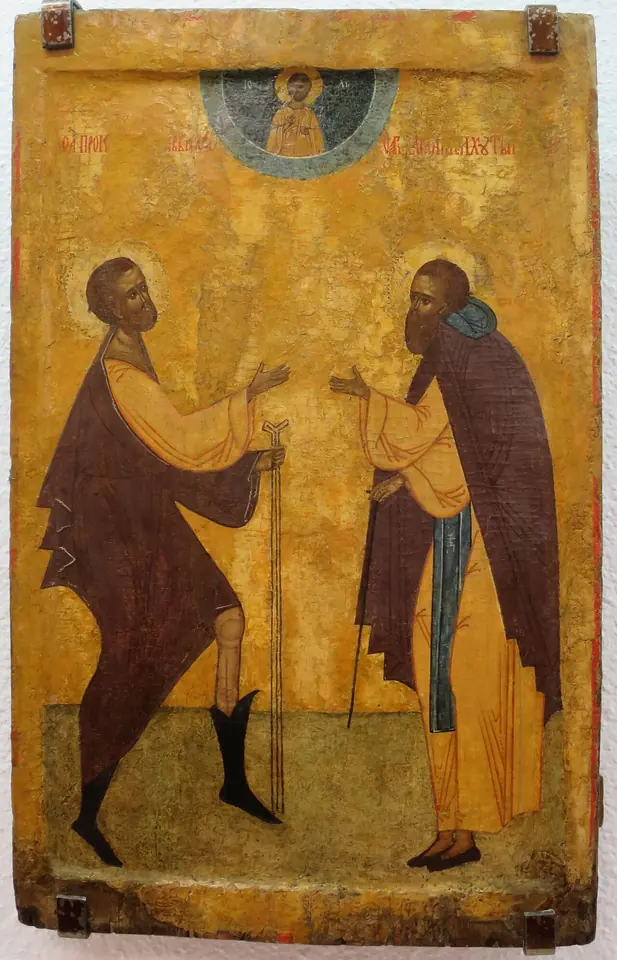
At Ustyug he chose what the old life calls the "turbulent and, according to the apostle, foolish way of life," taking St. Paul at his word: "We are fools for Christ's sake" (1 Corinthians 4:10). Summer and winter he went barefoot in poor clothes, carrying three wooden pokers under his arm. He ate whatever scraps he was given and slept on church porches or on the bare ground. People beat him and mocked him, and he bore it without complaint.
He accepted alms from simple, compassionate people but never from rich men who had grown fat on usury, even when that meant going hungry for days.
Warmth in the frost
On one terrible winter night, the OrthoChristian life recounts, it was so cold that birds froze in flight. Procopius went from door to door and no one let him in. He lay down beside some dogs for warmth, and they ran away from him. As he lay freezing, he felt a sudden warmth and the touch of an angel on his face, and he recovered his strength. He told the story only to a cleric of the cathedral named Simeon, and asked him to keep it secret until his death.

The miracles of St. Procopius
The stone cloud of 1290
His best-known miracle is traditional, kept in the Church's calendar of feasts. In 1290 Procopius went through Ustyug for a week, begging the people to repent so that the town would not suffer the fate of Sodom and Gomorrah. Nobody listened. Then a black cloud rose and grew until day turned to night, with lightning and thunder so loud that people could not hear one another. The townspeople ran to the cathedral, where they found Procopius already on his knees before the icon of the Annunciation.
The OCA dates his prayer before the icon to June 25, 1290. As they prayed, the tradition says, myrrh flowed from the icon in such abundance that the vessels of the church were filled, and the sick who were anointed with it were healed. The air cleared and the sun came out. About twenty versts from the town, over an empty place in the forest, the cloud burst with hail and stones that flattened an old forest, and no person or animal was hurt.
The Church still honors the icon on July 8 as the Ustyug Annunciation. It was taken to Moscow in 1567 and is now in the Tretyakov Gallery. Some historians read the "stone cloud" as the memory of a meteorite fall, but for the people of Ustyug it was always a sign of God's mercy granted through the prayers of the Mother of God and of their holy fool.


Other signs
- Traditional: he once bowed to a three-year-old girl and told her mother, "This is the mother of a great saint." The girl grew up to be the mother of St. Stephen of Perm, the missionary bishop of the Zyrians.
- Reported: after his death, many healings were recorded at his grave, along with accounts of his appearing to the faithful.
His death and relics
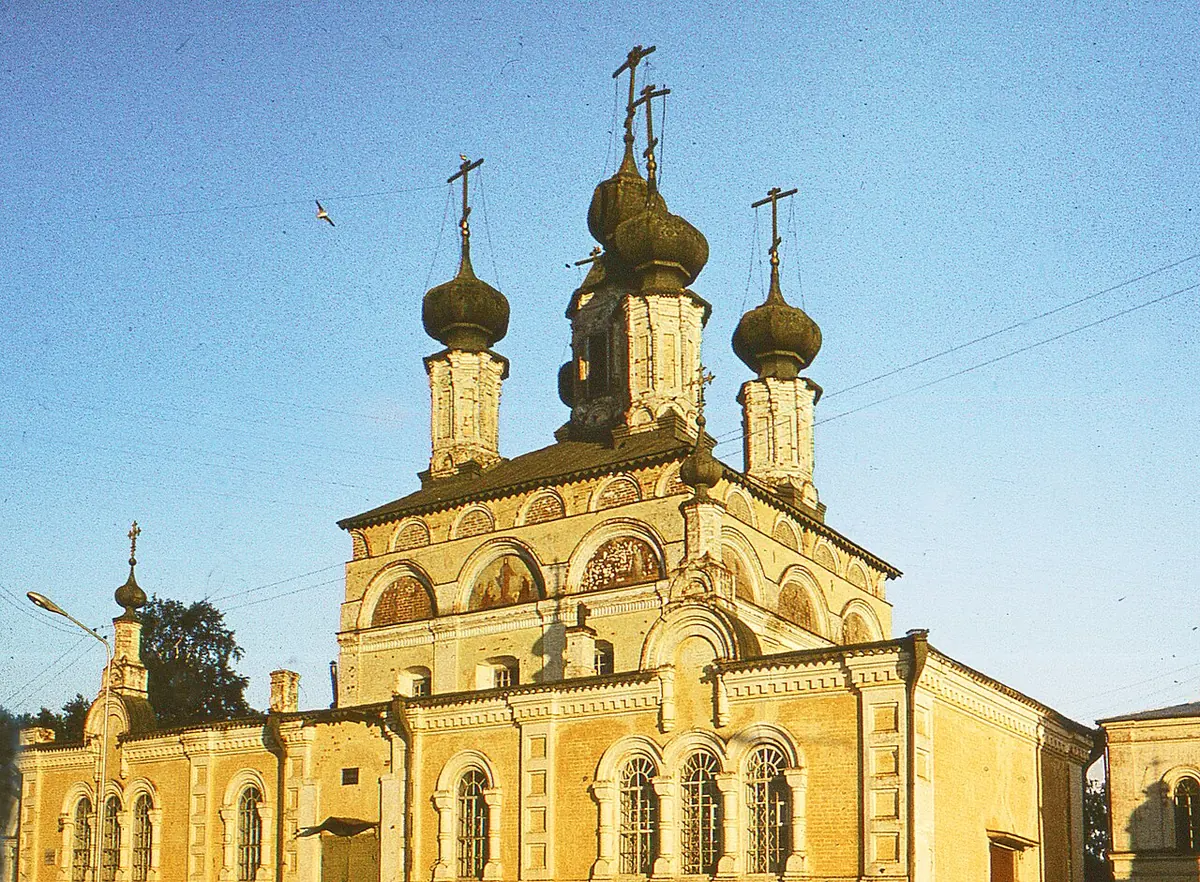
Procopius died in great old age in 1303, at the gate of the Archangel monastery in Ustyug. His relics were kept in the Ustyug cathedral, and the town built a stone church in his honor, the Cathedral of St. Procopius, which still stands on the old cathedral court.
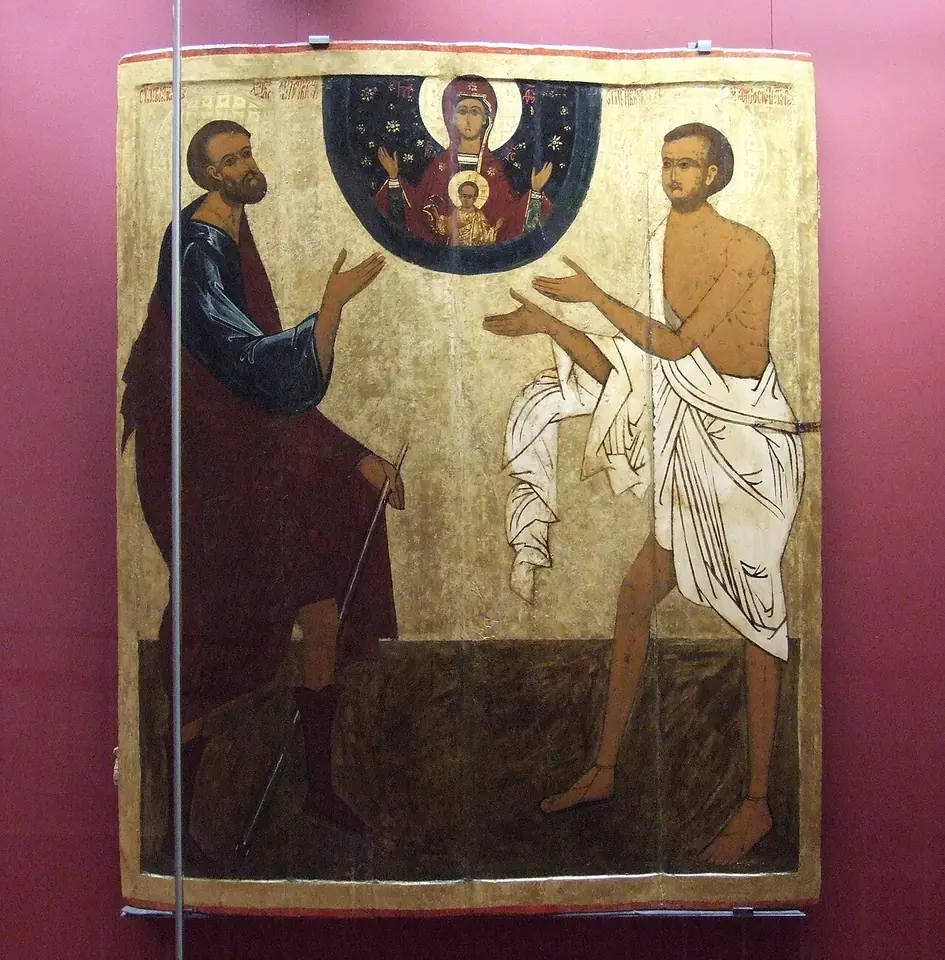
Ustyug produced another holy fool two centuries later, Blessed John of Ustyug (died 1494), and the two are often painted together.
Where the relics of St. Procopius of Ustyug are kept: see them on the relics map →
Symbols of St. Procopius of Ustyug in art
Russian icons of Procopius are easy to recognize once we know what to look for.
- Three wooden pokers or staffs, held in his left hand. His life says he always carried them, and it does not explain why.
- Bare feet and a poor, ragged cloak, the mark of the holy fool who has given up everything.
- A right hand raised in prayer, turned toward the Mother of God, who often appears in a cloud in the upper corner. This recalls his prayer before the Annunciation icon in 1290.
- A long gray beard and bare head, showing him in old age.
Larger "vita icons" surround his figure with small scenes of his life: the merchant in Novgorod, the monk at Khutyn, the stone cloud, his death at the monastery gate. When he appears with a second holy fool, the younger, nearly naked figure is John of Ustyug.
Feast day
The Orthodox Church keeps his memory on July 8, the day of his death, together with the feast of the Ustyug Annunciation icon. On the civil calendar the day falls on July 21. See our feast day calendar and other holy fools such as St. Simeon the Holy Fool and St. Xenia of St. Petersburg.
Prayer to St. Procopius of Ustyug
The Orthodox Church sings his troparion on his feast. In the English version published by OrthoChristian.com, it ends:
Undefiled life of tolerance and purity has thou lived and passed away preserving the virtuous faith. After death let us see the light of thy life, as thou art imparting wonders from the source inexhaustible upon the believers who come to thy sacred grave, Oh, all-blessed Procopius, pray Christ our God that He may save our souls.
Let us ask St. Procopius to pray for all who are homeless and cold tonight, for merchants and business people tempted by greed, and for every town that needs to hear the call to repentance before the storm.
Frequently asked questions
Who was St. Procopius of Ustyug?
A foreign merchant in Novgorod, by tradition from Lübeck, who became Orthodox, entered the Khutyn Monastery of St. Varlaam, and then lived as a homeless fool for Christ in Ustyug until his death in 1303. He is called the first holy fool of Russia.
What is the stone cloud of Ustyug?
In 1290, by tradition, Procopius called the town to repentance for a week. Then a black storm cloud covered the sky; he and the people prayed before the icon of the Annunciation, and the storm broke about twenty versts away in an empty forest, leaving the town unharmed.
When is the feast of St. Procopius of Ustyug?
July 8 on the Church calendar, the day of his death in 1303. Churches on the Old Calendar keep it on July 21 of the civil calendar.
Why is St. Procopius shown with three sticks?
His life says he walked through Ustyug summer and winter with three wooden pokers under his arm. Russian icons always show him barefoot in a poor cloak, holding them.
Keep exploring
Sources
- Holy Trinity Russian Orthodox Church: St. Procopius, fool-for-Christ, wonderworker of Ustiug (1303). His conversion in Novgorod, the Khutyn monastery, the three pokers, refusing alms from usurers, the stone cloud, his death at the Archangel monastery gate and relics in the Ustyug cathedral
- OrthoChristian.com (Pravoslavie.ru): St. Procopius, the Fool-for-Christ of Ustiug. The miracle of warmth in the frost, the prophecy about the mother of St. Stephen of Perm, the 1290 storm and myrrh from the Annunciation icon, and his troparion
- Orthodox Church in America: Miracle of the Annunciation Icon of the Mother of God at Ustiug. The date of June 25, 1290, and the icon's later move to Moscow and the Tretyakov Gallery