St. Sunniva of Selja: Irish Princess, Martyr of Selja and Patron of Western Norway

St. Sunniva of Selja is honored as Norway's oldest saint: by tradition an Irish princess who fled by sea to escape a pagan suitor, landed on the island of Selja off western Norway with her companions, and died when the mountain over their cave collapsed. Her relics were enshrined in Bergen in 1170. Her feast is July 8, and she is the patron of Bergen and Western Norway.
Who was St. Sunniva?
St. Sunniva of Selja is the oldest saint of Norway and the patron of Bergen and the whole west coast. Her story is told in a Latin legend written down about 1170: an Irish princess, a Christian, fled across the sea with her people rather than marry a pagan tyrant, came ashore on the small island of Selja near Stad, and died with her companions when the rock face over their cave came down. Years later, the legend says, a light over the island led King Olaf Tryggvason to their bones. In 1170 her shrine was carried to Bergen's cathedral, where it stood until the Reformation.

St. Sunniva's name is still common in western Norway, often in the form Synnøve. Here we tell her story as the Church in Norway does, through the Catholic diocese's own biography, and we say plainly which parts are legend.
The legend of St. Sunniva
The princess who would not marry
According to the legend, Sunniva lived in Ireland in the days of Emperor Otto the Great (936–973). She had inherited her father's kingdom, ruled it as a Christian, and gave generously to the Church and the poor. A tyrant heard of her beauty and wealth, overran her lands and demanded that she marry him, threatening to slaughter her people if she refused.
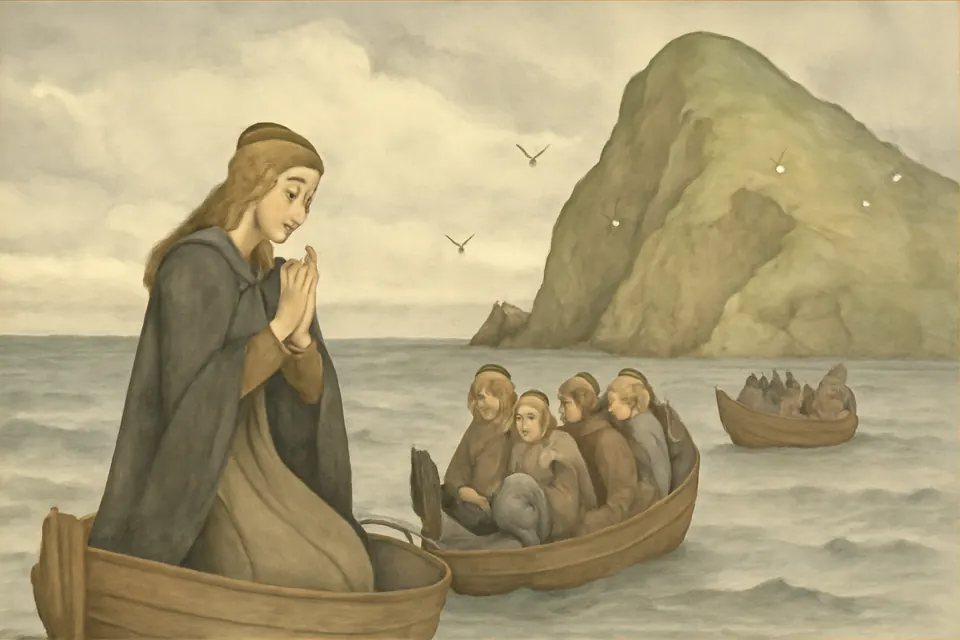
She chose exile instead. With a large company of men and women she put out to sea in ships without sails, oars or rudders, trusting God to take them where he willed.
Selja
The boats were carried north past Scotland and Orkney to the coast of western Norway. The pagans of the Fjordane country drove them off with arrows and stones. A storm scattered the ships: Sunniva and most of her people reached Selja, and the rest landed on the island of Kinn to the south. On Selja they lived in caves, fishing and praying.
Farmers from the mainland grazed cattle on the island. When animals went missing, they blamed the strangers who spoke another language and worshiped another God, and they asked Earl Haakon, the ruler of Norway, to come and kill them. When the armed men landed, Sunniva and her companions hid in their cave and prayed that God would give their souls rest and their bodies a grave. The mountain fell and buried them, and the earl's men left without finding anyone.

The light over the island
After Earl Haakon's death, the Christian king Olaf Tryggvason came to power. Merchants sailing past Selja saw a column of light rising from the shore, and under it they found a shining human skull that gave off a sweet fragrance. They brought it to the king, were baptized, and told their story. Olaf and his English court bishop, Sigurd, sailed to Selja, searched among the fallen rocks and found fragrant bones. Among them, the legend says, lay the body of Sunniva, whole and incorrupt, as if asleep. They built a church on the island and enshrined the relics in 996.
History and legend
The Norwegian Catholic biography is frank about the difficulties. The written legend is about 170 years later than the events it describes. Many scholars since the nineteenth century have noted how closely it follows the legend of St. Ursula and her virgins: a Christian princess, a pagan suitor, a sea voyage, death with all her company far from home. Others have pointed to Gaelic legends of island hermits, and it is likely that Irish Christians did live on these islands.
What is certain is that the cult is old. The oldest tradition honored the nameless "Selje Men," with Sunniva coming to the front only in the twelfth century. Around 1070 Selja became one of Norway's first three bishoprics, each built around a saint's shrine: Olaf at Nidaros, Hallvard at Oslo and Sunniva at Selja. By this encyclopedia's labels, the story of her death, the column of light and the incorrupt body are all traditional. The medieval Norwegian liturgy also recorded healings on Selja, which are reported: a girl blind from birth who spent the night in Sunniva's church and went home seeing, a boy who fell from a wall and seemed dead but was given back to his mother, and a lame woman who walked home.

Why St. Sunniva is the patron of Bergen and Western Norway
In 1170 the bishop's seat moved from Selja to Bergen, and the bishop carried Sunniva's shrine with him to the new cathedral, Christ Church. From then on she was Bergensium patrona, the protector of the people of Bergen. Twice, when great fires swept the city in the twelfth century, her shrine was carried out against the flames. Merchants and sailors from Bergen spread her cult to northern Norway, Sweden, Denmark, Iceland and the Hanseatic ports. She is honored as a patron of Norway, of the west coast and of seafarers.
Symbols of St. Sunniva in art
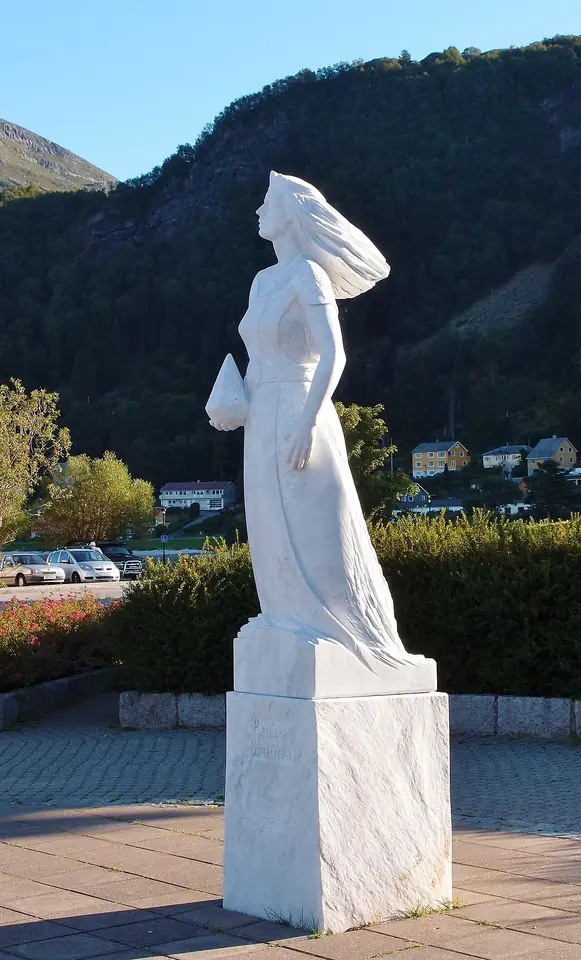
Twenty-three images of her survive from medieval Norway, most of them on altar shrines. They follow one pattern:
- A piece of rock, held in front of her with both hands, for the rockfall that buried her.
- A crown, for the Irish princess.
- A palm branch, sometimes, for a martyr.
- A book, sometimes, as on many virgin saints.
Feast day, shrine and prayer
Her feast is July 8, the medieval Seljumannamesse, which was one of the great feast days of the Norwegian year. The cathedral in Bergen that held her shrine was torn down in 1531 on royal orders, and the shrine disappeared. Today its outline is marked in the ground at Bergenhus Fortress. Selja is called Norway's oldest place of pilgrimage, and pilgrims still cross to the island. For other saints and their days, see our feast days and patron saints pages.

We know of no traditional English prayer to St. Sunniva. The Catholic Church in Norway honors her with the Mass of martyrs on her feast. Let us ask her to pray for Norway, for all who travel by sea, and for everyone who must leave home for the sake of their faith: St. Sunniva, pray for us.
Frequently asked questions
When is the feast of St. Sunniva?
July 8, kept in Norway since the Middle Ages as the Seljumannamesse, the Feast of the Selje Men. The Catholic calendar of Norway keeps it as the feast of St. Sunniva and the Selje Men, martyrs.
Who was St. Sunniva?
According to the Latin legend written about 1170, she was an Irish king's daughter who gave up her kingdom rather than marry a pagan tyrant. She set out to sea with her people in boats without sails or oars, landed on Selja, and died with them when rocks sealed their cave. Historians debate how much of this is history. The cult of the Selje Men on the island is older than the written legend.
Why is St. Sunniva shown holding a stone?
Because she died under the fallen rocks of the cave where she and her companions hid. Medieval Norwegian altar paintings and carvings usually show her crowned, holding a piece of rock with both hands.
Where are the relics of St. Sunniva?
They were moved from Selja to Christ Church, Bergen's cathedral, in 1170. The cathedral was torn down in 1531 and her shrine was confiscated and lost. A few relics of the Selje Men survive, including some kept today in St. Magnus Catholic Church in Lillestrøm.
Keep exploring
- Patron saint pages
- Sailors
- Feast-day calendar
- Saints remembered in JulySaint of the day
- More
- Saints A to ZPatron saints A to ZExplore every section
Sources
- Den katolske kirke (katolsk.no): Den hellige Sunniva av Selja. The Latin legend of about 1170 in Norwegian, Odd Snorrason's version, the Ursula parallel and the scholarly debate, the bishopric of Selja, the 1170 translation, the 1531 demolition, the July 8 feast, the iconography