Pope St. Adrian III
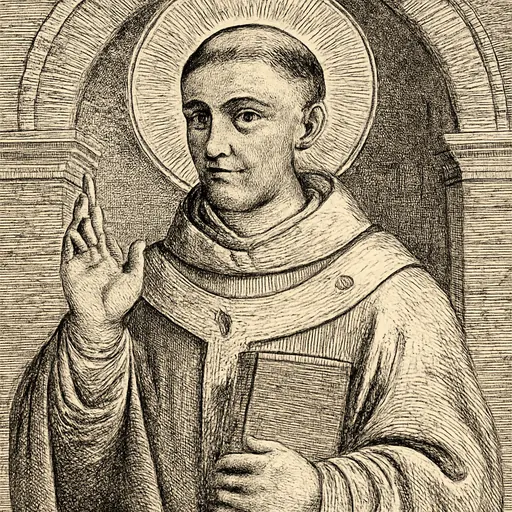
St. Adrian III (Hadrian III) was pope for little more than a year, from May 884 to the summer of 885. A Roman, he helped his people through famine and war, and died near Modena on his way to an imperial assembly at Worms. He was buried at Nonantola Abbey, where he has been honored ever since, and we keep his feast on July 8.
Who was St. Adrian III?
St. Adrian III was the bishop of Rome for little more than a year, in one of the darkest stretches of the Church's history. Elected on May 17, 884, he died in the summer of 885 on the road north, near Modena, and was buried at the great Benedictine abbey of Nonantola. The monks there have honored him as a saint from that day to this. In 1891 Pope Leo XIII confirmed that long devotion, and the Roman Martyrology now remembers him on July 8.
His name is sometimes written Hadrian III. He is not the same man as St. Adrian of Nicomedia, the soldier martyr, or St. Adrian of Canterbury, the abbot who taught in England.
A short reign in hard times
We know little about Adrian before his election except that he was a Roman. Some old lists give his family name and say he was called Agapitus before he became pope, but that report is uncertain and may confuse him with a later pope.
The late ninth century was a brutal time in Rome. His predecessor-but-one, John VIII, had been murdered in 882. Noble factions fought for control of the city, Saracen raiders struck the Italian coasts, and the empire of Charlemagne was coming apart among his heirs.
Into this Adrian brought what relief he could. The record of his reign says he helped the people of Rome generously through a severe famine. He wrote to Patriarch Photius of Constantinople with the customary letter announcing his election, keeping the door to the East open after years of quarrels. He took monasteries under the protection of the Apostolic See, among them the abbey of Saint-Gilles in southern France, whose monks were being mistreated by their bishop, and Montier-en-Der in Champagne.
We should be honest that the chronicles also record harsh punishments in his reign. A Lateran official named George, an enemy of John VIII, was blinded, and a noblewoman named Maria was whipped through the streets. These were the customs of a violent age. The Church has never claimed its saints were spotless, and the devotion of Nonantola grew from what the monks saw of the man at the end of his life.

The journey to Worms and his death
In 885 the emperor Charles the Fat called an imperial diet at Worms, on the Rhine. He wanted his illegitimate son Bernard recognized as his heir, and he wanted help against the Saracens. He summoned the pope to attend.
Adrian left Bishop John of Pavia in charge of Rome and set out north. He crossed the Apennines, but near Modena he fell ill and died, at San Cesario sul Panaro by most accounts. Some sources say he was murdered. No one knows. His body was not taken back to Rome. The monks of the nearby Abbey of San Silvestro at Nonantola carried it to their church and buried it in the apse.
The tomb at Nonantola
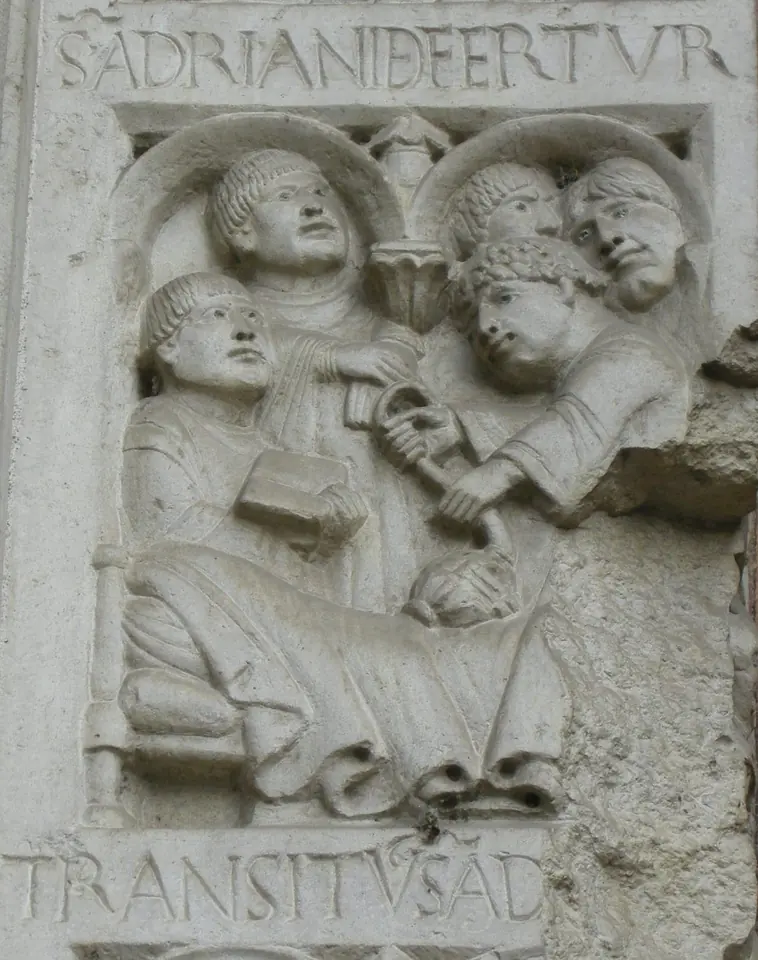
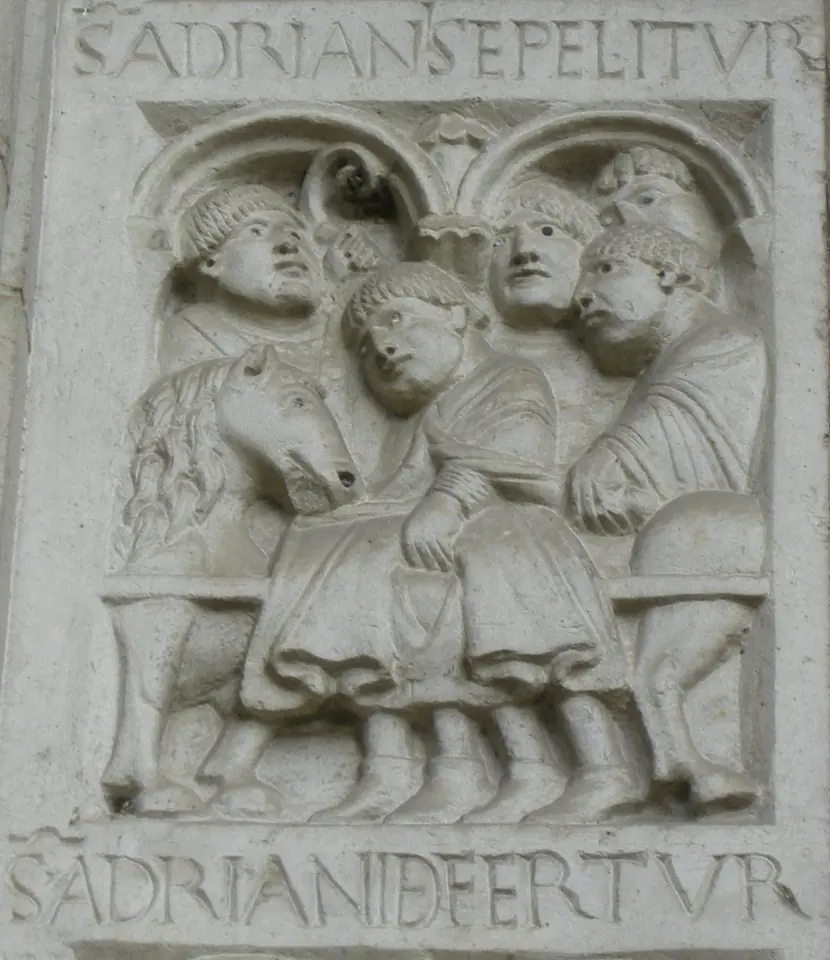
The pope's grave became a place of pilgrimage at once, and the abbey kept his memory as its own. About 1122, when the main doorway of the church was rebuilt, sculptors of the school of Wiligelmo carved scenes from the abbey's history on its stone jambs. Panels on the left jamb tell of Adrian, with Latin captions for his death, the bearing of his body to the abbey and his burial.
His remains lay in the apse for more than ten centuries. In 1914 they were moved down to the crypt and placed under its main altar, in a sarcophagus of red Verona marble together with the relics of other saints, each name cut into its sides.
Miracles
We have no written record of particular miracles from his tomb that we could verify. The Catholic Encyclopedia says only that his memory "has ever since been held in local veneration" at Nonantola. That steady devotion over a thousand years, rather than any famous wonder, is what led Pope Leo XIII to confirm his cult on June 2, 1891.
Symbols of St. Adrian III in art
St. Adrian III has no special emblem of his own, so we recognize him by the place and the setting:
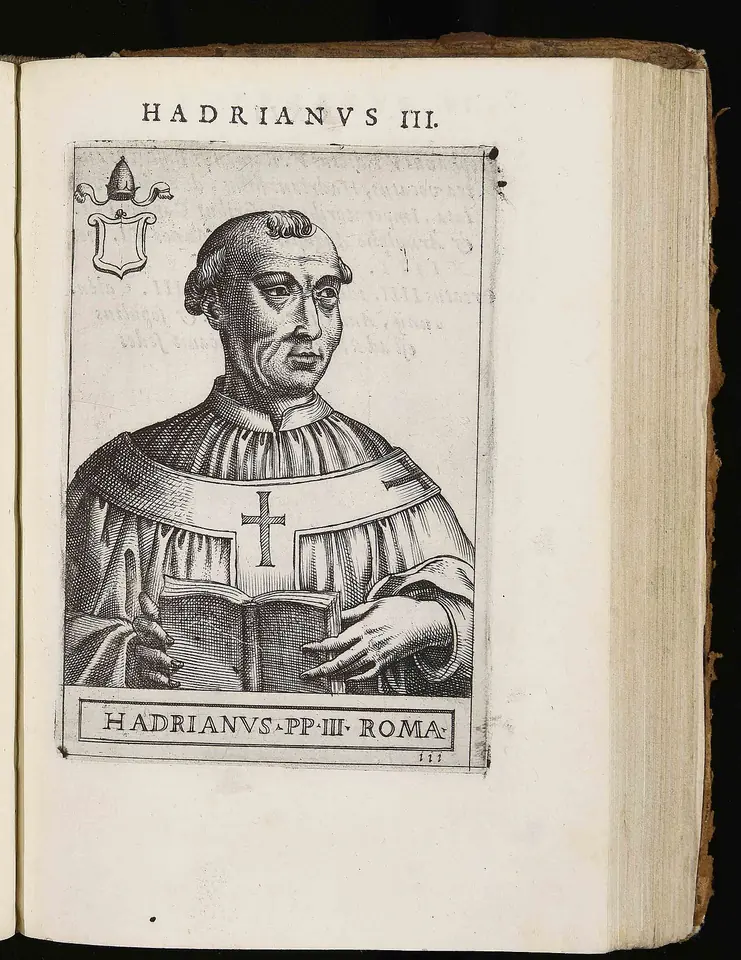
- Papal vestments and the pallium: the white wool band with dark crosses worn by the pope and archbishops. Old papal portraits, like Cavalieri's engraving of 1580, show him tonsured, with a cross on his breast.
- A book: the sign of a bishop who teaches the faith.
- The funeral bier and the deathbed: on the Nonantola doorway he is shown dying among the monks and carried to his grave, because his death on the road is the center of his story there.
In the Nuremberg Chronicle of 1493 he is just one small woodcut pope among many, with tiara and cross staff. If you see a pope carved on a Romanesque doorway in Emilia, near Modena, it is very likely him.
Feast day and where he is honored
We keep his feast on July 8. See the feast day calendar. The Abbey of Nonantola, north of Modena, still holds his tomb in its crypt, and pilgrims pray there at the altar above his relics.
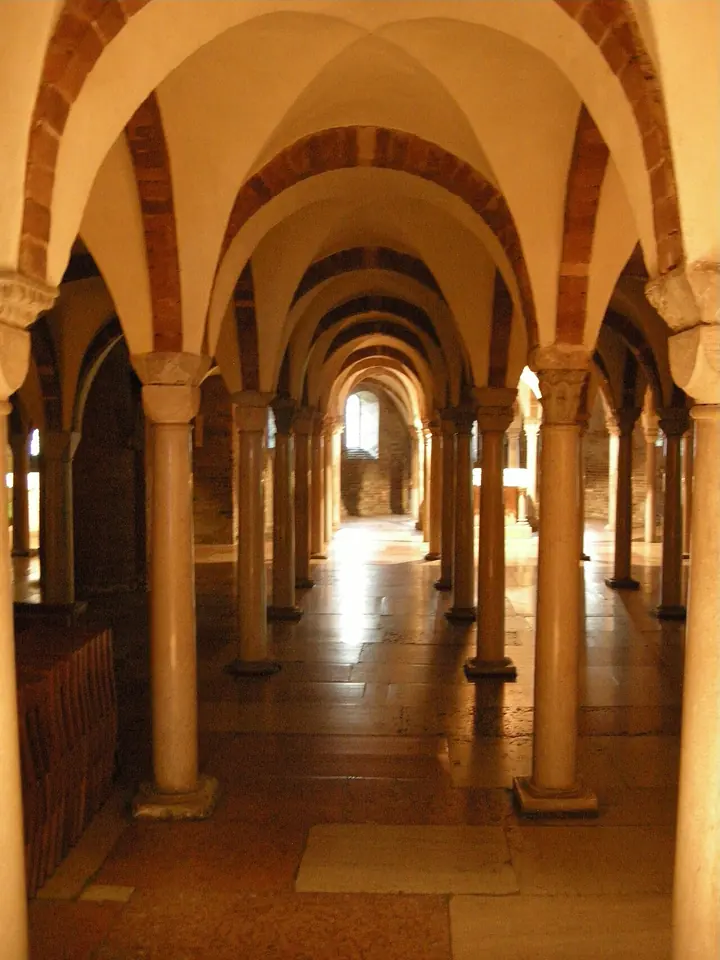
There is no traditional prayer to St. Adrian III in common use. Let us ask him, a shepherd who fed the hungry in a hard year and died on a journey for the good of the Church, to pray for the pope and for all who must travel and labor for peace in troubled times.
Frequently asked questions
Who was St. Adrian III?
The bishop of Rome from May 17, 884 until his death in 885. He was a Roman, worked to relieve a harsh famine, kept up friendly letters with Constantinople, and died near Modena while traveling to a diet called by the emperor Charles the Fat. Pope Leo XIII confirmed his cult in 1891.
When is the feast of St. Adrian III?
July 8, as given in the Roman Martyrology. He is not on the General Roman Calendar, so his feast is kept mainly at Nonantola, in the Archdiocese of Modena, and by the clergy of Rome.
Where is St. Adrian III buried?
At the Abbey of San Silvestro in Nonantola, near Modena. His remains lay in the apse for over a thousand years and were placed in 1914 under the main altar of the crypt.
Is St. Adrian III the same as St. Adrian of Nicomedia?
No. St. Adrian of Nicomedia was a Roman officer martyred about 306, with his wife St. Natalia. St. Adrian III was a ninth-century pope.
Keep exploring
Sources
- Catholic Encyclopedia (1907): Pope St. Adrian III. His election in 884, death near Modena on the way to the diet, burial and local veneration at Nonantola, and Leo XIII's decree
- Salvador Miranda, The Cardinals of the Holy Roman Church: Adriano (Pope Adrian III). His election on May 17, 884, the famine relief, the bulls of his pontificate, the harsh punishments recorded against his enemies, the 1914 translation of his remains, and the confirmation of his cult on June 2, 1891