St. Morwenna of Morwenstow, Cornwall
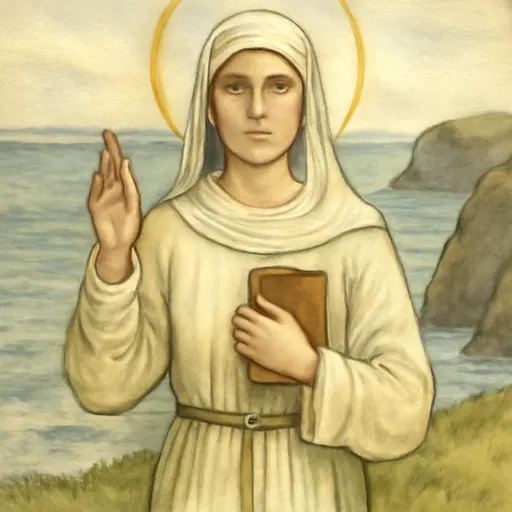
St. Morwenna is the early Celtic holy woman for whom the parish of Morwenstow in Cornwall is named. Tradition makes her one of the holy children of the Welsh king Brychan and says she founded the church there, carrying its font up from the shore on her head. Her feast is usually kept on July 8.
Who was St. Morwenna?
St. Morwenna is the patron of Morwenstow, the northernmost parish of Cornwall, where high cliffs look out over the Atlantic toward Wales. The village is named for her: Morwenstow means "Morwenna's holy place." Her church, her font and her holy well are still there. Of her life, though, almost nothing can be known for certain, and it is only right to say so before telling her story.
She belongs to the age of the Celtic saints, the 5th and 6th centuries, when holy men and women crossed the seas between Ireland, Wales, Cornwall and Brittany. No early life of her survives. What we have is local tradition, written down from the 17th century on, and the guesses of later historians.
Daughter of Brychan?
Welsh tradition gave the old king Brychan of Brycheiniog (Brecon) an enormous family of saints, and many churches in north Cornwall claim one of them. Morwenna is counted among them.
The historian Sabine Baring-Gould, in The Lives of the British Saints (1911), went further. He suggested that Morwenna might be the same person as Monynna, or Moninne, an Irish abbess of Killeavy in County Armagh, possibly linked by marriage to Brychan's family. In that case the Cornish foundations "not necessarily made by Monynna in person, but by disciples," as he put it, would be Morwenstow, Marhamchurch, perhaps St. Minver and St. Merryn. He was frank that "of direct evidence there is none. At the best we have but a presumption." We keep both possibilities open.
The legend of the font and the well
The oldest written story about her comes from a manuscript kept at Portledge, in Devon, of about 1610. Baring-Gould quotes it:
The tradition is that, when the parishioners were about to build their church, this Saint went down under a cliff, and chose a stone for the font, which she brought up upon her head. In her way, being weary, she laid down the stone, and rested herself, out of which place sprang a well, from thence called S. Moorwin's Well.
The same tradition says the people had begun building in another place, but what they built by day was pulled down by night and carried to the present site, so they built where "they were directed to by a wonder." Both the spring and the moving of the church are traditional, the kind of story told of many Celtic churches.

The ancient font of Morwenstow is still in the church, a heavy stone bowl with a carved band around it. Hawker, who served the parish for forty years, believed it belonged to the first church on the site, with its carved stone cable recalling the fishermen's boats of Galilee.

Hawker's Morwenna
The Victorian vicar of Morwenstow, the poet Robert Stephen Hawker, loved his patron saint and wrote her a fuller legend in Footprints of Former Men in Far Cornwall. In his telling, Morwenna was a daughter of King Breachan of Wales, sent to the court of the Saxon king Ethelwolf to teach his daughter, the princess Edith. When the king offered her any gift she liked, she asked for the headland she had watched from Wales across the water:
Give me, then, as I beseech thee, my lord the king, a station for a messenger and a priest in that scenery of my early prayer
Hawker's story is lovely, but it is not history. Ethelwolf reigned in the 9th century, and the editor of Hawker's book notes that Baring-Gould found the tale "full of anachronisms, arising from the confusion of three different saints, Morwenna of Cornwall, Modwenna of Burton-on-Trent, and Monynna of Newry." We read it as devotion, not record.
Symbols of St. Morwenna in art
Old images of Morwenna are almost all at Morwenstow:
- A habit and veil: a nun or abbess. Baring-Gould suggested she could fittingly be shown as an Irish abbess in white.
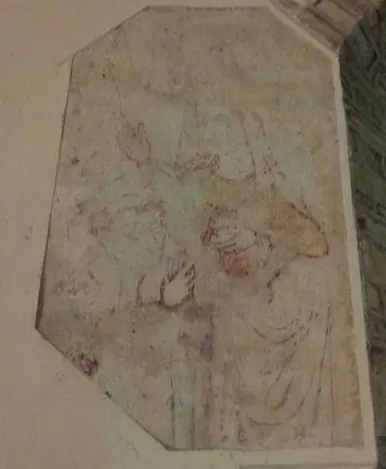
- One hand raised in blessing, the other held to her breast: as she appears in the medieval wall painting on the north wall of the church, which Baring-Gould described in 1911.
- A stone font on her head: the Portledge legend.
- A book, with a young princess: Hawker's story of Morwenna the teacher, shown in the east window he described in the chancel.
Her church and holy well
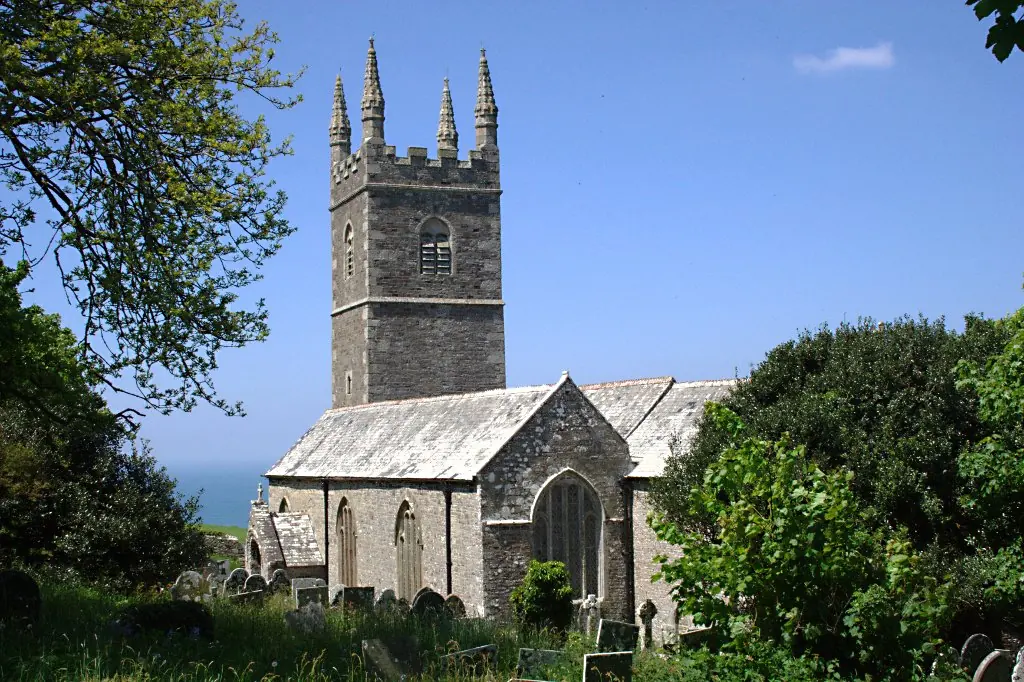
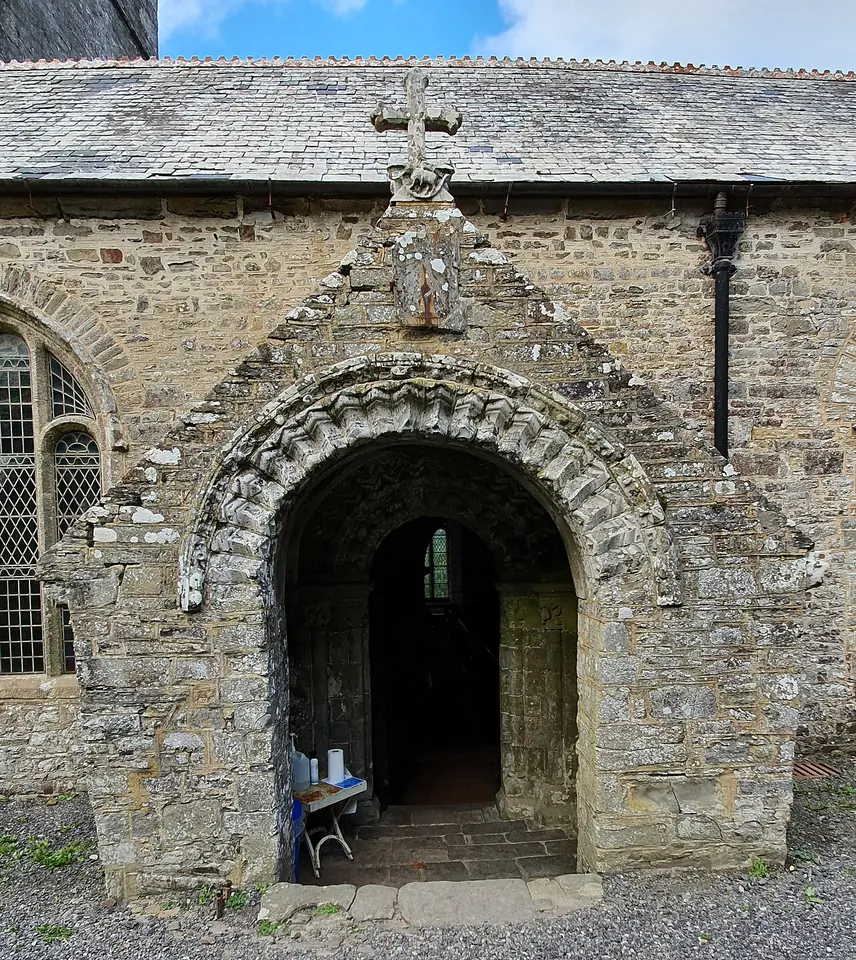
The Church of St. Morwenna and St. John the Baptist stands in a fold of the cliffs, with a Norman doorway and porch carved with zigzag ornament. At some point both the church and the well were placed under the patronage of St. John the Baptist, which is why the old parish feast was kept on June 24.
St. Morwenna's Well lies halfway down Vicarage Cliff, a short walk from the church. Its little gabled well house has medieval origins and was repaired by Hawker. Hawker wrote a verse for it: "Amidst these rocks a place of holy ground."

Feast day
Her feast is usually kept on July 8. The calendars of the Middle Ages that Baring-Gould lists, from Reading Abbey and elsewhere, have her on July 5; the Irish calendars keep Monynna of Killeavy on July 6. See other saints of early July on our feast days page.
Prayer to St. Morwenna
No ancient prayer to St. Morwenna has come down to us. When we visit her church or her well, we can ask her prayers simply: for the people of Morwenstow and of Cornwall, for teachers of children, for sailors on that wild coast, and for the grace to build our lives where God directs.
Frequently asked questions
Who was St. Morwenna?
A Celtic holy woman, probably of the 6th century, honored as the founder of the church at Morwenstow in north Cornwall. Almost nothing about her is certain. The Welsh and Cornish traditions make her a member of King Brychan's family, and the historian Sabine Baring-Gould thought she might be the Irish abbess Monynna of Killeavy.
Where is St. Morwenna's Well?
Halfway down Vicarage Cliff, below Morwenstow church, in a small stone well house of medieval origin. The vicar Robert Stephen Hawker repaired it in the 19th century.
When is St. Morwenna's feast day?
July 8 is the date most often given today. Medieval English calendars list her on July 5, and the Irish calendars keep Monynna on July 6.
What does Morwenstow mean?
The "stow," or holy place, of Morwenna. Hawker translated it from the Latin as Morwennae Statio, "Morwenna's station."